
In global steel procurement, technical specifications often vary by region. If your engineering drawings specify C45, but your supplier offers 1045 or S45C, you need to know if they are truly interchangeable. Understanding the C45 steel equivalent is not just about matching names; it is about ensuring the mechanical integrity of your components.
Table of Contents
Understanding the EN 10083 Standard
C45 is a medium carbon steel grade defined by the European standard EN 10083-2. It is widely utilized for manufacturing gears, bolts, and axles due to its balanced strength and machinability. However, many buyers struggle when cross-referencing this grade with American or Japanese counterparts. Finding the right C45 steel equivalent requires a deep dive into chemical limits and heat treatment responses.
C45 vs 1045 Steel: The Most Common Comparison
The most frequent question in international trade is regarding C45 vs 1045 steel. While both are medium carbon steels with approximately 0.45% carbon, they are governed by different regulatory bodies. AISI 1045 is the American standard (ASTM A29), whereas C45 is European.
When evaluating AISI 1045 carbon steel properties, you will find that the allowable range for manganese and impurities like Phosphorus and Sulfur slightly differs from the European C45. In most structural applications, they are interchangeable, but for high-precision CNC machining, these subtle variations in a C45 steel equivalent can impact tool wear and surface finish.

Global Comparison Table of C45 Steel Equivalent
To simplify your sourcing process, we have compiled a C45 carbon steel billet international standards table comparing the most common grades used today.
| Standard | Grade | Carbon (%) | Manganese (%) | Impurity Control (P/S) |
| EN 10083 | C45 | 0.42 – 0.50 | 0.50 – 0.80 | Standard |
| ASTM A29 | 1045 | 0.43 – 0.50 | 0.60 – 0.90 | Moderate |
| JIS G4051 | S45C | 0.42 – 0.48 | 0.60 – 0.90 | Strict |
| DIN 17200 | Ck45 | 0.42 – 0.50 | 0.50 – 0.80 | High Purity |
Data Source: British Standards Institution (BSI) – EN 10083-2
The Role of S45C Steel Equivalent in Asian Markets
If you are sourcing from Asia, you will frequently encounter the S45C steel equivalent. Governed by JIS G4051, S45C is Japan’s answer to C45. It is known for exceptionally consistent carbon distribution, making it a favorite for automotive precision parts. When choosing an C45 steel equivalent from Asian mills, verifying the “S” (Sulfur) content is vital, as lower sulfur improves toughness but may slightly decrease machinability.
Is Ck45 the Same as C45?
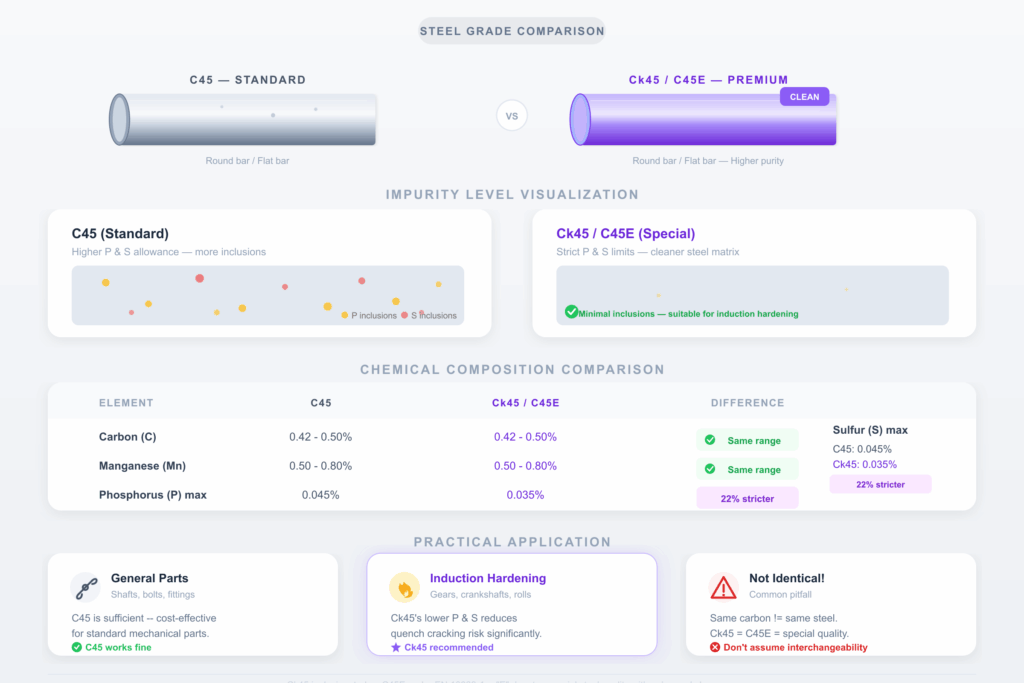
A common pitfall is assuming C45 and Ck45 are identical. While they share the same carbon range, Ck45 (or C45E) is a “special steel” with much stricter limits on Phosphorus and Sulfur. This makes Ck45 a superior C45 steel equivalent for parts requiring induction hardening, as the higher purity reduces the risk of quench cracking.
Mechanical Properties and Heat Treatment
The mechanical properties of C45 quenched and tempered states are what define its industrial value. After proper heat treatment, C45 can reach a tensile strength of 570-700 MPa.
However, users often ask: can I use C45 instead of 1045 steel for heavy-duty shafts? The answer is yes, provided the tempering temperature is adjusted. Because the manganese content in 1045 is slightly higher, it may show better hardenability in larger sections compared to a standard C45 steel equivalent.
Chemical Composition Difference Between C45 and 1045
To ensure long-term performance, engineers must monitor the chemical composition difference between C45 and 1045. The primary difference lies in the Manganese (Mn) range. 1045 typically allows up to 0.90% Mn, which can improve the depth of hardness during quenching. If your project involves large-diameter billets, you should specify the Mn requirements when ordering your C45 steel equivalent.

Critical Applications for C45 Steel Equivalent
Whether you are producing hydraulic cylinders or simple fasteners, selecting the correct C45 steel equivalent ensures compliance with international safety codes.
- Hydraulic Shafts: S45C is often preferred for its surface consistency.
- Transmission Gears: Ck45 is the choice for induction-hardened teeth.
- General Forgings: Standard 1045 or C45 is usually sufficient and cost-effective.
الخاتمة
Selecting a C45 steel equivalent is a balance between availability, cost, and technical requirements. While 1045, S45C, and C45 are cousins in the steel family, their subtle differences in impurity levels and manganese can affect high-end manufacturing outcomes.
Always consult with your metallurgical partner to verify that your chosen C45 steel equivalent meets the specific stress and environmental conditions of your application. For those requiring detailed material certifications, we provide full EN 10204 3.1 reports for all our carbon steel products.
الأسئلة الشائعة
What is the closest American equivalent to C45?
The closest C45 steel equivalent in the USA is AISI 1045, though minor differences in manganese limits exist between EN and ASTM standards.
Can I weld C45 steel?
Yes, but due to its medium carbon content, preheating to 200-300°C is required to prevent cold cracking.
Is C45 suitable for induction hardening?
Absolutely. It is one of the most common grades for induction hardening, typically reaching surface hardness of 50-55 HRC.
Why use Ck45 instead of standard C45?
Ck45 has lower sulfur and phosphorus, making it more reliable for critical parts where fatigue resistance and clean microstructure are essential.