
Welcome to My Blog!
Before we dive into the content, I’d love for you to join me on my social media platforms where I share more insights, engage with the community, and post updates. Here’s how you can connect with me:
Facebook:https://www.facebook.com/profile.php?id=100087990137347
LinkedIn:https://www.linkedin.com/company/89825762/admin/dashboard/
YouTube:www.youtube.com/@carbonsteelsupply-kj9lw
TikTok:www.tiktok.com/@carbonsteelsupply
Now, let’s get started on our journey together. I hope you find the content here insightful, engaging, and valuable.
Table of Contents
مقدمة

-34CrMo4
34CrMo4 is a low alloy high-strength steel, widely used in machinery and engineering fields, with high yield strength and tensile strength, suitable for medium loads suitable for a certain degree of wear and tear of the application environment, widely used in the manufacture of gears, shafts, connectors and other mechanical components.
-50CrMo4
50CrMo4 is a high-strength low alloy steel with excellent mechanical properties and wear resistance, widely used in the field of engineering and heavy-duty machinery, maintains good toughness at both high and low temperatures, reduces the risk of brittle fracture, and is widely used in high-load mechanical components, such as gears, bearings, transmission shafts, etc.
Chemical Composition
| Grade | C | Si | Mn | P | S | Cr | Mo |
| 34CrMo4 | 0.30-0.37 | 0.1-0.4 | 0.6-0.9 | ≤ 0.035 | ≤ 0.035 | 0.9-1.2 | 0.15-0.30 |
| Grade | C | Si | Mn | P | S | Cr | Mo |
| 50CrMo4 | 0.46-0.54 | ≤0.40 | 0.50-0.80 | ≤ 0.035 | ≤ 0.035 | 0.9-1.2 | 0.15-0.30 |
34CrMo4 vs 50CrMo4
Common Points
-Alloying Elements: Both steels contain two alloying elements, chromium (Cr) and molybdenum (Mo), which together provide properties that increase the steel’s strength, hardness and wear resistance.
-Heat Treatment: Both 34CrMo4 and 50CrMo4 can be heat treated (e.g. quenching and tempering) to improve their mechanical properties, including increasing hardness and strength.
-High strength: Both steels are high strength steels and are widely used in applications where high loads need to be carried.
-Good toughness: They both have good toughness, which means they can absorb energy without breaking when subjected to impact or heavy loads.
-Industrial applications: Both steels are used in a wide range of industrial applications such as automotive, aerospace, and mechanical engineering, especially in the manufacture of shafts, gears, piston rods, and other highly loaded components.
-Weldability: Both steels have good weldability and can be processed into various shapes and structures by welding.
-Corrosion resistance: Due to the presence of chromium, both steels have a certain degree of corrosion resistance, which is not as strong as that of stainless steel, but is sufficient in many industrial applications.
-International standards: both steels have corresponding international standards, such as 34CrMo4 in accordance with ISO 4954-1-2024 and 50CrMo4 in accordance with ISO 683-2-2016, which makes them widely recognized and used worldwide.
-Surface treatment: Both steels can undergo surface treatment such as carburizing and nitriding to further improve their surface hardness and wear resistance.
Distinctions
-Mechanical properties
34CrMo4:
Tensile strength: ≥985 MPa
Yield strength: ≥835 MPa
Elongation: ≥12%
Strike power: ≥63 J
50CrMo4:
Tensile strength: ≥1130 MPa
Yield strength: ≥930 MPa
Elongation: ≥11%
Impact work: ≥48 J
-Heat treatment:
34CrMo4: Common heat treatments include quenching and tempering, with quenching typically at 850°C.
50CrMo4: also quenched and tempered, usually quenched at 840°C.
-Strength and Toughness
34CrMo4: has good toughness and is suitable for applications requiring high plasticity.
50CrMo4: Higher strength due to higher carbon content, but relatively low toughness.
Application Scenarios of 34CrMo4 and 50CrMo4

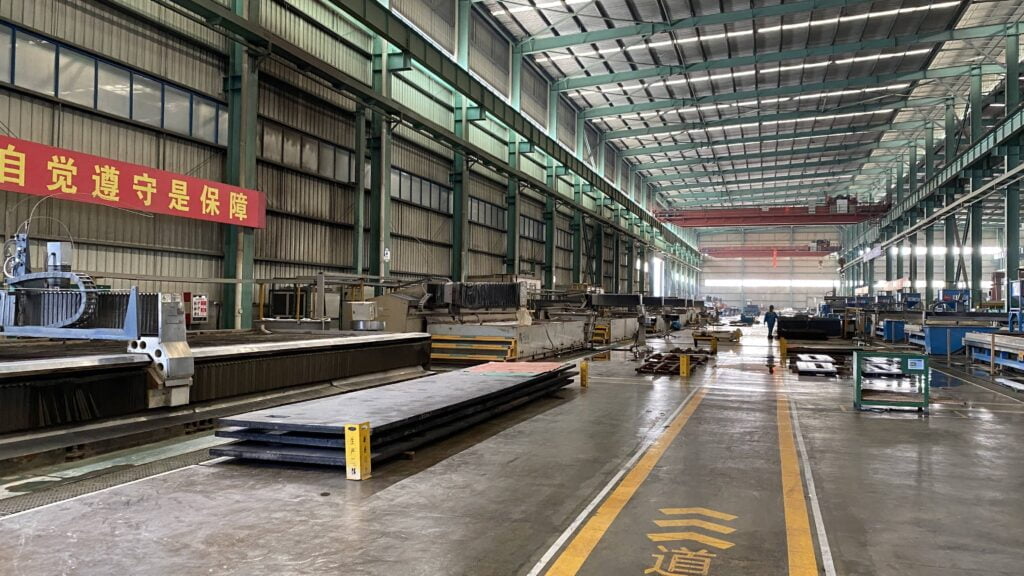
-Application Scenarios of 34CrMo4:
High-strength bolts, springs, bearings, transmission shafts: Because 34CrMo4 has excellent mechanical properties, such as high strength, heat resistance, wear resistance, and good plasticity and toughness, it is widely used in the manufacture of these key components.
Pressure vessels, boilers, automotive parts: 34CrMo4 is also suitable for the manufacture of pressure vessels, boilers and automotive parts, etc., especially in applications requiring higher strength and heat resistance.
Oil and gas industry: 34CrMo4 is commonly used in the manufacture of pipelines, high-pressure boilers and vessels in the oil and gas industry, etc. It can withstand high temperatures and pressures.
Wind turbine spindles and drive trains: Due to its good hardening properties, 34CrMo4 is also commonly used in the manufacture of wind turbine spindles and drive trains.
-Application Scenario of 50CrMo4:
Aerospace, petrochemical, automobile manufacturing, shipbuilding and other fields: 50CrMo4 is widely used in these fields due to its high strength, wear resistance and corrosion resistance.
Turbine blades of aircraft engines, valve parts at high temperatures, automotive friction discs: 50CrMo4 is used to manufacture these mechanical parts under high load and high strength working conditions.
Heavy-duty screws, gears, crankshafts: 50CrMo4 is also used in the manufacture of heavy-duty screws, gears and crankshafts, etc. These applications require materials with good strength and wear resistance.
Thrust rollers, guides, valves, bolts, thrust rings: these are other applications for 50CrMo4 that show its versatility and applicability in the manufacture of industrial parts.
Which should I use, 34CrMo4 or 50CrMo4?
The choice between 34CrMo4 or 50CrMo4 depends on your specific application requirements:
-Strength requirements: If you need higher strength and hardness, 50CrMo4 is suitable for applications requiring high strength due to its higher carbon content, providing a higher yield point and tensile strength.
-Toughness and plasticity: If the application requires better toughness and plasticity, 34CrMo4 may be more suitable as it has a lower carbon content and generally offers better plasticity and toughness.
-Heat Resistance: Both have good heat resistance, but 34CrMo4 has a better ability to maintain properties in high temperature environments due to its chemical composition.
-Hardenability: 34CrMo4 has better hardenability and is suitable for applications requiring an integral hardening.
-Machinability: 34CrMo4 has good plasticity and machinability in machining, but is relatively difficult to machine and requires attention to proper cooling and decelerated cutting.
-Weldability: 34CrMo4 has poor weldability, it needs preheating before welding, heat treatment as well as stress relief after welding, while 50CrMo4 may have better welding performance.
-Applications: 34CrMo4 is widely used in automotive, aerospace, marine, metallurgy, petroleum and chemical fields for manufacturing high-strength bolts, bearings, gears, shafts and other parts. 50CrMo4, on the other hand, is suitable for the manufacture of thrust rollers, heavy screws, gears, guides, valves, crankshafts and so on.
-Depending on your specific needs, consider the above factors to select the most suitable material for your application scenario.
الخاتمة
Both 34CrMo4 and 50CrMo4 are high-strength alloy steels tailored for various industrial uses. 34CrMo4 is ideal for producing high-strength bolts, bearings, and drive shafts, thanks to its excellent toughness and heat resistance. In contrast, 50CrMo4 is better suited for heavily loaded mechanical components in aerospace and petrochemical sectors because of its superior strength and wear resistance. The primary distinction between the two lies in their carbon content, which influences their strength and application scope.
Frequently Asked Questions
-Which material is more stable in high temperature environment?
34CrMo4 is more stable in high temperature environments due to its chemical composition, and has high endurance and creep strength, making it suitable for use in high temperature working conditions. 50CrMo4, on the other hand, is not as stable as 34CrMo4 at high temperatures, although it is also heat resistant.
-What is the hardenability of 34CrMo4 and 50CrMo4?
34CrMo4 has good hardenability, which means that it can be hardened in its entirety, making it suitable for applications that require hardening in its entirety. 50CrMo4, although it also has good hardenability, outperforms 34CrMo4 in this regard.
-What is the difference in strength between 34CrMo4 and 50CrMo4?
50CrMo4 is stronger than 34CrMo4 because of its higher carbon content. 50CrMo4 has higher yield and tensile strengths than 34CrMo4, making it suitable for use in applications that require higher load carrying capacity.