
When a project demands reliable fluid transport or structural support, the choice often boils down to a single question: do you really need seamless, or is welded pipe the smarter move for your bottom line? For machine builders, irrigation crews, and metal fabricators, the answer lies in understanding the specific threshold where cost meets performance.
So, what exactly is welded pipe? In its simplest form, it is the result of taking a precision-rolled steel strip or flat plate and fusion-welding the seam—whether through high-frequency induction or arc welding. While the longitudinal weld line is visible, modern manufacturing has closed the gap between welded and seamless options in terms of reliability. From structural scaffolding to municipal water mains, this “workhorse of the industry” offers a combination of tight tolerances and high-yield efficiency that makes it the go-to specification for the bulk of global engineering and construction tasks.
Table of Contents
what exactly is welded pipe?
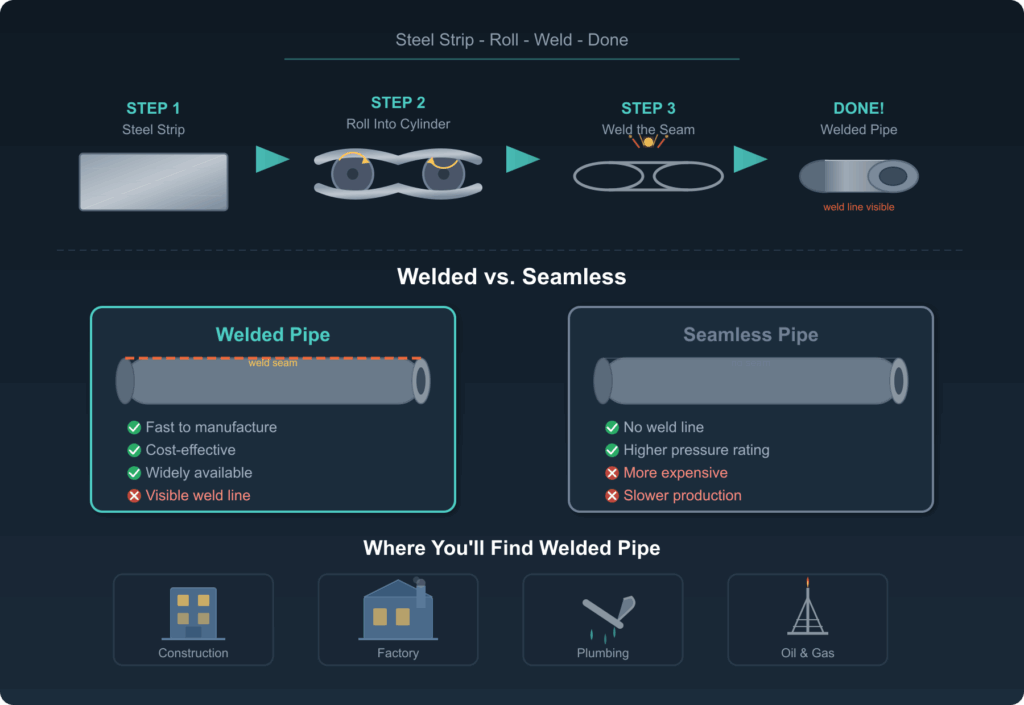
Here’s the deal: take a strip of steel or a flat plate. Roll it into a cylinder. Weld the seam shut——high-frequency, arc welding, whatever fits the process. That’s it. That’s welded pipe.
Unlike the seamless kind, you can see the weld line. But it’s quick to make and easy on the wallet. That’s why you find this stuff everywhere——from construction sites to factory floors.
What grades are on the market?
Q195, Q215, Q235B——the everyday workhorses. Scaffolding, conduit, water lines, drainage pipes, basic structural bracing. Most common, highest volume.
Q355B (used to be called 16Mn)——the stronger sibling. Pressure piping, steel frameworks, machinery frames, load-bearing supports. When Q235 won’t cut it, this one steps in.
20# steel——a solid all-rounder. Low-pressure fluid transfer, some structural components. Does a bit of everything.
Stainless grades——201, 304, 316L. Corrosion-resistant. Drinking water systems, gas lines, chemical handling, food processing, bathroom fixtures, anything sitting outside in the weather year after year.
Galvanized——hot-dipped or electroplated. Zinc coating over carbon steel. Fights off rust. Electrical conduit, fire suppression lines, outdoor structures, greenhouse frames.
Welded versus seamless: where do you draw the line?
Seamless starts from a solid billet. Pierced, rolled, drawn——no weld seam anywhere. Stronger overall. Handles pressure and heat better. Takes impact without breaking a sweat. Meant for high-pressure, high-temperature, explosive environments——anywhere a failure would be a disaster.
Welded starts flat, gets rolled and seamed. You end up with one longitudinal weld. Simpler manufacturing, tighter tolerances, cleaner surface finish. Works fine for atmospheric pressure or low-pressure fluids, structural support, general fabrication.
Cost and availability? Seamless is complicated, wasteful, expensive. Harder to find in large diameters. Welded is efficient, high-yield, fast to produce in bulk. More sizes in stock, shorter lead times.
Why welded pipe wins in its lane
Price first. Same specs, welded costs way less than seamless. Your budget goes further.
Precision matters. Better roundness, even wall thickness, smooth surface. Easier to thread, cut, weld, bend. The guys doing the installation will thank you.
Range is broad. Small conduit up to big municipal mains. Custom lengths available. Scaffolding, steel frames, fire lines, drainage, guardrails, greenhouse construction——this stuff covers the bulk of ordinary engineering and civilian jobs. Stay within its limits, and it’s tough to beat.
الخاتمة
Deciding to specify welded pipe isn’t about cutting corners; it’s about engineering efficiency. By choosing a welded tube over a solid-billet seamless alternative, you gain superior dimensional accuracy, a cleaner surface finish, and a significantly lower cost per foot. Whether your job calls for the everyday reliability of Q235B or the corrosion-resistant longevity of 316L stainless steel, the versatility of this material is unmatched in low-pressure and structural applications.
The key to a successful build is knowing where to draw the line. For high-pressure, explosive environments, seamless remains king. But for everything else—from greenhouse frames and guardrails to complex machinery skeletons—welded pipe wins in its lane every single time. Stay within the mechanical limits of the seam, and you’ll find a product that is faster to procure, easier to install, and tough enough to last for decades.
Modern welded pipe production: Utilizing advanced induction welding and precision large panel cutting for uniform wall thickness and structural integrity.
[Contact Our Expert Team Today for a Real-Time Quote] — Let our precision craftsmanship provide the solid foundation your next grand blueprint deserves.
الأسئلة الشائعة
What are the main advantages of welded pipe?
Cost-effective, fast production, quick delivery. Good dimensional accuracy, clean appearance. Easy to machine——cutting, welding, threading, bending. Full size range, custom lengths available. Handles most routine construction needs.
Where does welded pipe typically go?
Water and drainage lines, fire suppression systems, electrical conduit, scaffolding, structural columns, guardrails, greenhouse frames, municipal distribution networks, fluid transfer, general machinery framing. Low-pressure and structural applications.
What’s galvanized welded pipe for?
Zinc coating on carbon steel welded pipe. Better rust and corrosion resistance. Meant for outdoor exposure, damp environments, aggressive conditions. Outdoor guardrails, cable trays, water and gas distribution lines.