Welcome to My Blog!
Before we dive into the content, I’d love for you to join me on my social media platforms where I share more insights, engage with the community, and post updates. Here’s how you can connect with me:
Facebook:https://www.facebook.com/profile.php?id=100087990137347
LinkedIn:https://www.linkedin.com/company/89825762/admin/dashboard/
YouTube:www.youtube.com/@carbonsteelsupply-kj9lw
TikTok:www.tiktok.com/@carbonsteelsupply
Now, let’s get started on our journey together. I hope you find the content here insightful, engaging, and valuable.
مقدمة

D2 tool steel round bar is increasingly becoming the go-to material for manufacturers and toolmakers worldwide. This alloy is renowned for its exceptional properties, making it ideal for creating high-performance tools. Whether you’re in the automotive, aerospace, or manufacturing industries, the benefits of using D2 tool steel round bar cannot be overstated. This article will explore the unique properties, applications, and advantages of D2 tool steel round bar, establishing why it is an optimal choice for tool making.
Properties of D2 Tool Steel Round Bar
مقاومة عالية للتآكل
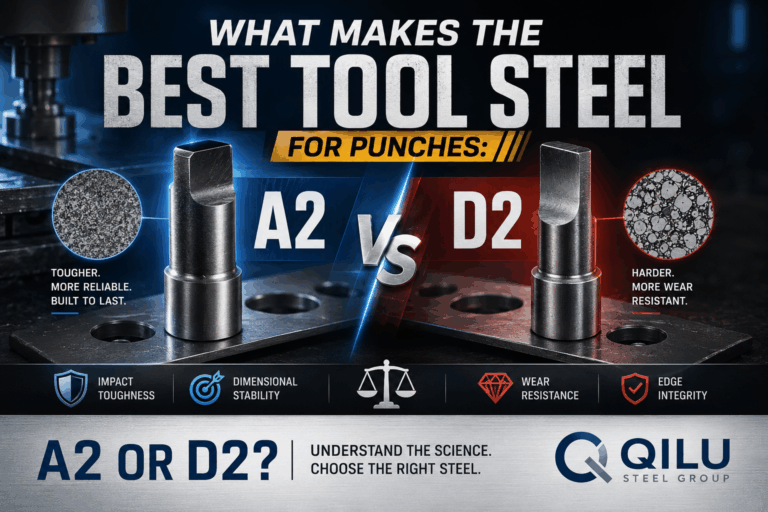
One of the most critical properties of D2 tool steel round bar is its high wear resistance. This attribute is crucial in tooling applications where contact with abrasive materials is frequent. D2 can withstand substantial wear, maintaining its integrity over extended periods.
Excellent Hardness
D2 tool steel is characterized by a hardness rating that typically ranges from 58 to 62 HRC (Rockwell Hardness Scale). This level of hardness is achieved through a specific heat treatment process, allowing D2 to retain a sharp edge even under intense operational conditions.
Stability during Heat Treatment
Another significant advantage of D2 tool steel round bar is its stability during heat treatment processes. Unlike some other tool steels, D2 maintains its shape and dimensions, reducing the likelihood of warping or distortion. This stability is crucial when precise dimensions are needed for tooling applications.
Chemical Composition
The performance of D2 tool steel can be attributed to its unique chemical composition. The main elements include:
- Carbon (C): Approximately 1.40%
- Chromium (Cr): About 12.00%
- Manganese (Mn): Around 0.60%
- Silicon (Si): Typically 0.30%
- Vanadium (V): Minimal, enhancing wear resistance.
The carbon content contributes to hardness and strength, while chromium improves corrosion resistance and overall toughness.
Key Properties of D2 Tool Steel Round Bar
| Property | Value |
|---|---|
| Hardness | 58-62 HRC |
| Carbon Content | 1.40% |
| Chromium Content | 12.00% |
| Manganese Content | 0.60% |
| Silicon Content | 0.30% |
| Wear Resistance Rating | High |
| Toughness | Moderate |
Applications of D2 Tool Steel Round Bar
D2 tool steel round bar is widely utilized in various applications, particularly in the tool-making industry. The following sections detail its most common uses.
Cutting Tools
D2 is widely used for manufacturing cutting tools. Its high wear resistance and hardness make it suitable for producing blades, drill bits, and cutters. The ability to retain a sharp edge makes D2 particularly effective in high-speed machining applications.
Molds and Dies
In the realm of manufacturing, D2 tool steel round bar is often employed in creating molds and dies. This material is perfect for injection molding and die-casting processes, where durability and precision are paramount. The wear resistance of D2 allows molds to withstand repeated cycles without significant degradation.
Stamping Tools
D2 tool steel round bar is also ideal for stamping tools. Its high strength and resistance to deformation make it suitable for producing dies and stamps that endure significant pressure during operation. The robustness of D2 ensures that these tools maintain their shape, even under demanding conditions.
Tooling Applications in Automotive Industry
In the automotive industry, D2 tool steel is used for making a variety of tooling components, including dies for stamping body panels and tools for machining engine components. The automotive sector benefits from D2’s ability to produce tools that are both durable and capable of delivering precise results.
Aerospace Applications
The aerospace industry also leverages D2 tool steel for creating tooling used in aircraft manufacturing. The strength and durability of D2 make it suitable for producing tools that meet the rigorous standards required in this field.
Common Applications of D2 Tool Steel Round Bar
| Application | Description |
|---|---|
| Cutting Tools | Blades, drill bits, and high-speed cutters |
| Molds and Dies | Injection molding and die-casting applications |
| Stamping Tools | Dies and stamps for sheet metal forming |
| Automotive Tools | Components for vehicle manufacturing |
| Aerospace Tools | Tools for precision in aircraft manufacturing |
Benefits of Using D2 Tool Steel Round Bar
When considering the material for tool making, D2 tool steel round bar offers numerous advantages:
Cost-Effectiveness
While the initial cost of D2 tool steel may be higher than other materials, its longevity and performance justify the investment. The extended lifespan of tools made from D2 reduces the need for frequent replacements, ultimately saving money.
Versatility
D2 tool steel is versatile, suitable for a wide range of tools and applications. Whether you’re creating cutting tools, molds, or dies, D2 can meet the diverse needs of various industries. This adaptability makes it a valuable addition to any toolmaker’s inventory.
سهولة التصنيع الآلي
Despite its hardness, D2 tool steel can be machined to precise dimensions. It can be shaped and ground to meet specific tolerances, making it easier for manufacturers to produce high-quality tools.
Excellent Dimensional Stability
D2 tool steel exhibits minimal dimensional changes during heat treatment, which is crucial for maintaining tool specifications. This stability ensures that tools manufactured from D2 retain their intended dimensions, leading to higher accuracy in applications.
Ability to Take Fine Edges
D2 tool steel can be sharpened to a fine edge, making it ideal for cutting applications. This characteristic is particularly beneficial in industries where precision cutting is required.
Benefits of D2 Tool Steel Round Bar
| Benefit | Description |
|---|---|
| Cost-Effectiveness | Long lifespan reduces replacement costs |
| Versatility | Suitable for various tools and applications |
| سهولة التصنيع الآلي | Can be machined to high precision |
| Dimensional Stability | Minimal changes during heat treatment |
| Ability to Take Fine Edges | Sharp edges enhance cutting performance |
Heat Treatment Process for D2 Tool Steel Round Bar
To maximize the performance of D2 tool steel round bar, proper heat treatment is crucial. The standard heat treatment process includes several steps:
Austenitizing
Austenitizing involves heating the steel to a specific temperature to dissolve the carbides, transforming the microstructure into austenite. This step is critical for achieving the desired hardness in D2 steel.
Quenching
After austenitizing, the steel is rapidly cooled, usually in oil or air. This quenching process hardens the steel by transforming the austenite into martensite, which is significantly harder.
Tempering
Tempering is a subsequent reheating process that relieves stresses in the steel. During this step, the hardness of the steel is reduced to improve toughness while still maintaining significant wear resistance.
Heat Treatment Process Steps
| Step | Temperature Range | Purpose |
|---|---|---|
| Austenitizing | 1,500°F – 1,700°F | Dissolve carbides |
| Quenching | Room Temperature | Harden the steel |
| Tempering | 400°F – 1,000°F | Improve toughness |
Common Mistakes to Avoid
When working with D2 tool steel round bar, certain pitfalls should be avoided to ensure optimal results:
Improper Heat Treatment
One of the most critical mistakes is skipping or improperly conducting the heat treatment process. Failing to temper D2 tool steel can lead to brittleness, compromising tool performance.
Inadequate Machining Techniques
Using the wrong machining techniques or tools can cause excessive wear on both the cutting tools and the D2 steel itself. It’s essential to select the right tools and methods to prevent unnecessary damage.
Ignoring Maintenance
Regular maintenance of tools made from D2 tool steel is essential to prolong their lifespan. Neglecting to clean and inspect tools can lead to premature wear and failures.
الخاتمة
In summary, D2 tool steel round bar is an excellent choice for tool making due to its outstanding properties, versatility, and cost-effectiveness. The high wear resistance, excellent hardness, and stability during heat treatment make D2 an optimal material for cutting tools, molds, and stamping tools. By understanding its applications and proper handling techniques, manufacturers can harness the full potential of D2 for their tooling needs.
الأسئلة الشائعة
Q1: What is D2 tool steel round bar best used for?
A1: D2 tool steel round bar is ideal for cutting tools, molds, and stamping tools due to its high wear resistance.
Q2: How does D2 compare to other tool steels?
A2: D2 offers higher wear resistance and hardness compared to many other tool steels, making it a preferred choice for high-performance applications.
Q3: Is heat treatment necessary for D2 tool steel?
A3: Yes, proper heat treatment is essential to maximize the hardness and toughness of D2 tool steel.
Q4: Can D2 tool steel round bar be welded?
A4: Welding D2 can be challenging due to its hardness; preheating and post-weld heat treatment are often recommended.
Q5: What industries use D2 tool steel?
A5: D2 tool steel is widely used