Understanding Q235B chemical composition is essential for engineers and fabricators who work with structural steel. Under the Chinese GB/T 700 standard, Q235B is a low-carbon structural steel widely used in construction, bridges, machinery, and vehicle components. Its chemical balance is the key to its versatility, weldability, and moderate strength. For more on its properties and general applications, please refer to our Q235B steel guide.
Inhaltsverzeichnis
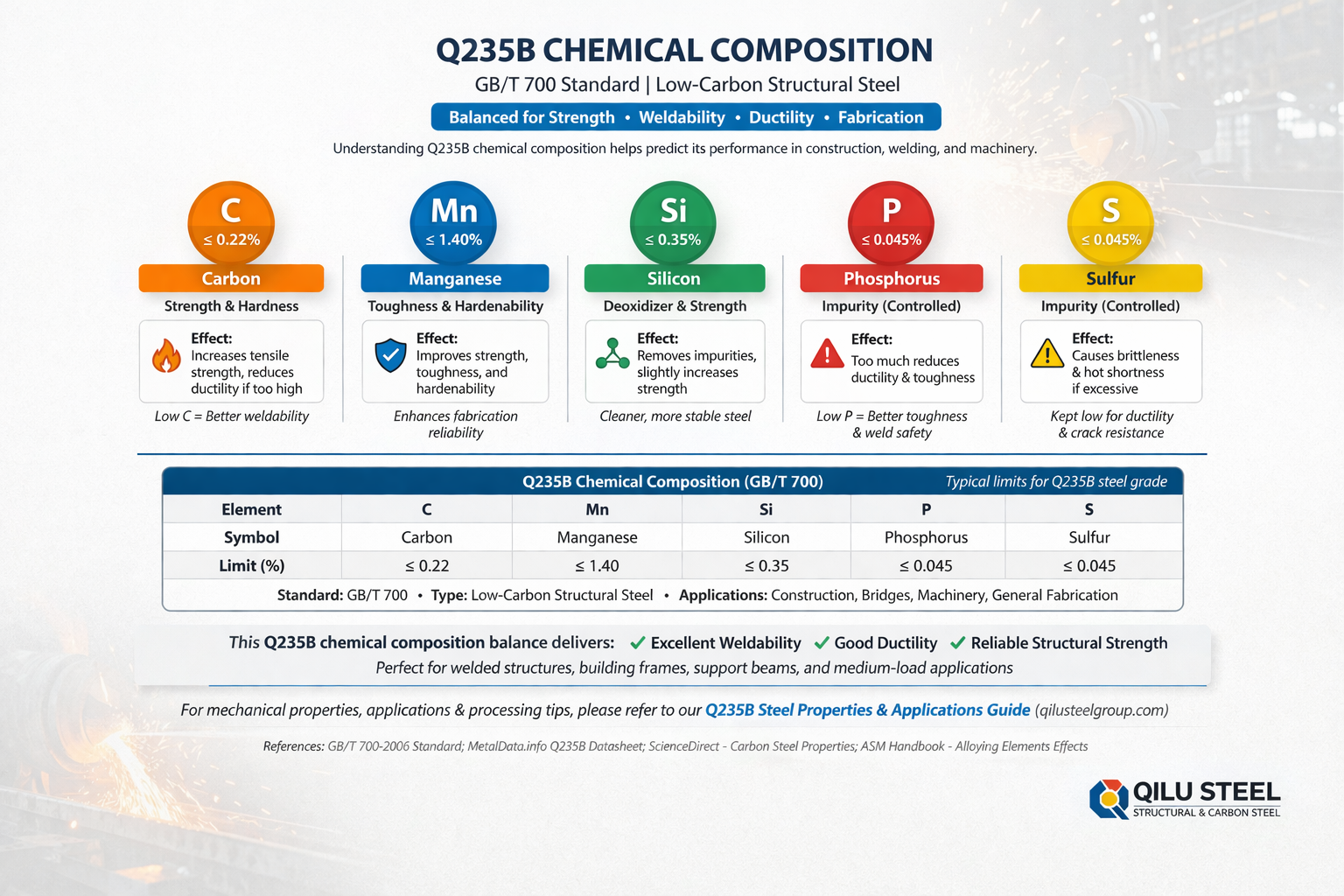
Q235B chemical composition chart
| Element | Symbol | Typical limit |
|---|---|---|
| Kohlenstoff | C | ≤0.22% |
| Mangan | Mn | ≤1.40% |
| Silizium | Si | ≤0.35% |
| Phosphorus | P | ≤0.045% |
| Sulfur | S | ≤0.045% |
This Q235B chemical composition chart reflects the limits set under GB/T 700. The composition ensures good ductility and formability while maintaining sufficient structural strength. Tightly controlling phosphorus and sulfur is important to preserve toughness and prevent brittleness. (metaldata.info)
Role of Carbon
Carbon content directly influences steel’s hardness, tensile strength, and weldability. In Q235B chemical composition, the low-carbon design (≤0.20%) allows the steel to be easily formed, bent, and welded, making it ideal for medium-load structures and general-purpose applications. High carbon would increase strength but reduce ductility, which is not desired for most structural projects.
Role of Manganese
Manganese strengthens the steel and improves toughness and hardenability. In practical terms, this ensures consistent performance during fabrication, bending, and welding. Manganese also helps offset sulfur’s negative effects, enhancing the steel’s durability in construction and machinery frameworks.
Silicon, Phosphorus, and Sulfur
Silicon is used primarily as a deoxidizer, with a minor role in increasing strength. Controlled levels help the steel resist impurities and internal defects. Phosphorus and sulfur are considered harmful at high levels because they reduce ductility and toughness. That’s why Q235B chemical composition keeps them tightly limited, ensuring reliable welding and forming performance. (newsummitsteel.mystagingwebsite.com)
Practical Implications for Fabrication
The balance of elements in Q235B chemical composition allows efficient fabrication processes. Engineers choose this grade because it can be easily cut, bent, welded, and drilled with minimal cracking or deformation. Projects that use medium-load structural steel, such as building frames, support beams, or machinery components, benefit from this predictable performance. For a broader discussion on mechanical properties and industrial uses, please see our comprehensive Q235B steel guide.
How to Read Composition Data
When reviewing Q235B chemical composition:
1.Kohlenstoff: Determines weldability and strength.
2.Manganese: Supports toughness and hardenability.
3.Phosphorus & Sulfur: Indicators of brittleness risk.
This simple framework is sufficient to determine if Q235B is suitable for a project without overcomplicating the selection process.
Schlussfolgerung
Understanding Q235B chemical composition provides valuable insight into why this material is widely used in structural and industrial applications. The balanced combination of carbon, manganese, silicon, phosphorus, and sulfur ensures a practical mix of strength, ductility, and weldability, making it suitable for a wide range of engineering projects. By analyzing each element’s role, engineers and buyers can make more informed decisions when selecting materials for fabrication and construction.
For a broader perspective on how this steel performs in real-world applications, including its mechanical properties and common uses, please refer to our detailed guide on Q235B steel properties and applications.
Understanding the limits of Q235B is critical for ensuring structural safety. If you want to know more about how this material fits your specific industrial project, please [click here] to consult with our technical specialists.
FAQ
What is the chemical composition of Q235B steel?
It consists of carbon, manganese, silicon, phosphorus, and sulfur, with limits designed to balance strength, ductility, and weldability.
Why is low carbon important?
Low carbon allows better ductility and welding while maintaining sufficient structural strength for general applications.
How does manganese affect the steel?
Manganese increases toughness, strength, and fabrication reliability.
Why are phosphorus and sulfur limited?
Because higher levels reduce ductility and increase brittleness, particularly in welded structures.
Can Q235B chemical composition be used for welded structures?
Yes, the low-carbon and controlled impurity levels make it widely suitable for welded applications.