n global infrastructure development, Q235B serves as the backbone of structural engineering due to its exceptional versatility and cost-efficiency. However, its inherent vulnerability to oxidation is a direct result of its specific elemental makeup. To understand how specific elements influence its performance, explore our detailed breakdown of Q235B chemical composition. Because of this chemistry—primarily iron with a controlled low-carbon balance—implementing a robust Q235B steel corrosion protection strategy is non-negotiable, especially when materials are destined for high-salinity maritime transit or demanding coastal construction environments.
Without proper surface treatment, the salty, humid air of the Pacific or Atlantic crossing can initiate “red rust” within days. This doesn’t just affect aesthetics; it can compromise the structural integrity of the steel before it even reaches the job site. Understanding the mechanics of Q235B steel corrosion protection is the first step toward project success.
Inhaltsverzeichnis
The Challenge: Maritime Transit and Salt Spray
Before discussing solutions, we must address the primary threat: the C5-M (Marine) environment. According to the American Galvanizers Association (AGA), the corrosion rate of unprotected carbon steel in coastal regions is significantly higher than in inland rural areas.
When evaluating how long does galvanized Q235B last in marine environments?, one mustconsider the zinc erosion rate. In a typical marine setting, zinc corrodes at a rate of roughly 1.5to 2.0um per year. This emphasizes why Q235B steel corrosion protection must becalculated based on the intended service life of the structure.
As established in our complete guide to Q235B steel properties, this material provides excellent mechanical strength, but its lack of chromium or nickel means the “passivation” layer must be added artificially through secondary processing.
Hot-Dip Galvanizing (HDG) for Q235B
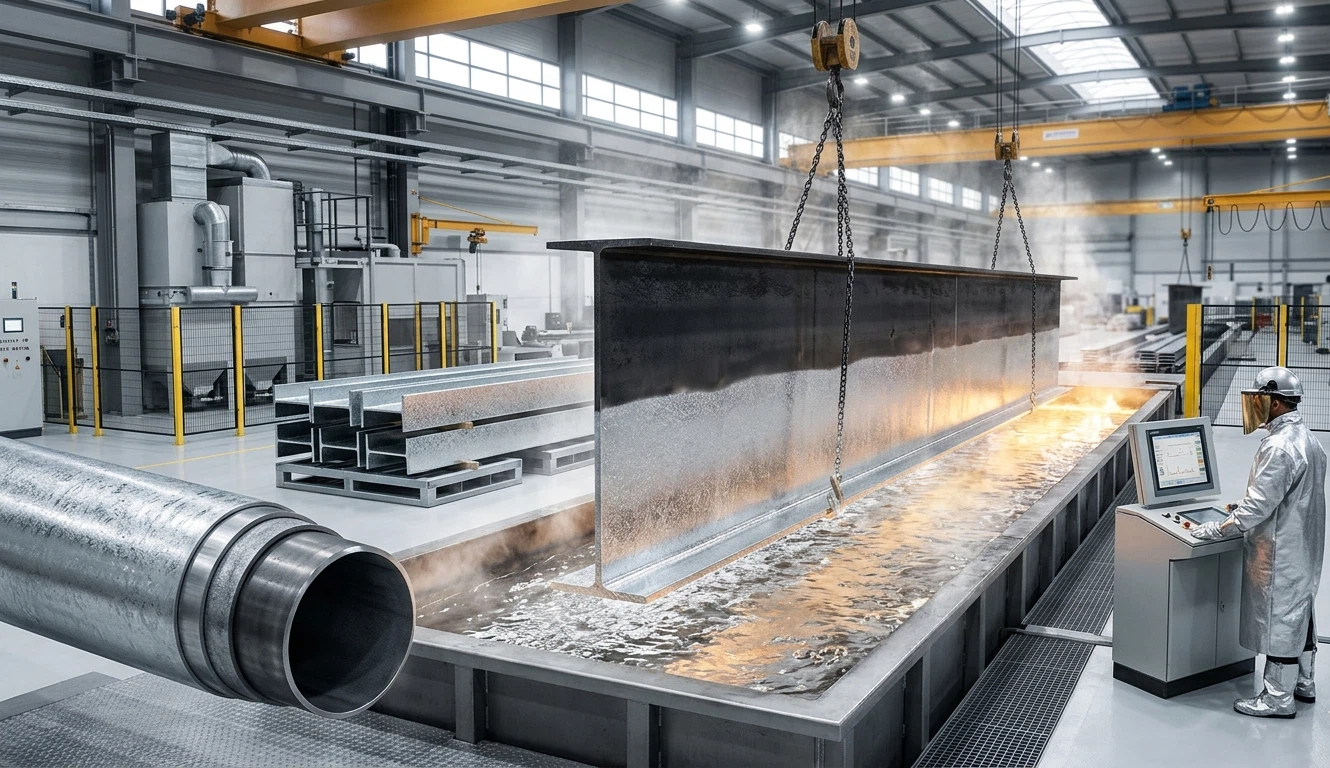
The most reliable method for long-term defense is hot-dip galvanizing for Q235B. This process involves immersing the steel in a bath of molten zinc at approximately 450°C (842°F).
Why HDG is Superior
Unlike simple paint, hot-dip galvanizing for Q235B creates a metallurgical bond. The zinc reacts with the steel to form a series of zinc-iron alloy layers that are harder than the base steel itself. This provides “sacrificial protection,” meaning if the surface is scratched, the surrounding zinc will corrode first, shielding the exposed Q235B.
Adhering to the ASTM A123 standard ensures that the coating thickness is sufficient to provide decades of maintenance-free service. For heavy-duty industrial projects, this is often the most cost-effective rust prevention for structural steel when factoring in the total lifecycle cost.
Industrial Coatings and High-Performance Primers
While galvanizing is powerful, it is not always feasible for extremely large structures or those requiring a specific aesthetic finish. This is where industrial coating for carbon steel comes into play.
ISO 12944 Corrosion Classes
To standardize protection levels, engineers refer to ISO 12944 corrosion classes. This international standard categorizes environments from C1 (very low) to CX (extreme marine). For a project involving Q235B, the coating system—usually a combination of a zinc-rich epoxy primer, an intermediate micaceous iron oxide (MIO) layer, and a polyurethane topcoat—must be rated for the specific class.
Implementing an industrial coating for carbon steel provides a barrier against moisture and oxygen. However, unlike galvanizing, it requires strict surface preparation (usually Sa 2.5 white metal blasting) to ensure adhesion. Without this, your Q235B steel corrosion protection will fail prematurely due to delamination.
Comparing Protection Strategies: HDG vs. Powder Coating
When deciding on a finish, many buyers ask about the difference between HDG and powder coating for steel.
Powder coating offers a superior aesthetic and good chemical resistance, but it lacks the metallurgical bond of galvanizing. If the powder layer is breached, rust can spread underneath the coating (undercutting). For structural components hidden within a building, powder coating is excellent. For bridge girders or marine piling, Q235B steel corrosion protection via hot-dip galvanizing is almost always the safer bet.
Surface Treatment Comparison Table
| Merkmal | Hot-Dip Galvanizing (HDG) | Epoxy/Polyurethane Coating | Powder Coating |
| Bond Type | Metallurgical (Alloy) | Mechanical Adhesion | Mechanical Adhesion |
| Service Life (C3) | 50+ Years | 15 – 25 Years | 10 – 15 Years |
| Maintenance | None required | Periodic touch-ups | Difficult to repair |
| Initial Cost | Mäßig | High (due to prep) | Mäßig |
| Standard | ASTM A123 | ISO 12944 | Qualicoat / AAMA |
| Primary Use | Infrastructure / Marine | Heavy Industrial | Architectural / Indoor |
For those seeking cost-effective rust prevention for structural steel, the table clearly shows that HDG offers the lowest cost-per-year-of-service.
Cost-Effective Rust Prevention for Structural Steel
Budget constraints are a reality in every B2B transaction. Achieving cost-effective rust prevention for structural steel doesn’t mean choosing the cheapest paint. It means analyzing the “Years to First Maintenance.”
For example, a high-quality industrial coating for carbon steel might be cheaper today than galvanizing, but if you have to repel and repaint a bridge in a marine environment every 7 years, the labor costs will eventually exceed the original price of the steel. Strategic Q235B steel corrosion protection involves spending 10% more upfront to save 200% over thirty years.
Global Compliance and Standards
When exporting Q235B products to Europe, the Middle East, or the Americas, adhering to ISO 12944 corrosion classes is the best way to speak the same technical language as your client. These standards define exactly how many microns of protection are needed for each environment.
Authorized labs can perform “Salt Spray Tests” (ASTM B117) to simulate years of maritime exposure in a matter of weeks. Ensuring your Q235B steel corrosion protection passes these tests is the ultimate proof of quality for an international buyer.
Schlussfolgerung
Choosing the right Q235B steel corrosion protection is a balance of environment, budget, and desired longevity. For maritime projects, the metallurgical protection provided by hot-dip galvanizing for Q235B remains the gold standard. For architectural or highly specific industrial needs, a multi-layer industrial coating for carbon steel rated to ISO 12944 offers the versatility required for modern design.
By focusing on cost-effective rust prevention for structural steel, you ensure that your project remains a viable asset for decades to come.
Ready to secure your supply chain with high-performance materials? [Get your free technical coating proposal] and ensure long-term durability for your Q235B steel components now.
FAQ
Is Q235B steel naturally rust-resistant?
No. Q235B is a low-carbon steel. Without surface treatment like galvanizing or specialized coatings, it will rust quickly when exposed to moisture.
What is the best standard for galvanizing steel?
For most industrial and structural applications, ASTM A123 is the globally recognized standard for hot-dip galvanizing.
Can I paint over galvanized Q235B?
Yes, this is called a “Duplex System.” It provides the highest level of protection by combining the sacrificial benefits of zinc with a secondary barrier of industrial paint.
How does sea transport affect “Black” (untreated) steel?
Sea air contains high levels of chlorides. Untreated Q235B will likely arrive at its destination with significant surface corrosion, requiring expensive sandblasting before use.