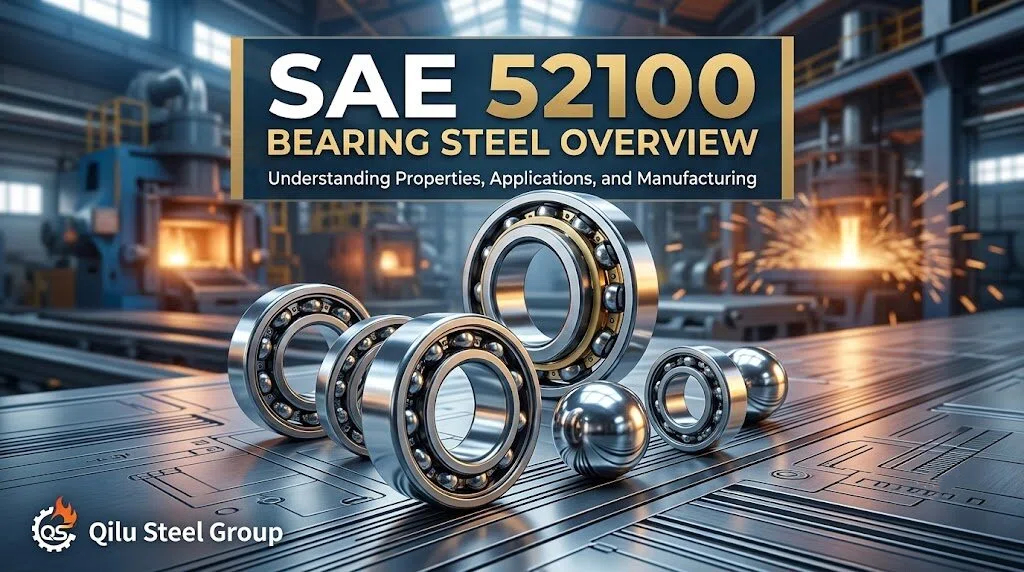
SAE 52100 round bar is the benchmark in bearing steel. With a nominal composition of 1.00% carbon and 1.5% chromium, it delivers a hardened hardness range of 60–67 HRC and tensile strength around 850–1000 MPa. Its balanced combination of wear resistance, fatigue strength, and dimensional stability has made it a standard material for rolling-element bearings, automotive drivetrains, aerospace landing gear, and industrial spindles for over a century. This article covers its chemical composition, global grade equivalents (100Cr6, SUJ2, GCr15), heat treatment parameters, key advantages and limitations, as well as common application cases—giving engineers, machinists, and material specifiers a concise reference without marketing fluff.
Inhaltsverzeichnis
What Is It?
SAE 52100 is a high-carbon chromium bearing steel. The name tells you what’s in it: “5” means it falls in the chromium steel category, “21” roughly indicates the chromium content, and “100” translates to about 1.00% carbon. That’s the SAE/AISI system for you.
If you’re sourcing outside the U.S., you’ll run into different labels. German mills call it 100Cr6 (DIN 1.3505). The Japanese know it as SUJ2. In China it’s GCr15. The British have it as 535A99 or EN31. Different designations, but for practical purposes, they’re the same material.
52100 round bar typically comes as hot-rolled or forged stock, ranging from 12 mm up to several hundred millimeters in diameter. You can anneal it, harden it, temper it—whatever your application calls for.
What It Does Well
Hardness and wear resistance
After proper heat treatment, you’re looking at 60–67 HRC. The chromium carbides distribute evenly through a martensitic matrix, giving you wear life that most other steels can’t match.
Fatigue strength
Fine grain structure plus uniform carbide distribution makes it tough for cracks to get started, let alone spread. Under cyclic loading, it keeps going longer than you’d expect.
Dimensional stability
With the right quench and temper, it holds its shape even under thermal and mechanical stress. That’s why it works so well for precision parts where tolerances are tight.
Good combination of strength and toughness
Tensile strength falls around 850–1000 MPa. With a well-chosen tempering cycle, you can retain hardness without making the steel overly brittle.
Machine-ability
In the annealed state, it machines without much fuss. After hardening? You’re grinding. No shortcut there.
The Upsides
Decades of proven performance—This steel has been around for over a century. The data is solid, the heat treatment procedures are well-established, and you know exactly what you’re working with.
Cost-effective—You get excellent performance without paying for exotic alloy elements. Works well for high-volume production where every dollar counts.
Easy to source—International standard grades, produced by mills worldwide. You won’t have to chase down a supplier.
Wide heat treatment window—The hardening and tempering range is reasonably forgiving. Get close to the right numbers and you’ll usually end up with a good result.
The Downsides
Corrosion resistance is limited—At 1.5% chromium, it’s nowhere near stainless. If rust is a concern, you’ll need plating, coating, or a rust-preventive oil.
Welding is out of the question—High carbon content makes cracking almost a sure thing. If your design requires welded joints, look for a different grade.
Heat treatment requires attention—Get the quench or temper wrong and you could lose dimensional stability or end up with parts that are too brittle. The process isn’t complicated, but it does need to be done right.
Toughness is moderate—Fracture toughness is decent but not exceptional. Under severe impact in the wrong conditions, it can fail in a brittle manner.
Where It Actually Gets Used
Bearings—This is the obvious one. Inner rings, outer rings, balls, rollers. This is what the steel was made for.
Automotive—Wheel bearings, transmission gears, drive shafts, steering components. Anything that rotates under load.
Aerospace—Landing gear bearings, engine turbine components, precision spindles. Where failure isn’t an option but you don’t need to pay superalloy prices.
Industrial machinery—Machine tool spindles, hydraulic cylinder rods, ball screws, pump and valve components.Cutting tools and dies—High-performance fixed blades, custom knives, punches, drawing dies, gauges. With proper heat treatment it reaches 60–64 HRC and holds an edge well. Just be
In summary, SAE 52100 remains the workhorse bearing steel for good reason. Its proven balance of hardness, wear resistance, and fatigue strength, combined with global availability and reasonable cost, makes it a practical default for a wide range of rotating and precision applications. That said, the material is not a universal fix—its limited corrosion resistance, poor weldability, and moderate toughness demand careful design and process control. Heat treatment, in particular, must be executed correctly to avoid brittleness or dimensional issues. For the vast majority of bearing, automotive, and industrial machinery uses, however, 52100 delivers consistent, reliable performance when specified and processed appropriately. If your application pushes into high-impact or highly corrosive environments, it may be worth evaluating alternatives; otherwise, this classic steel remains a safe, well-understood choice that continues to justify its century-long track record.
FAQ
What’s the difference between SAE 52100 and GCr15?
Not much, honestly. The chemistry and mechanical properties are essentially the same. 52100 follows the American SAE/AISI standard; GCr15 follows Chinese GB/T. You might see minor differences in trace element control or impurity limits, and the heat treatment specifications use different wording. But for 99% of applications, you can use whichever your supplier carries.
What condition does it normally come in?
Mostly hot-rolled or forged and annealed. Annealed hardness is typically below 250 HBW, which is soft enough to machine without wearing out your tooling. You handle the hardening and tempering yourself — or have a heat treater do it — to hit that 60 – 67 HRC range.
Can you make knives out of it?
Yes, you can. Fixed blades and custom knives, mainly. It reaches 60
–
64 HRC with good edge retention and wear resistance. The key is getting the heat treatment right
—
the quench and temper parameters need to be dialed in. Too hard and it chips; too soft and it won’t keep an edge. If you’re a hobbyist maker, it’s doable, but it’s not the most forgiving steel to start with.