Welcome to My Blog!
Before we dive into the content, I’d love for you to join me on my social media platforms where I share more insights, engage with the community, and post updates. Here’s how you can connect with me:
Facebook:https://www.facebook.com/profile.php?id=100087990137347
LinkedIn:https://www.linkedin.com/company/89825762/admin/dashboard/
YouTube:www.youtube.com/@carbonsteelsupply-kj9lw
TikTok:www.tiktok.com/@carbonsteelsupply
Now, let’s get started on our journey together. I hope you find the content here insightful, engaging, and valuable.
Table of Contents
Giriş
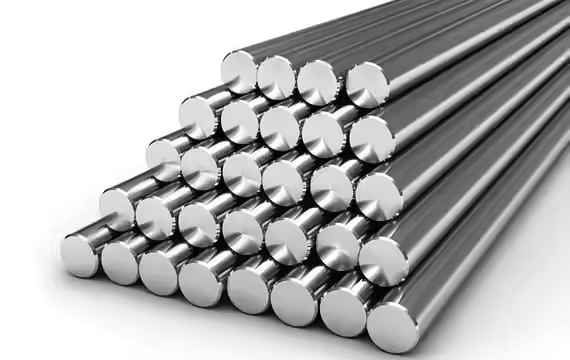
The density of low carbon steel is a fundamental property that significantly impacts its mechanical behavior, applications, and industrial usage. Low carbon steel, also known as mild steel, is widely used in construction, automotive manufacturing, and engineering due to its excellent strength, ductility, and cost-effectiveness. Understanding the density of low carbon steel is essential for selecting the right materials for structural, mechanical, and industrial applications.
This comprehensive guide explores the density of low carbon steel, its influencing factors, variations, and comparisons with other steel types. A detailed table is included to illustrate different densities based on steel composition and manufacturing processes.
What Is the Density of Low Carbon Steel?
The density of low carbon steel typically falls within the range of 7.85 g/cm³ to 7.87 g/cm³. This variation is influenced by factors such as carbon content, alloying elements, heat treatment, and processing methods. The density of low carbon steel is similar to that of other carbon steels but slightly lower than alloy steels due to the reduced presence of heavier alloying elements.
Factors Affecting the Density of Low Carbon Steel
Carbon Content
Low carbon steel contains between 0.05% and 0.25% carbon, which influences its mechanical properties. The lower the carbon content, the closer the density remains to 7.85 g/cm³.
Alaşım Elementleri
While low carbon steel is mainly composed of iron and carbon, it may contain small amounts of manganese, silicon, sulfur, and phosphorus. Occasionally, elements like nickel or chromium are added, which may slightly alter the density.
Isıl İşlem
Processes like annealing, quenching, and normalizing can modify the microstructure of low carbon steel. However, these processes have a negligible impact on overall density, typically altering it by no more than 0.01 g/cm³.
Manufacturing Methods
The method used to process low carbon steel can cause slight density variations. Cold-rolled steel has a slightly higher density than hot-rolled steel due to the compacted atomic structure formed during rolling.
Comparing the Density of Low Karbon Çelik with Other Steels
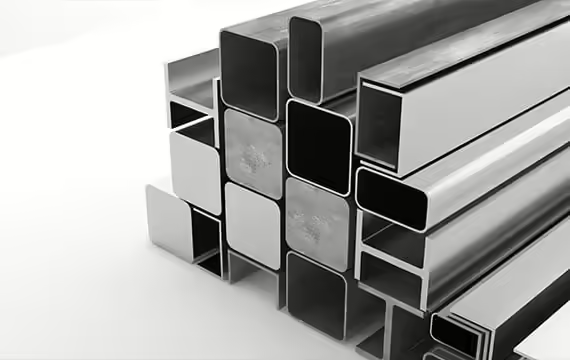

The table below provides a comparison of the density of low carbon steel with other common types of steel:
Table: Density of Low Carbon Steel vs. Other Steel Types
| Steel Type | Carbon Content (%) | Density (g/cm³) | Common Applications |
|---|---|---|---|
| Low Carbon Steel (Mild Steel) | 0.05 – 0.25 | 7.85 – 7.87 | Construction, automotive, machinery |
| Medium Carbon Steel | 0.25 – 0.60 | 7.84 – 7.86 | Railway tracks, gears, axles |
| High Carbon Steel | 0.60 – 1.00 | 7.82 – 7.85 | Cutting tools, springs, wires |
| Stainless Steel (304) | 0.08 max | 7.93 | Food processing, medical equipment |
| Stainless Steel (316) | 0.08 max | 7.98 | Marine applications, chemical industry |
| Alloy Steel (Nickel-Chromium) | 0.10 – 0.40 | 7.80 – 7.95 | Aerospace, high-stress components |
As seen in the table, the density of low carbon steel remains relatively stable across different variations but is generally lower than that of stainless steel due to fewer alloying elements.
Applications of Low Carbon Steel Based on Density
İnşaat Sektörü
The density of low carbon steel makes it an ideal material for building frameworks, bridges, reinforcement bars (rebar), and pipelines. Its strength and ductility make it an essential material in modern construction.
Otomotiv Endüstrisi
Due to its density of 7.85 g/cm³, low carbon steel is commonly used in car frames, body panels, and chassis structures. It provides the necessary balance between strength and weight for improved vehicle efficiency.
Pipe and Tubing Industry
The density of low carbon steel allows for the production of water supply pipes, gas pipelines, and oil transportation tubes, offering durability and reliability in industrial applications.
Sheet Metal and Fabrication
Low carbon steel is widely used in furniture, appliances, and industrial equipment due to its lightweight properties, ease of fabrication, and cost-effectiveness.
Machinery and Equipment
Its density makes it suitable for machine frames, fasteners, and mechanical components that require durability without excessive weight.
Methods for Measuring the Density of Low Carbon Steel
Theoretical Calculation
The density can be calculated using the formula:
Density (ρ) = Mass (m) / Volume (V)
By accurately measuring the mass and volume of a steel sample, the density can be determined.
Archimedes’ Principle
A sample of low carbon steel is weighed in air and then submerged in water. The volume of displaced water is used to calculate the density.
Industrial Testing Methods
Industries employ ultrasonic testing, X-ray techniques, and laser density measurement for precise density analysis of steel materials.
Sonuç
The density of low carbon steel is a key property that affects its mechanical strength, weight, and suitability for various applications. With a density of approximately 7.85 g/cm³, low carbon steel is extensively used in construction, automotive, machinery, and pipe manufacturing.
Factors such as carbon content, alloying elements, and manufacturing methods can slightly alter the density, but overall, low carbon steel remains a highly versatile and cost-effective material. Understanding its density helps manufacturers and engineers optimize material selection, reduce costs, and improve product performance.
SSS
What is the standard density of low carbon steel?
The standard density of low carbon steel is 7.85 g/cm³, but it may vary slightly based on composition and processing.
Does heat treatment affect the density of low carbon steel?
Heat treatment can change the microstructure of low carbon steel but has minimal impact on its density, usually altering it by no more than 0.01 g/cm³.
How does the density of low carbon steel compare with stainless steel?
Stainless steel has a higher density, typically 7.93 – 7.98 g/cm³, due to the presence of elements like chromium and nickel.
Can the density of low carbon steel change over time?
No, the density remains stable unless the material undergoes corrosion, oxidation, or structural degradation.
Is cold-rolled steel denser than hot-rolled steel?
Yes, cold-rolled steel is slightly denser due to its compressed atomic structure, but the difference is negligible.
How is the density of low carbon steel measured in industrial applications?
Industries use ultrasonic, X-ray, and Archimedes’ principle methods for accurate density measurements.
Why is the density of low carbon steel important in construction?
The density ensures a balance between weight and strength, making it ideal for structural support, reinforcement, and load-bearing applications.