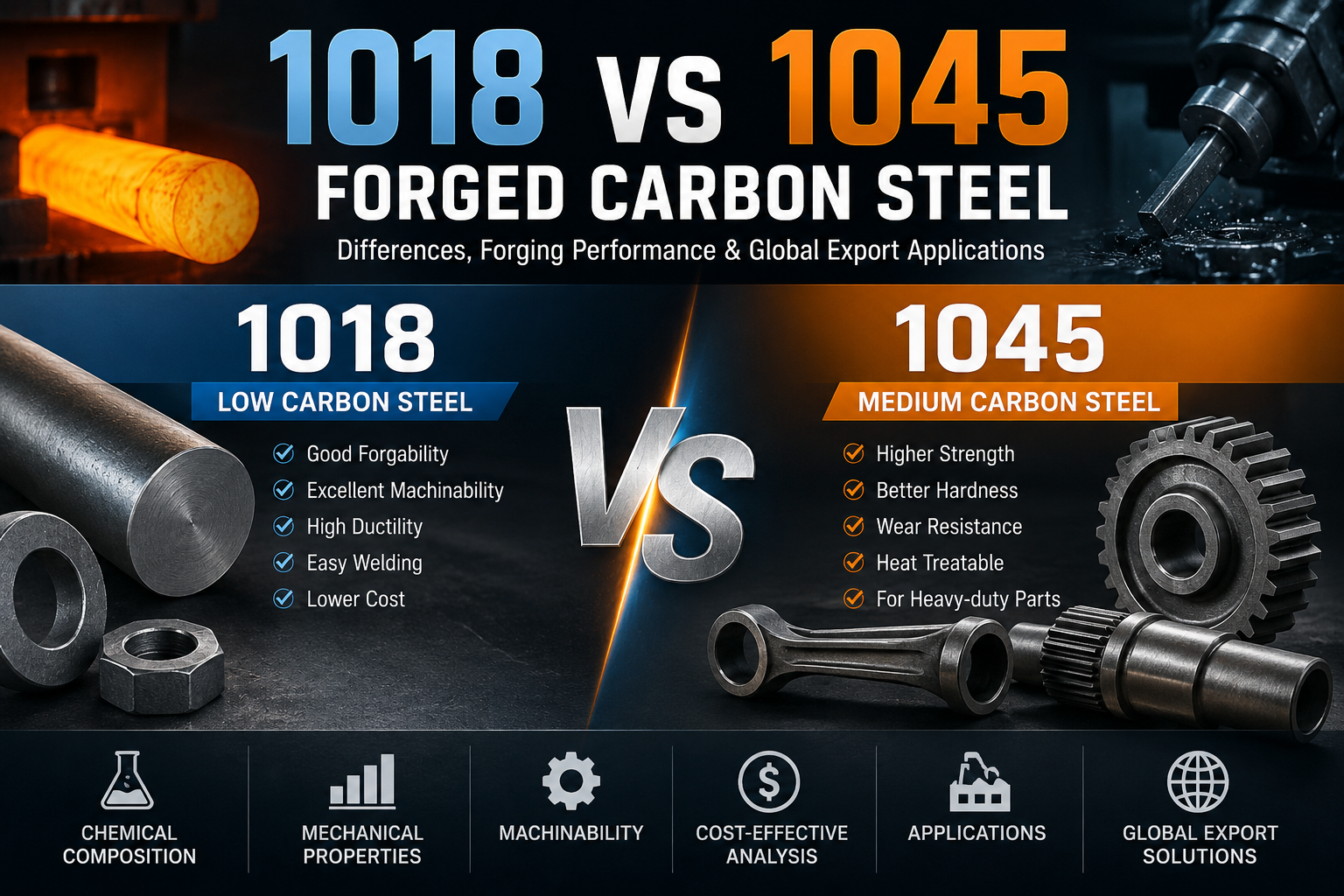
1018 and 1045 are the most mainstream low-carbon and medium-carbon forged steels in the global steel export industry.Known for their stable performance,economical pricing,and excellent forgeability,they have become the most commonly used materials for general machinery components,hardware accessories,and structural parts.Most overseas buyers tend to prioritize these two carbon steels for routine forging projects.However,they often lack a clear understanding of the performance differences between the two and their respective suitable applications.This article will analyze in detail the forging characteristics,mechanical properties,machinability,cost-effectiveness,and application fields of 1018 and 1045 forged carbon steels,aiming to provide a professional reference for global steel procurement and project design.
Table of Contents
Chemical Composition
| Element | 1018 (%) | 1045 (%) |
| C | 0.15 ~ 0.20 | 0.43 ~ 0.50 |
| Mn | 0.60 ~ 0.90 | 0.60 ~ 0.90 |
| Si | ≤ 0.10 | 0.15 ~ 0.35 |
| P | ≤ 0.040 | ≤ 0.040 |
| S | ≤ 0.050 | ≤ 0.050 |
| Cr | ≤ 0.15 | ≤ 0.20 |
| Ni | ≤ 0.15 | ≤ 0.20 |
| Cu | ≤ 0.20 | ≤ 0.20 |
Mechanical Properties
| Indicators | 1018 | 1045 | Remark |
| Tensile Strength (MPa) | ~440 | 570 ~ 700 | 1045 can reach 850+ after quench and tempering |
| Yield Strength (MPa) | ~370 | 310 ~ 520 | 1045 in hot rolled condition will be about 310,and will be higher after cold drawing/normalizing |
| Hardness (HB) | 120 ~ 130 | 170 ~ 210 | 1045 can reach HRC 40 ~ 55 after quench and tempering |
| Elongation (%) | ~15 | 12 ~ 14 | 1018 has better plasticity |
| Reduction area (%) | ~40 | ~40 | Similar for both |
| Elastic modulus (GPa) | ~205 | ~205 | Basically the same |
| Impact toughness | Good | Medium | 1018 has slightly better low-temperature toughness |
Machinability
1018 is widely recognized as a “free-machining steel”,offering long tool life and allowing more aggressive cutting parameters.It provides excellent surface finish after cold drawing,making it suitable for precision turning and cold forming.
Due to its higher hardness and larger proportion of pearlite,1045 causes faster tool wear during machining,requiring reduced feed rates or the use of coated tools.After heat treatment,its hardness increases,making grinding the primary method for finishing.
Overall,1018 offers lower machining costs and higher efficiency.
Cost-effective
1018 has low raw material costs,minimal machining energy consumption and tool wear,and typically requires no heat treatment,resulting in the lowest overall manufacturing cost.It is the economical first choice for general components.
The raw material cost of 1045 is about 30-50% higher,and machining costs increase slightly.However,if heat treatment is required,additional process costs are incurred.Nevertheless,its strength advantage can reduce component cross-sectional dimensions and lower overall weight.potentially achieving system-level cost savings under load-bearing conditions.
From a full lifecycle, perspective,1018 is suitable for low-stress,high-volume,
low-cost scenarios.1045 is suitable for moderate-load parts that require wear resistance or heat treatment,with its cost-effectiveness reflected in”trading moderate cost for significant performance improvement”.
Uygulamalar
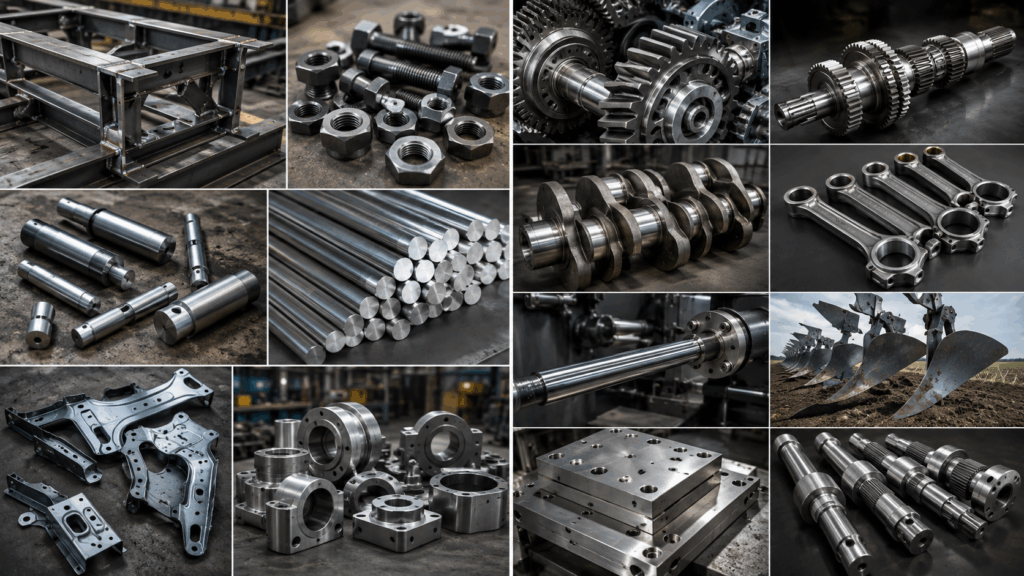
1018 is widely used in welded structural parts,common bolts and nuts,low-load pins,cold-drawn bright bars,automotive body brackets,and general machinery components.It is a versatile base material that embodies the principle of “save where you can”
1045 is used for gears,transmission shafts,crankshafts,connecting rods, hydraulic piston rods,agricultural plowshares,mold base plates,and various types of shaft parts requiring quenching and tempering.It is the backbone material for “strength-first” applications.
Sonuç
1018 vs 1045 forged carbon steel is not a simple comparison between “cheap steel” and “strong steel.” The better choice depends on what the part needs to do.
Choose 1018 when the project requires good forgeability, easy machining, better ductility, reliable weldability, and lower total manufacturing cost. It is a practical choice for hardware accessories, welded structural parts, low-load pins, cold-drawn bright bars, automotive brackets, and general machinery components where high strength is not the main requirement.
Choose 1045 when the part needs higher strength, better hardness, improved wear resistance, and stronger performance after quenching and tempering. It is more suitable for gears, transmission shafts, crankshafts, connecting rods, hydraulic piston rods, agricultural plowshares, mold base plates, and other forged parts that must handle medium loads or repeated mechanical stress.
For global buyers, the real decision should not be based only on material price. 1018 can reduce machining cost and simplify production, but it may not be enough for load-bearing or wear-resistant parts. 1045 can deliver stronger mechanical performance, but it may increase machining difficulty, heat treatment cost, and welding risk.
Before ordering, confirm the drawing, working load, machining process, heat treatment condition, hardness requirement, inspection standard, and final application. In export projects, 1018 is usually the economical choice for low-stress and high-volume parts, while 1045 is the stronger choice for heat-treated, wear-resistant, and load-bearing forged components.
SSS
Is 1045 steel stronger than 1018?
Yes. 1045 steel is usually stronger than 1018 because it has higher carbon content. 1018 is a low-carbon steel, while 1045 is a medium-carbon steel. That higher carbon level gives 1045 better tensile strength, hardness, and wear resistance, especially after heat treatment.
What is the main difference between 1018 and 1045 forged carbon steel?
The main difference is carbon content. 1018 usually contains about 0.15–0.20% carbon, while 1045 contains about 0.43–0.50% carbon. This changes strength, hardness, machinability, weldability, and heat treatment response.
Is 1018 steel good for forging?
Yes. 1018 steel is good for general forging, especially when the part needs good plasticity, easy machining, lower cost, and stable performance. It is suitable for low-stress forged parts, hardware accessories, brackets, pins, and general machinery components.
Is 1045 steel good for forging?
Yes. 1045 steel is widely used for forged parts that need higher strength, hardness, and wear resistance. It is commonly selected for shafts, gears, crankshafts, piston rods, agricultural parts, and components that may need quenching and tempering.
What are the disadvantages of using 1045 steel?
The main disadvantages of 1045 steel are lower weldability, higher machining difficulty, more tool wear, and extra heat treatment cost when higher hardness is required. Compared with 1018, it is less suitable for welded structures or high-volume low-cost parts.
Is 1045 carbon steel strong?
Yes. 1045 carbon steel is considered a strong medium-carbon steel. It has higher strength and hardness than 1018, and it can become much harder after quenching and tempering. This makes it suitable for load-bearing and wear-resistant parts.
Which is easier to machine, 1018 or 1045?
1018 is usually easier to machine. It has lower carbon content and lower hardness, so it gives better tool life and smoother cutting in many general machining operations. 1045 is harder and stronger, so machining may require slower cutting speeds, better tooling, or grinding after heat treatment.
Which is better for welding, 1018 or 1045?
1018 is better for welding. Its lower carbon content reduces cracking risk and makes it easier to weld in normal fabrication work. 1045 can be welded, but it usually needs more control, and preheating may be required for thicker or more critical parts.
What is 1045 steel commonly used for?
1045 steel is commonly used for gears, shafts, crankshafts, connecting rods, hydraulic piston rods, agricultural tools, mold base plates, and other medium-load parts. It is a good choice when strength, hardness, and wear resistance matter more than weldability.
What is 1018 steel commonly used for?
1018 steel is commonly used for hardware accessories, welded structural parts, low-load pins, bolts, nuts, brackets, cold-drawn bars, and general machinery components. It is often chosen when easy machining, formability, weldability, and cost control are more important than high strength.
Can 1018 replace 1045?
Only in low-load applications. If the part does not need high strength, hardness, wear resistance, or heat treatment, 1018 may replace 1045 and reduce cost. But for shafts, gears, or load-bearing forged parts, replacing 1045 with 1018 may increase failure risk.
Can 1045 replace 1018?
Sometimes, but it may be overdesigned. 1045 can provide higher strength and hardness, but it also brings higher material cost, harder machining, and poorer weldability. If the part only needs basic strength and easy processing, 1018 is usually more economical.
1018 vs 1045 yield strength: which is higher?
1045 usually has higher potential yield strength, especially after normalizing, cold drawing, or quenching and tempering. In some common conditions, 1018 and hot-rolled 1045 may look close, so buyers should confirm the exact supply condition and heat treatment state before comparing numbers.
Is 1045 steel better than A36?
It depends on the application. A36 is a common structural steel used for plates, beams, and welded structures. 1045 is a medium-carbon steel used when higher strength, hardness, and wear resistance are needed. For welded structural fabrication, A36 may be more practical. For shafts and wear-resistant forged parts, 1045 is usually better.
Is 1018 mild steel?
Yes. 1018 is commonly treated as a low-carbon mild steel. It has good weldability, machinability, ductility, and cost efficiency, which makes it useful for general-purpose parts and high-volume machining work.
What should buyers confirm before ordering 1018 or 1045 forged carbon steel?
Buyers should confirm steel grade, forging size, delivery condition, heat treatment requirement, mechanical properties, hardness range, machining allowance, inspection standard, quantity, and final application. For export orders, also confirm whether the customer needs ASTM, SAE, EN, JIS, or GB equivalent documentation.