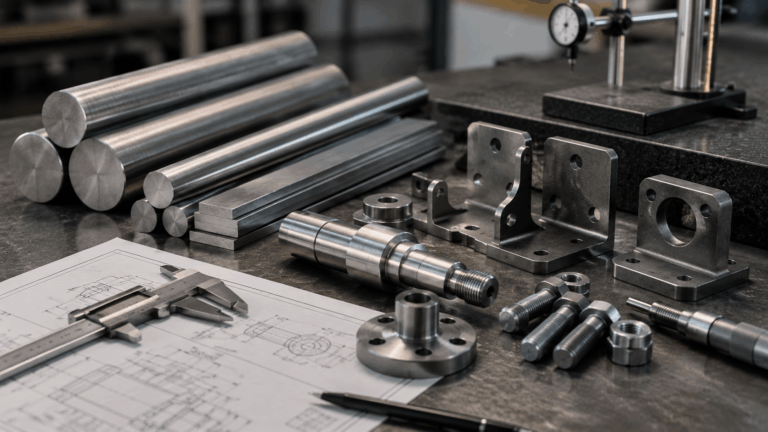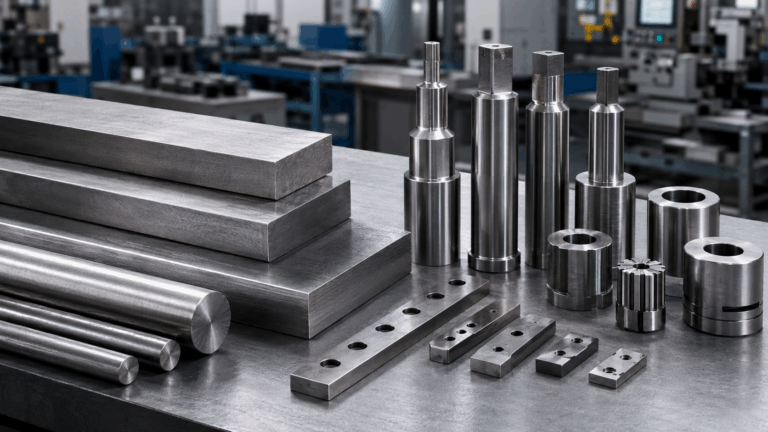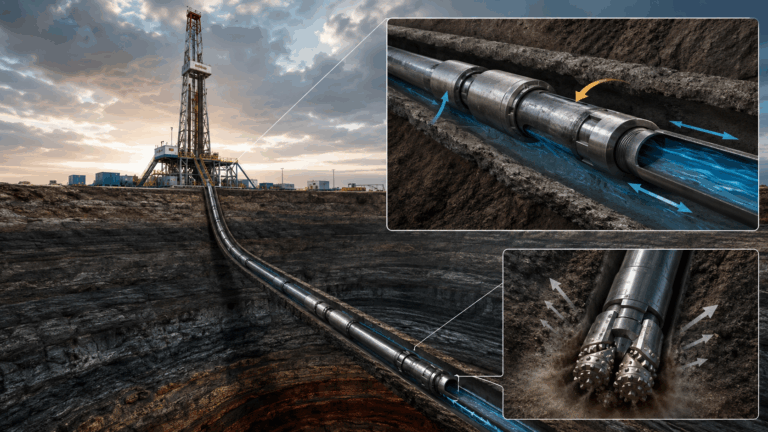
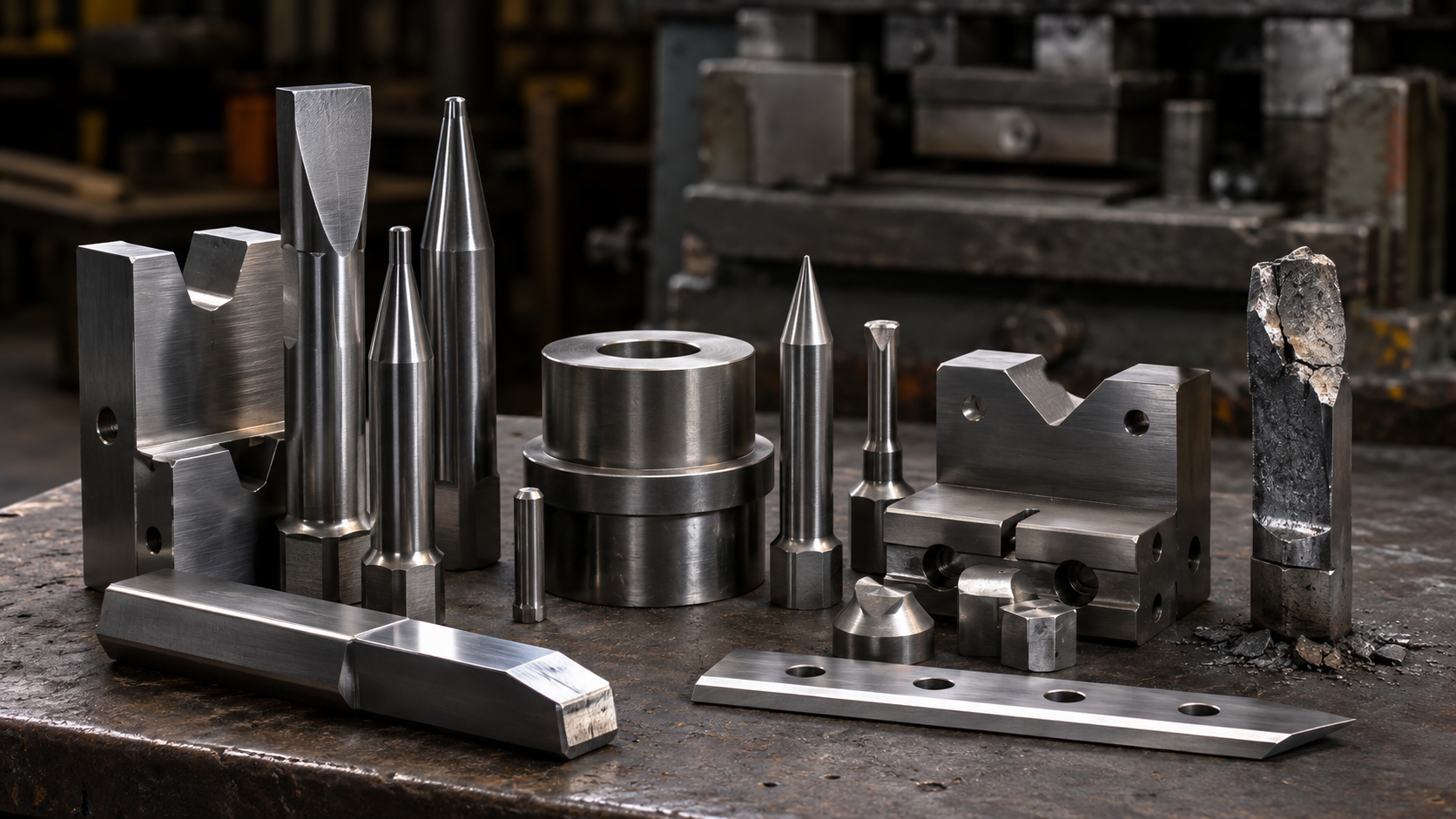
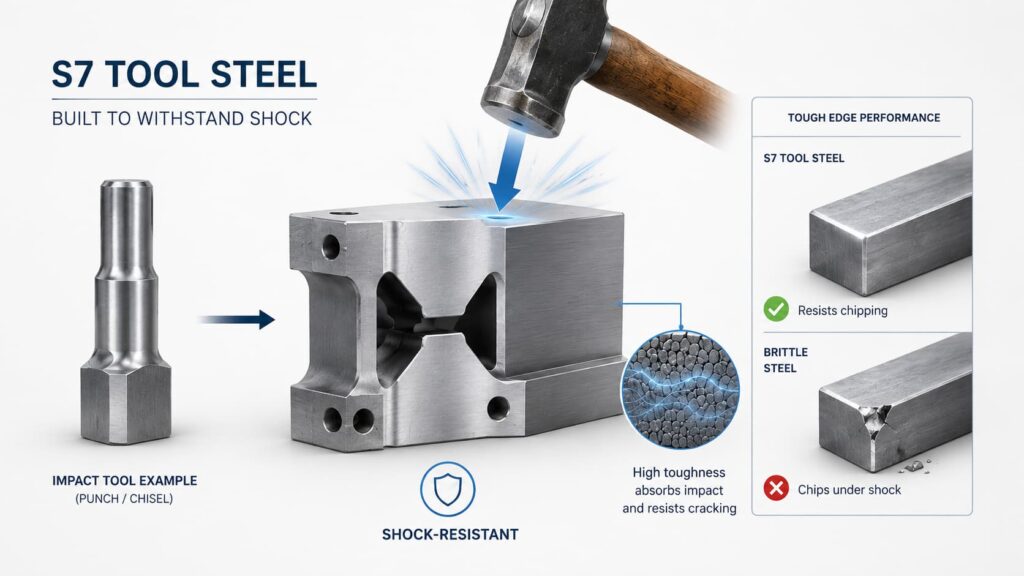
S7 tool steel is not the first choice when maximum wear resistance is the only goal. It is chosen when a tool faces impact, shock loading, edge pressure, or sudden force that would make harder steels chip too early.
That is why punches, chisels, shear blades, forming tools, and impact dies still use this grade. This guide explains its composition, properties, hardness, heat treatment, machining behavior, and how it compares with D2 and 4140.
Table of Contents
What Is S7 Tool Steel and Why Is It Shock-Resistant?
S7 tool steel is a shock-resisting tool steel designed for tools that need toughness and impact resistance. It belongs to the AISI S-series tool steels, where the “S” group is associated with shock-resisting grades.
AZoM’s technical article on S7 tool steel describes it as a shock-resisting steel under UNS T41907 and lists equivalent designations including ASTM A681 and UNS T41907. MatWeb also describes Carpenter S7 as an air-hardening tool steel with high impact and shock resistance.
The key point is simple: S7 tool steel is not about chasing the highest Rockwell number. It is about keeping enough hardness while resisting chipping and cracking under shock.
S7 Tool Steel Composition and Chemical Design
The composition of S7 tool steel is designed to balance hardness, hardenability, toughness, and moderate wear resistance. It is not a high-carbon, high-chromium wear steel like D2.
Typical elements include carbon, chromium, molybdenum, silicon, manganese, and vanadium. Carbon supports hardness. Chromium and molybdenum help hardenability and tempering response. Silicon supports shock resistance. Vanadium helps grain control.
| Element | Why It Matters |
|---|---|
| Carbon | Builds hardness and strength |
| Chromium | Improves hardenability and moderate wear resistance |
| Molybdenum | Supports toughness and tempering stability |
| Silicon | Helps shock resistance |
| Manganese | Supports hardenability |
| Vanadium | Helps grain refinement |
S7 Tool Steel Properties Buyers Should Check
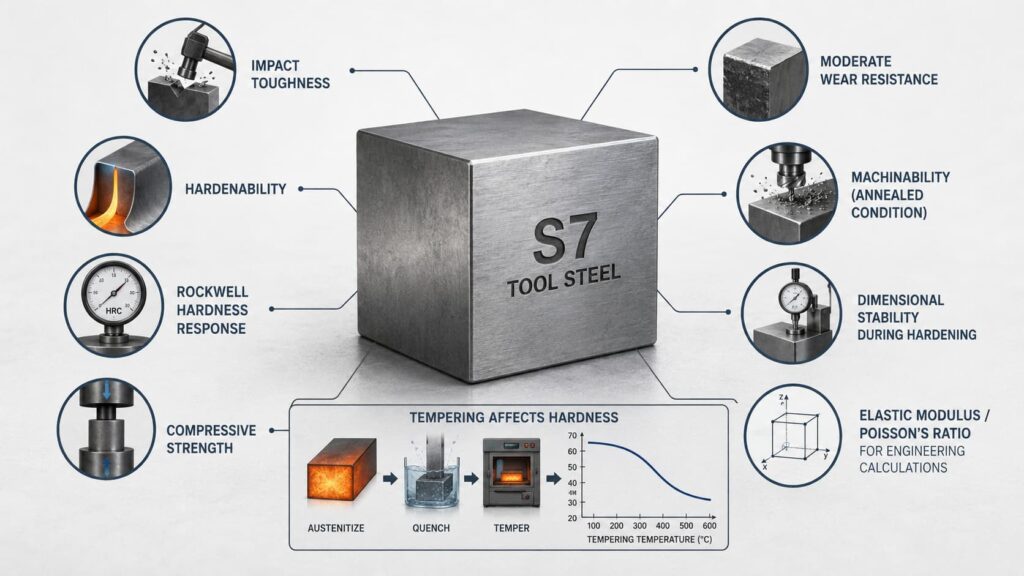
When buyers search for S7 tool steel properties, they usually want more than a chemistry table. They want to know whether the steel can survive real tooling loads.
The most important properties are:
- impact toughness
- hardenability
- Rockwell hardness response
- compressive strength
- moderate wear resistance
- machinability in annealed condition
- dimensional stability during hardening
- elastic modulus and Poisson’s ratio for engineering calculations
How Hard Is S7 Tool Steel After Heat Treatment?
S7 tool steel hardness depends on heat treatment. That is why a single hardness number can be misleading.
| Application | Hardness Priority | Practical Note |
|---|---|---|
| Punches | Hardness + toughness | Avoid edge chipping |
| Chisels | Toughness first | Repeated impact matters |
| Shear blades | Edge stability | Needs crack resistance |
| Forming dies | Toughness balance | Avoid brittle failure |
| Impact tools | Chipping resistance | Do not chase maximum HRC |
How to Heat Treat and Harden S7 Tool Steel Without Losing Toughness
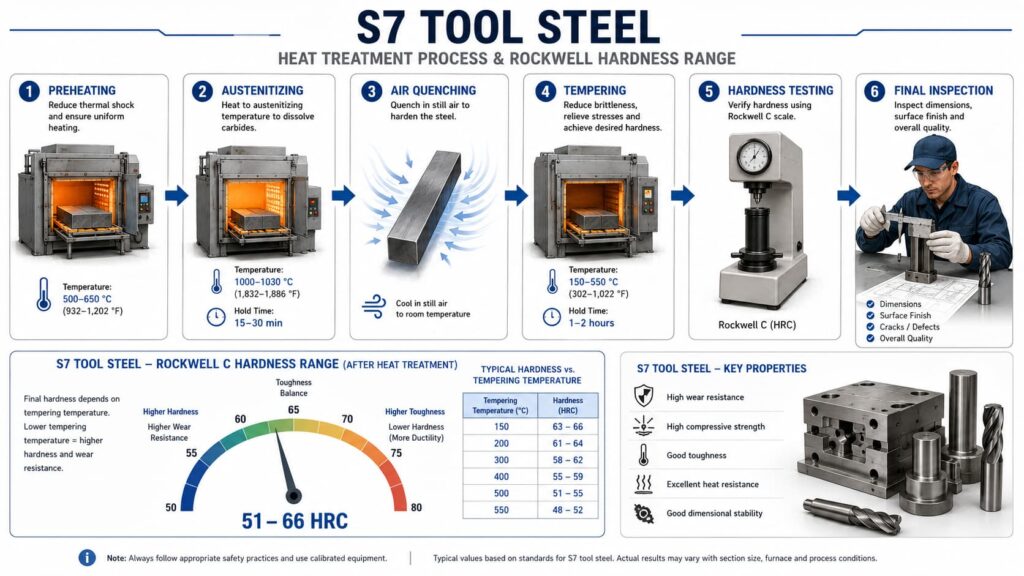
S7 tool steel heat treatment must protect the reason the material was chosen in the first place: toughness.
A typical workflow includes:
1.Preheating to reduce thermal shock
2.Austenitizing at the specified range
3.Air quenching or controlled cooling
4.Tempering to the target hardness
5.Stress relief when needed
6.Rockwell hardness testing
7.Crack and dimensional inspection
Carpenter’s CarTech S7 document gives a hardening range of 1700–1750°F (927–954°C), with soaking guidance based on section thickness before quenching. Hudson Tool Steel also gives annealing guidance and states that annealed S7 should reach a maximum of 223 HBW.
The practical rule is this: do not push S7 tool steel to maximum hardness if the tool’s main risk is impact chipping.
How to Machine S7 Tool Steel Before and After Hardening
S7 tool steel is easier to machine in the annealed condition. After hardening, cutting becomes more difficult and may require grinding, EDM, or hard machining.
For better tool life, machining plans should consider:
- annealed supply condition
- machining allowance before heat treatment
- distortion after hardening
- cutting speed and tool material
- coolant use
- final grinding or EDM requirements
This is especially important for punches, dies, and tools with sharp corners. Poor machining geometry can create stress concentration, even if the steel grade is correct.
What Is S7 Tool Steel Used For in Real Tooling?
S7 tool steel is used when the tool is more likely to break, chip, or crack than simply wear away.
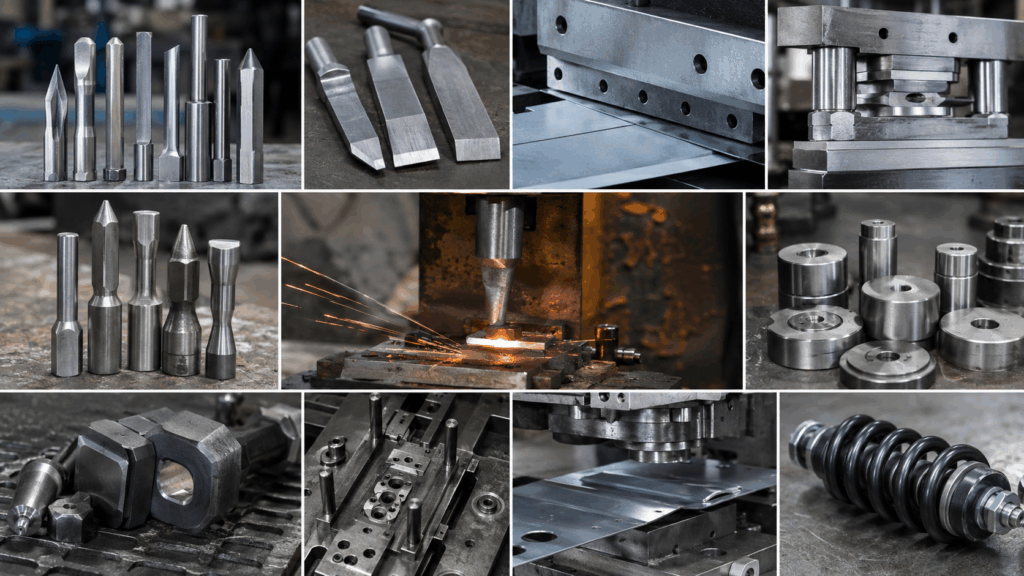
Common applications include:
- punches
- chisels
- shear blades
- forming dies
- rivet sets
- cold work dies
- impact tools
- heavy-duty tooling
- stamping tools
- shock-loaded components
S7 Tool Steel vs D2 When Chipping Is the Main Problem
S7 tool steel vs D2 is not a simple “better steel” comparison. These grades solve different problems.
| Factor | S7 Tool Steel | D2 Tool Steel |
|---|---|---|
| Main strength | Impact toughness | Wear resistance |
| Best use | Shock-loaded tools | Abrasive wear tools |
| Chipping resistance | Better | Lower |
| Wear resistance | Moderate | High |
| Typical applications | Punches, chisels, impact tools | Dies, cutters, wear tools |
Choose S7 if the tool fails by chipping, cracking, or impact fracture. Choose D2 if the tool mainly fails by abrasive wear and edge rounding.
S7 Tool Steel vs 4140 and the Meaning of Stronger
Is S7 stronger than 4140? It depends on what “stronger” means.
4140 is a chromium-molybdenum alloy engineering steel often used for shafts, gears, and mechanical parts. S7 tool steel is a shock-resisting tool steel for impact tooling. If the part is a machine shaft, 4140 may be the better engineering choice. If the part is a punch or chisel facing repeated shock, S7 is usually the more appropriate material.
| Factor | S7 Tool Steel | 4140 Steel |
|---|---|---|
| Steel type | Shock-resisting tool steel | Alloy engineering steel |
| Best use | Impact tooling | Shafts and machine parts |
| Key advantage | Chipping resistance | Structural strength and toughness |
| Better when | Tool faces repeated shock | Part carries mechanical load |
Does S7 Tool Steel Corrode, Weld, or Stay Magnetic?
S7 is not stainless steel, so it can corrode if stored without protection. Use oiling, dry packaging, or surface protection for storage and shipping.
S7 is generally magnetic because it is a ferrous tool steel.
Welding is possible, but it should not be treated like welding mild steel. Welding can affect hardness, toughness, and heat-treated condition. If welding is unavoidable, confirm preheat, filler choice, cooling, and post-weld treatment with a qualified welding or heat-treatment specialist.
When S7 Tool Steel Is Not the Right Choice
S7 tool steel is a poor choice when the real problem is abrasion, corrosion, or low-cost structural support.
Do not choose it for:
- extreme abrasive wear
- stainless corrosion resistance
- long-term high-temperature service
- mirror-polished plastic molds
- low-load structural parts
- parts where 4140 or carbon steel is enough
S7 works best when the tool fails from impact, shock, and chipping rather than simple wear.
Conclusion
S7 tool steel is not chosen because it is the hardest grade on the shelf. It is chosen because tough tools need more than hardness. They need resistance to impact, cracking, and chipping.
If a tool fails by abrasive wear, another tool steel may be better. If it fails by shock loading, edge cracking, or sudden fracture, S7 tool steel deserves serious consideration. That is why it remains a practical choice for punches, chisels, dies, shear blades, and impact-loaded tooling.
FAQ
What is S7 tool steel?
S7 tool steel is a shock-resisting tool steel designed for tools that need toughness, impact resistance, and reliable hardness.
What is S7 tool steel used for?
It is used for punches, chisels, shear blades, forming dies, rivet sets, cold work dies, and impact tools.
How hard is S7 tool steel?
It can reach high Rockwell C hardness after heat treatment, but the right hardness depends on the application and toughness requirement.
How do you heat treat S7 tool steel?
The process usually includes preheating, austenitizing, air quenching or controlled cooling, tempering, and final hardness inspection.
What is the difference between S7 and D2 tool steel?
S7 is better for impact toughness and chipping resistance. D2 is better for abrasive wear resistance.
Is S7 tool steel stronger than 4140?
For shock-loaded tools, S7 is usually more suitable. For shafts, gears, and structural machine parts, 4140 is often more appropriate.
Does S7 tool steel corrode?
Yes. It is not stainless steel and can rust without oil, packaging, or surface protection.
Is S7 tool steel magnetic?
Yes. It is generally magnetic because it is a ferrous tool steel.
Where can buyers find S7 tool steel plate or stock?
Buyers should look for suppliers that provide S7 plate, round bar, flat bar, certificates, heat-treatment support, and inspection documents.