When engineers, fabricators, and purchasing teams need a stainless steel that balances corrosion resistance, formability, availability, and cost, 304 stainless steel is usually the first grade they consider.
Often referred to as the industry standard for general-purpose stainless steel applications, 304 has earned its reputation through decades of proven performance. It is used in everything from commercial kitchens and water treatment systems to architectural components and industrial equipment.
But despite its popularity, many buyers still have questions about its composition, mechanical properties, equivalent grades, and real-world limitations. In this guide, we’ll break down what 304 stainless steel is, where it performs best, how it compares with other grades, and why it remains the most widely specified stainless steel worldwide.
Table of Contents
What Is It?
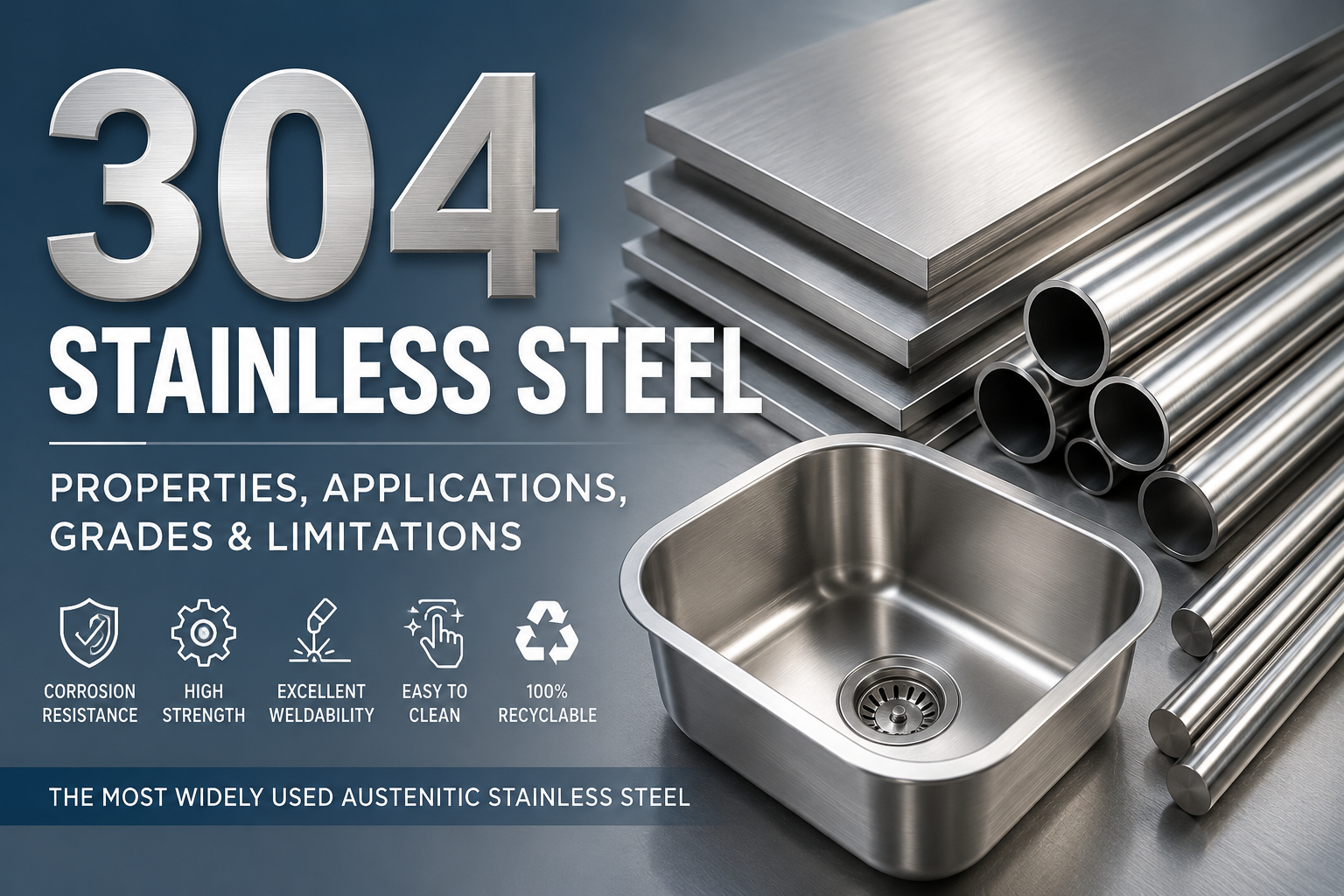
If you’ve ever bought a kitchen sink, walked past a building facade, or worked in a food processing plant, you’ve already seen 304 stainless steel. It’s the most widely used austenitic stainless steel on the planet, and for good reason—it gets the job done.
In the American system, it’s the classic 18-8 stainless steel: roughly 18% chromium, 8% nickel. That combination gives it corrosion resistance, toughness, and formability that plain carbon steel simply can’t match. In China, the current standard designation is 06Cr19Ni10 under GB/T 20878 (the old designation was 0Cr18Ni9). But honestly, most people in the trade just call it 304 or SUS304—everyone knows what you’re talking about.
The Chemistry
| Element | Content |
| Carbon (C) | ≤0.08% |
| Chromium (Cr) | 18.00% – 20.00% |
| Nickel (Ni) | 8.00% – 10.50% |
| Manganese (Mn) | ≤2.00% |
| Silicon (Si) | ≤1.00% |
| Phosphorus (P) | ≤0.045% |
| Sulfur (S) | ≤0.030% |
Nothing too complicated here. The chromium creates a passive oxide layer that keeps rust from forming, and the nickel stabilizes the austenitic structure so the steel stays tough and workable across a wide temperature range. It’s a well-balanced composition that’s been refined over decades.
Mechanical Properties
| Property | Value |
| Yield strength | ≥205 MPa |
| Tensile strength | 520 – 750 MPa |
| Elongation | ≥40% |
| Density | 7.93 g/cm³ |
Global Designations
| Standard | Designation |
| China GB/T 20878 | 06Cr19Ni10 (old: 0Cr18Ni9) |
| USA ASTM/UNS | 304 (S30400) |
| Japan JIS | SUS304 |
| Europe EN / Germany DIN | X5CrNi18-10 (1.4301) |
| UK BS | 304S15 |
Why 304?
Corrosion resistance that actually holds up
Atmospheric exposure, fresh water, mild acids and alkalis, food environments—304 handles all of these without rusting. It won’t hold up indefinitely in a chemical plant or seawater (that’s what 316 is for), but for everyday conditions, it’s more than adequate.
Forms and welds without drama
Good plasticity means it takes well to stamping, drawing, bending, and spinning. Welding is straightforward; the welds don’t crack or become brittle easily. If your shop can handle mild steel, they can handle 304 with a few minor adjustments.
Tough from cold to hot
It doesn’t turn brittle at low temperatures, and it doesn’t oxidize heavily at moderate elevated temperatures. Good stability under vibration and dynamic loads as well.
Safe and clean
The smooth surface doesn’t trap dirt or bacteria. No harmful substances leach out. It meets food-grade and medical standards. Cleaning is simple.
Available everywhere
Every major mill produces it. Sheet, plate, pipe, bar, section—whatever form you need, someone stocks it. Supply chains are reliable and lead times are usually reasonable.
Looks good too
Brushed, mirror-polished, sandblasted—however you finish it, 304 has a clean, modern appearance that works for both structural and decorative applications.
Where You’ll Find It
Food service and kitchens
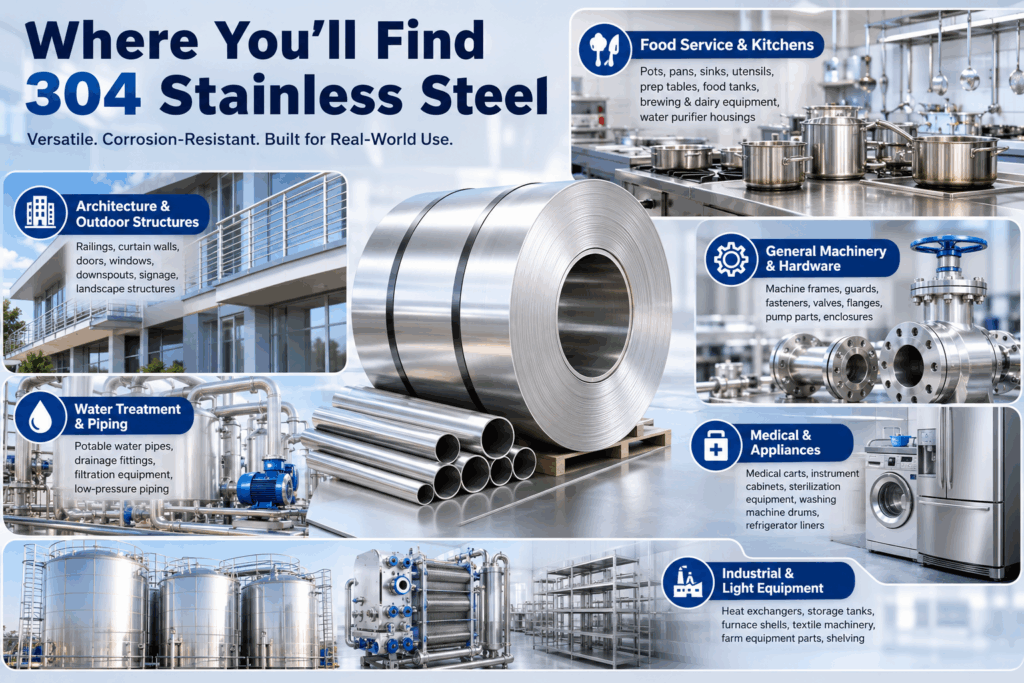
This is classic 304 territory. Pots, pans, knives, utensils, kettles. Commercial kitchen equipment—prep tables, steamers, shelving. Food processing tanks, conveyor systems, brewing and dairy vessels, water dispenser tanks, water purifier housings. If it touches food and needs to stay clean, 304 is the default choice.
Architecture and outdoor structures
Railings, curtain walls, trim, doors and windows, downspouts, billboard supports, landscape structures. Interior panels, ceilings, hardware. It weathers well and looks sharp.
General machinery and hardware
Machine frames, guards, sheet metal enclosures, fasteners (bolts, nuts, washers), valves, flanges, pump parts. The non-critical structural stuff that needs to resist corrosion without carrying massive loads.
Water treatment and piping
Potable water pipes, drainage fittings, wastewater equipment housings, filtration equipment, ventilation ducting, low-pressure fluid transfer welded pipe.
Medical and appliances
Medical carts, instrument cabinets, sterilization equipment, surgical accessories. Washing machine drums, refrigerator liners, microwave parts, water heater tanks.
Industrial and light equipment
Small heat treatment furnace shells, heat exchangers, general chemical storage tanks (for weak media), textile machinery, farm equipment corrosion-resistant parts, storage shelving.
The Honest Limitations
Let’s not overstate it. 304 is not a superalloy.
Not for heavy chlorides or seawater—salt spray, marine environments, or aggressive chemicals will eventually cause pitting. That’s 316 territory.
Not for high temperatures long-term—above about 800°C (1470°F), things start getting dicey. For sustained high-heat service, look at 310S or dedicated heat-resistant grades.
Not the hardest steel around—if you need wear resistance or high strength, you’ll need to cold-work it or choose a different grade entirely.
Not the cheapest option—carbon steel costs a fraction of what 304 does. Don’t spec stainless when painted mild steel will do the job.
Bottom Line
304 stainless steel is the default because it has earned that spot. Corrosion resistance, formability, weldability, availability, and a clean appearance—all at a price that, while higher than carbon steel, is reasonable for what you get. Unless your application specifically demands something better (316 for marine/chemical, 430 for non-critical decorative, carbon steel for pure cost), 304 is where you start. And for most buyers, it’s also where you finish.
FAQ
Is 304 stainless steel rust-proof?
No stainless steel is completely rust-proof. However, 304 stainless steel provides excellent corrosion resistance in most indoor, outdoor, and food-processing environments. Rust can still occur when the material is exposed to high concentrations of chlorides, aggressive chemicals, or poor maintenance conditions.
Is 304 stainless steel food grade?
Yes. 304 stainless steel is widely considered a food-grade material because it resists corrosion, does not easily react with food, and can be cleaned and sanitized effectively. It is commonly used in kitchen equipment, food processing machinery, storage tanks, and food preparation surfaces.
What is the difference between 304 and 316 stainless steel?
The primary difference is that 316 stainless steel contains molybdenum, which significantly improves resistance to chlorides and corrosive chemicals. While 304 is suitable for most general-purpose applications, 316 is preferred for marine environments, coastal areas, and chemical processing equipment.
Is 304 stainless steel magnetic?
In its annealed condition, 304 stainless steel is generally non-magnetic. However, cold working processes such as rolling, bending, or forming can create slight magnetic properties. This is normal and does not affect the material’s corrosion resistance.
Can 304 stainless steel be welded?
Yes. 304 stainless steel offers excellent weldability and can be welded using common methods such as TIG, MIG, and resistance welding. It is widely used in fabricated structures, piping systems, tanks, and industrial equipment because of its reliable welding performance.
What are the equivalent grades of 304 stainless steel?
Common equivalent grades include 06Cr19Ni10 under the Chinese GB/T standard, SUS304 under Japanese JIS standards, X5CrNi18-10 (1.4301) under European EN standards, and UNS S30400 under ASTM specifications in the United States. These grades have very similar chemical compositions and performance characteristics.