Engineers and procurement managers cannot afford guesswork when selecting marine-grade alloys. Understanding the exact 316 stainless steel specification is critical for ensuring the longevity of pressure vessels, pharmaceutical equipment, and marine hardware.
Unlike general-purpose alloys, this material is engineered for highly corrosive environments. Navigating the global standard for the 316 stainless steel specification requires a deep dive into metallurgical data, international grading systems, and rigorous testing protocols.
In industrial applications, compliance with the exact 316 stainless steel specification prevents catastrophic material failures, minimizes maintenance downtime, and ensures regulatory compliance. This technical data sheet breaks down the critical parameters you need to know.
Inhaltsverzeichnis
The Core of the Alloy: Chemical Composition
The defining factor of the 316 stainless steel specification lies in its precise chemical makeup. It is an austenitic chromium-nickel stainless steel containing an essential addition of molybdenum.
This specific molybdenum content in 316 stainless steel percentage (typically 2.0% to 3.0%) drastically increases general corrosion resistance. It specifically targets pitting and crevice corrosion in chloride environments.
The following table outlines the 316 stainless steel chemical composition chart ASTM A240 standard. This represents the absolute baseline for material acceptance.
| Element | Symbol | Minimum (%) | Maximum (%) |
| Kohlenstoff | C | – | 0.08 |
| Mangan | Mn | – | 2.00 |
| Phosphorus | P | – | 0.045 |
| Sulfur | S | – | 0.030 |
| Silizium | Si | – | 0.75 |
| Chrom | Cr | 16.00 | 18.00 |
| Nickel | Ni | 10.00 | 14.00 |
| Molybdän | Mo | 2.00 | 3.00 |
| Nitrogen | N | – | 0.10 |
Maintaining these exact percentages is non-negotiable. Even a 0.5% drop in molybdenum can render the material unsuitable for seawater exposure.
Mechanical Properties of AISI 316
Beyond chemistry, the mechanical boundaries of the 316 stainless steel specification dictate how the material behaves under extreme physical stress. Engineers rely on the AISI 316 technical data sheet to calculate load-bearing capacities.
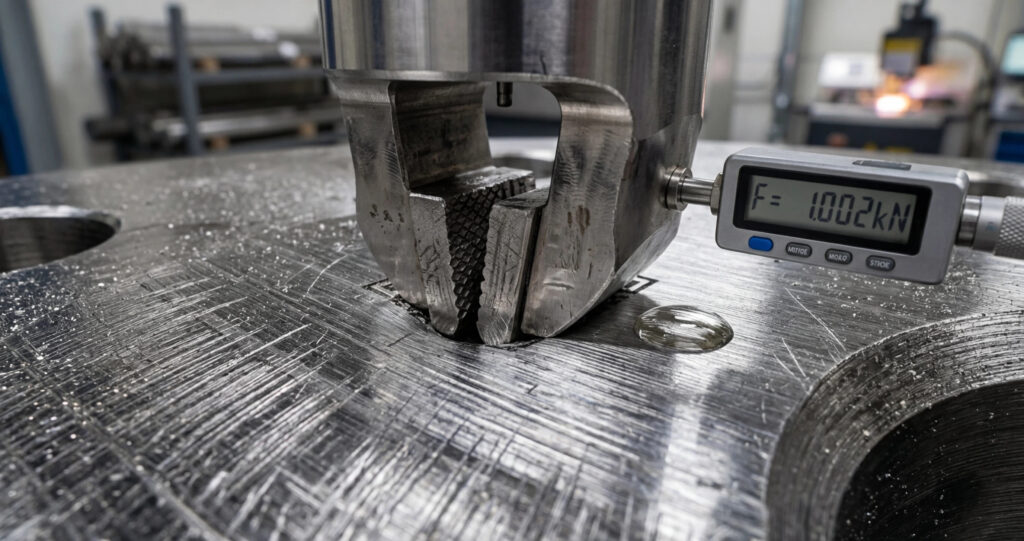
The mechanical properties are tested at room temperature. The minimum tensile strength for 316 stainless steel plates is typically 515 MPa (75,000 psi). This ensures the material will not fracture under standard industrial tension.
Yield strength is equally critical. The standard requires a minimum yield strength of 205 MPa (30,000 psi) at a 0.2% offset. Meeting the 316 stainless steel specification for structural integrity means the material will return to its original shape if stresses remain below this threshold.
Elongation stands at a minimum of 40% in 50mm. This high ductility is a hallmark of austenitic steels, allowing for severe forming, bending, and deep drawing without annealing.
High-Temperature Performance
Standard 316 stainless steel yield strength at elevated temperatures is superior to the 304 variant. It maintains excellent tensile strength and creep resistance at temperatures up to 870°C in intermittent service.
For continuous service, the maximum recommended temperature is 925°C. However, engineers must be cautious of carbide precipitation if the material is exposed to the 425°C to 860°C range for prolonged periods.
Physical Properties and Thermal Dynamics
A complete engineering assessment outlines the physical properties within the 316 stainless steel specification. These baseline metrics are vital for thermal and fluid dynamics calculations.
The 316 stainless steel physical properties indicate a density of 8.00 g/cm³. This is slightly heavier than standard carbon steels due to the high nickel and molybdenum content.
The melting point ranges between 1370°C and 1400°C. Its thermal conductivity is 16.3 W/m·K at 100°C, which is relatively low, making it an excellent insulator compared to aluminum or copper.
Pitting Resistance Equivalent Number (PREN)
To quantify corrosion resistance, metallurgists use the Pitting Resistance Equivalent Number. This index is a critical component of the 316 stainless steel specification for marine environments.
The formula calculates the relative pitting resistance based on the chemical composition. It is widely used when evaluating the 316 stainless steel specification against chloride pitting. The standard formula is:
PREN=%Cr + 3.3 x %Mo+ 16 x %N
A standard 316 alloy typically achieves a PREN value between 23 and 28. For applications requiring higher resistance, engineers often cross-reference this value to ensure the heat chemistry sits at the upper limit of the allowable molybdenum range.
International Standards and Equivalents
Global supply chains require cross-referencing different material designations. The UNS S31600 material properties align directly with the AISI 316 standards in North America.
In Europe, the EN 10088-2 grade 1.4401 chemical analysis serves as the primary reference. This is the European equivalent to the American 316 stainless steel specification, ensuring interoperability in multinational projects.
Other notable equivalents include the Japanese JIS SUS316 and the British BS 316S31. Despite minor regional variations in testing methodologies, these designations represent a harmonized 316 stainless steel specification across borders.
Supply Chain: MTR Verification
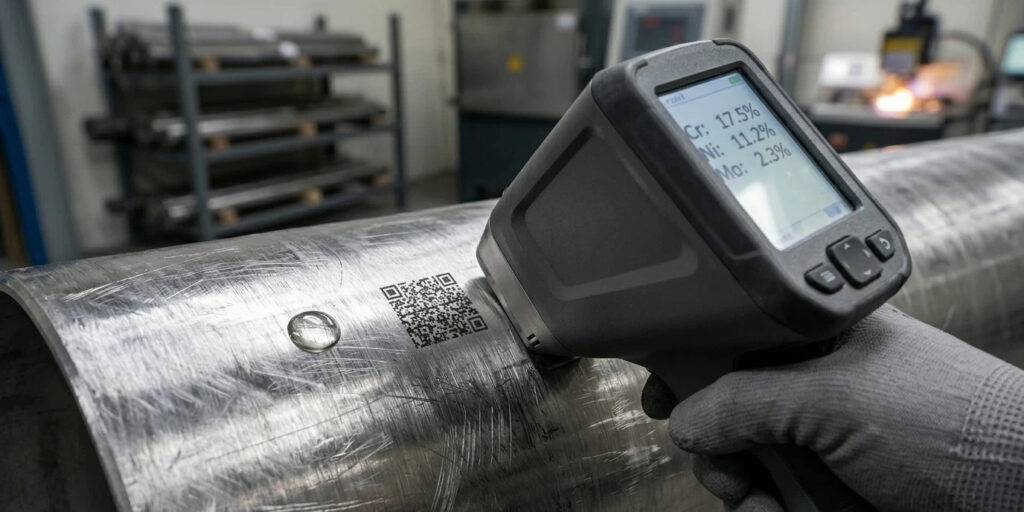
Procurement professionals must rigorously validate incoming raw materials. Simply ordering the material is not enough; verifying the 316 stainless steel specification on a Material Test Report (MTR) is mandatory.
An authentic EN 10204 3.1 MTR will list the exact heat number of the steel batch. It provides the actual chemical analysis from the mill, rather than just the acceptable ranges.
Buyers should specifically check the carbon and molybdenum levels on the MTR. If the carbon exceeds 0.08%, or the molybdenum drops below 2.0%, the material fails the specification and must be rejected.
Authoritative Citation:ASTM A240 / A240M – Standard Specification for Chromium and Chromium-Nickel Stainless Steel Plate, Sheet, and Strip for Pressure Vessels and for General Applications.
Processing and Machinability
Austenitic steels are notorious for work hardening during machining. When turning, milling, or drilling 316 stainless steel, heavy feeds and slow speeds are required.
Tooling must remain sharp and rigid. Copious amounts of cutting fluid are necessary to dissipate the heat generated by the material’s low thermal conductivity and high toughness.
Conclusion on Material Selection
Mastering this datasheet ensures that your engineering designs and procurement strategies are built on solid metallurgical facts. The 316 alloy remains the undisputed choice for balancing fabrication capability with aggressive corrosion resistance.
FAQ
What is the main difference between 316 and 316L chemical specifications?
The “L” stands for low carbon. While the standard 316 stainless steel specification limits carbon to 0.08%, 316L limits it to 0.03%. This prevents carbide precipitation during heavy welding.
Is 316 stainless steel magnetic?
No, 316 is an austenitic steel, which makes it essentially non-magnetic in its annealed state. However, severe cold working can induce slight magnetic properties.
Can ASTM A240 316 be used for pressure vessels?
Yes, ASTM A240 is explicitly designed as the standard specification for chromium-nickel stainless steel plate, sheet, and strip used in pressure vessels.
How does the molybdenum content affect the price?
Molybdenum is an expensive alloy addition. Because 316 requires a minimum of 2.0% molybdenum, its market price is significantly higher and more volatile than standard 304 stainless steel.