Willkommen auf Mein Blog!
Bevor wir uns mit den Inhalten befassen, würde ich mich freuen, wenn Sie mich auf meinen Social-Media-Plattformen begleiten, wo ich weitere Erkenntnisse teile, mich mit der Community auseinandersetze und Updates poste. So können Sie mit mir in Kontakt treten:
Facebook:https://www.facebook.com/profile.php?id=100087990137347
LinkedIn:https://www.linkedin.com/company/89825762/admin/dashboard/
YouTube:www.youtube.com/@carbonsteelsupply-kj9lw
TikTok:www.tiktok.com/@carbonsteelsupply
Jetzt geht es los auf unsere gemeinsame Reise Ich hoffe, dass Sie die Inhalte hier aufschlussreich, ansprechend und wertvoll finden.
Inhaltsverzeichnis
Einführung
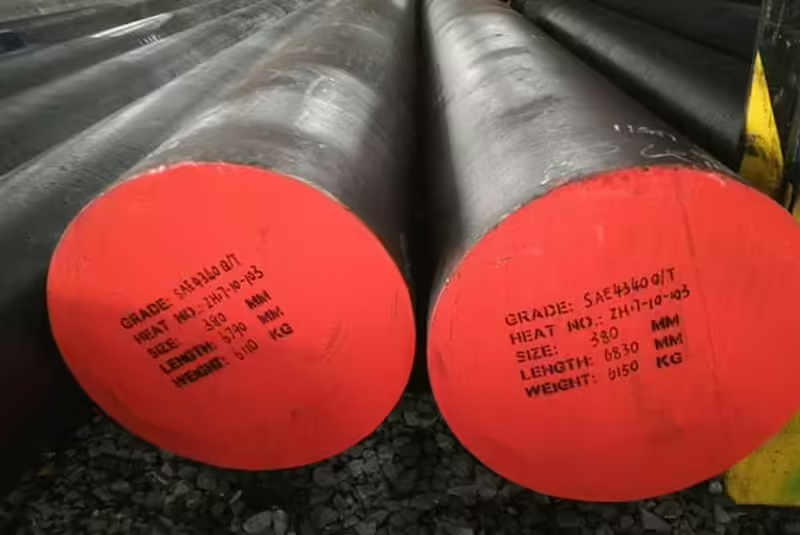
Metal forging is one of the oldest and most reliable methods of shaping metal into high-strength, durable components used in various industries. The ability to forge metals allows manufacturers to create parts that withstand extreme stress, wear, and environmental factors.
This blog explores the key processes of metal forging, the types of metals commonly used, their applications across different industries, and how to choose the best forging method for specific needs.
Key Metal Forging Processes
Open Die Forging
Open die forging, also known as free forging, involves shaping metal between flat or contoured dies that do not enclose the material completely. The metal is continuously hammered or pressed until it reaches the desired shape.
Advantages:
- Suitable for large components
- Improved material strength and grain structure
- Cost-effective for low-volume production
Common Applications:
- Shafts and rods for industrial machinery
- Heavy equipment parts
- Large-scale aerospace and shipbuilding components
Closed Die Forging
Closed die forging, or impression die forging, uses a mold to shape the metal. The metal is placed between two dies, which enclose it, and then compressed to take the shape of the cavity.
Advantages:
- High precision and repeatability
- Minimal material waste
- Superior mechanical properties
Common Applications:
- Automotive engine components
- Aerospace structural parts
- Hand tools and hardware
Cold Forging
Cold forging is performed at or near room temperature, applying high pressure to deform the metal without heating. This process is ideal for creating high-strength components with excellent surface finishes.
Advantages:
- Increased material strength due to work hardening
- High dimensional accuracy
- Reduced energy consumption compared to hot forging
Common Applications:
- Fasteners such as bolts and nuts
- Bearings and gears
- Small automotive and electronic components
Hot Forging
Hot forging involves heating the metal above its recrystallization temperature to increase its malleability before shaping it under high pressure.
Advantages:
- Suitable for complex shapes
- Reduced material strain and improved flow
- Enhanced ductility and impact resistance
Common Applications:
- Heavy machinery components
- Railway parts
- Structural steel components
Roll Forging
Roll forging is a specialized forging process that reduces cross-sectional area while increasing length by passing the metal through rotating rolls.
Advantages:
- High production efficiency
- Uniform grain structure
- Reduced machining requirements
Common Applications:
- Axles and connecting rods
- Agricultural equipment parts
- Railway track components
Commonly Forged Metals and Their Properties
| Metal Type | Strength | Ductility | Korrosionsbeständigkeit | Common Applications |
|---|---|---|---|---|
| Stahl | Hoch | Mäßig | Mäßig | Automotive, construction, machinery |
| Rostfreier Stahl | Hoch | Mäßig | Hoch | Medical equipment, food processing, aerospace |
| Aluminum | Mäßig | Hoch | Hoch | Aerospace, automotive, electrical |
| Copper | Niedrig | Hoch | Very High | Electrical components, plumbing, artistic works |
| Titanium | Very High | Mäßig | Very High | Aerospace, medical implants, marine |
Anwendungen von Forged Metals
Autoindustrie
Forged metals are widely used in the automotive sector due to their strength and impact resistance. Critical components such as crankshafts, gears, and connecting rods are often forged to withstand high stress and long-term wear.
Luft- und Raumfahrtindustrie
The aerospace industry relies on forged metals for critical components like landing gear, turbine blades, and structural components that must endure extreme conditions while maintaining lightweight properties.
Construction and Infrastructure
Forged steel and iron are commonly used in construction for bridges, railways, and high-rise buildings, where structural integrity is paramount.
Oil and Gas Industry
Forged metals are essential for drilling equipment, pipelines, and pressure vessels that must withstand extreme temperatures, high pressures, and corrosive environments.
Medical Equipment
The medical industry uses forged stainless steel and titanium for surgical instruments, orthopedic implants, and prosthetic devices due to their strength and biocompatibility.
Choosing the Right Forging Method
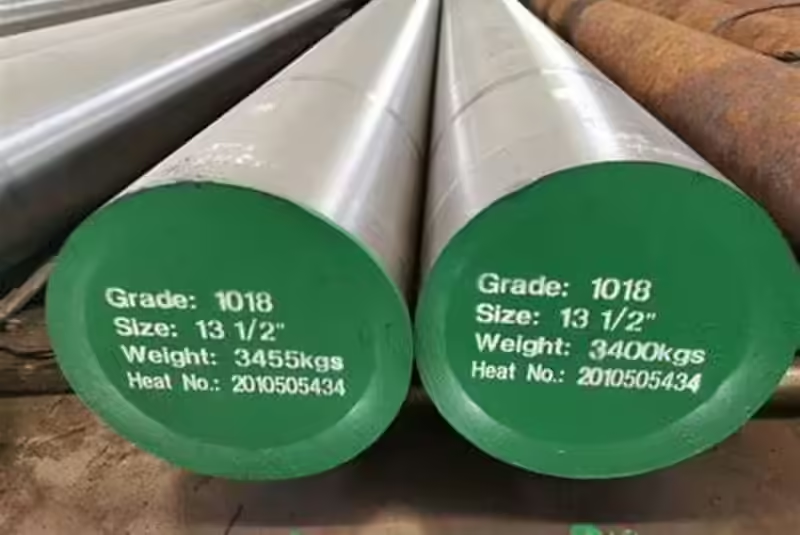
Consider the Material Properties
Each metal has different properties that influence its forgeability. For example, titanium requires higher temperatures and specialized equipment, whereas steel is highly versatile.
Evaluate Production Volume
For low-volume or custom components, open die forging is cost-effective. High-volume production benefits from closed die forging due to its precision and repeatability.
Factor in Component Complexity
Hot forging is better suited for complex shapes, while cold forging is ideal for precision parts with high surface quality.
Assess Strength and Durability Requirements
Industries requiring the highest strength components, such as aerospace and automotive, often use hot or closed die forging for maximum mechanical properties.
Schlussfolgerung
Forging metals is a time-tested process that enhances material strength, durability, and performance. The choice of forging method depends on factors such as material type, production volume, and application requirements.
From automotive parts to aerospace components and medical implants, forged metals play a crucial role in modern industries. By understanding different forging techniques, manufacturers can optimize production and achieve superior component performance. If you need more information, please feel free to kontaktieren Sie uns.
FAQ
What are the benefits of using forge metals in manufacturing?
Forge metals offer superior strength, durability, and resistance to wear and fatigue, making them ideal for high-stress applications in industries such as automotive, aerospace, and construction.
How does the forge metals process improve material properties?
The forge metals process refines the grain structure of the material, eliminating internal voids and defects, which enhances mechanical strength, toughness, and resistance to impact.
What are the most commonly used forge metals?
Common forge metals include steel, stainless steel, aluminum, titanium, and copper. Each metal offers unique properties suitable for various applications, from aerospace to medical implants.
What is the difference between hot and cold forge metals processes?
Hot forge metals processes involve heating the metal above its recrystallization temperature to improve malleability, while cold forge metals processes shape the material at room temperature, increasing strength through work hardening.
Why are forge metals preferred over casting in industrial applications?
Forge metals provide greater structural integrity, improved grain flow, and higher mechanical properties than cast metals, making them better suited for demanding applications such as automotive engine components and aerospace parts.
How do I choose the right forge metals method for my project?
The selection of a forge metals method depends on factors such as material type, production volume, required precision, and application demands. Open die forging is ideal for large components, while closed die forging ensures high accuracy for mass production.