P20 steel is still one of the most familiar mold steels in plastic tooling, not because it is the hardest steel available, but because it gives mold makers a practical balance of machinability, toughness, polishability, repairability, and cost control.
If you are comparing P20 steel plate, checking a P20 steel data sheet, or wondering whether P20 steel vs 4140 is a fair comparison, this guide explains what really matters before choosing a material for mold making.
Inhaltsverzeichnis
What Is P20 Steel?

P20 steel is a low-alloy mold steel commonly used for plastic injection molds, mold bases, cavities, cores, tooling plates, and some zinc die-casting dies.
It belongs to the family of mold and die steels used when a tool needs moderate hardness, good machinability, stable performance, and practical production cost.
The ASTM page for A681 tool steels explains that this specification covers wrought alloy tool steel products such as bar, plate, sheet, strip, rod, wire, and forgings, and that material selection depends on design, service conditions, and desired properties.
That last point is important. Mold steel selection is never just about one number on a data sheet.
Why Is It So Common in Mold Making?
P20 steel became common because many plastic molds do not need the highest possible hardness. They need a material that can be machined efficiently, polished to a usable surface finish, repaired when needed, and supplied in a condition that reduces process risk.
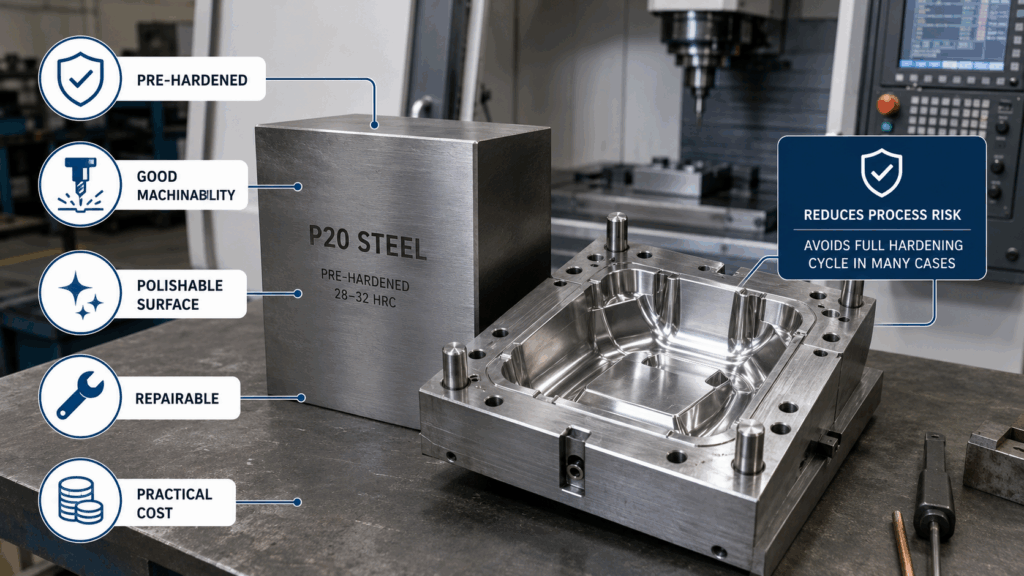
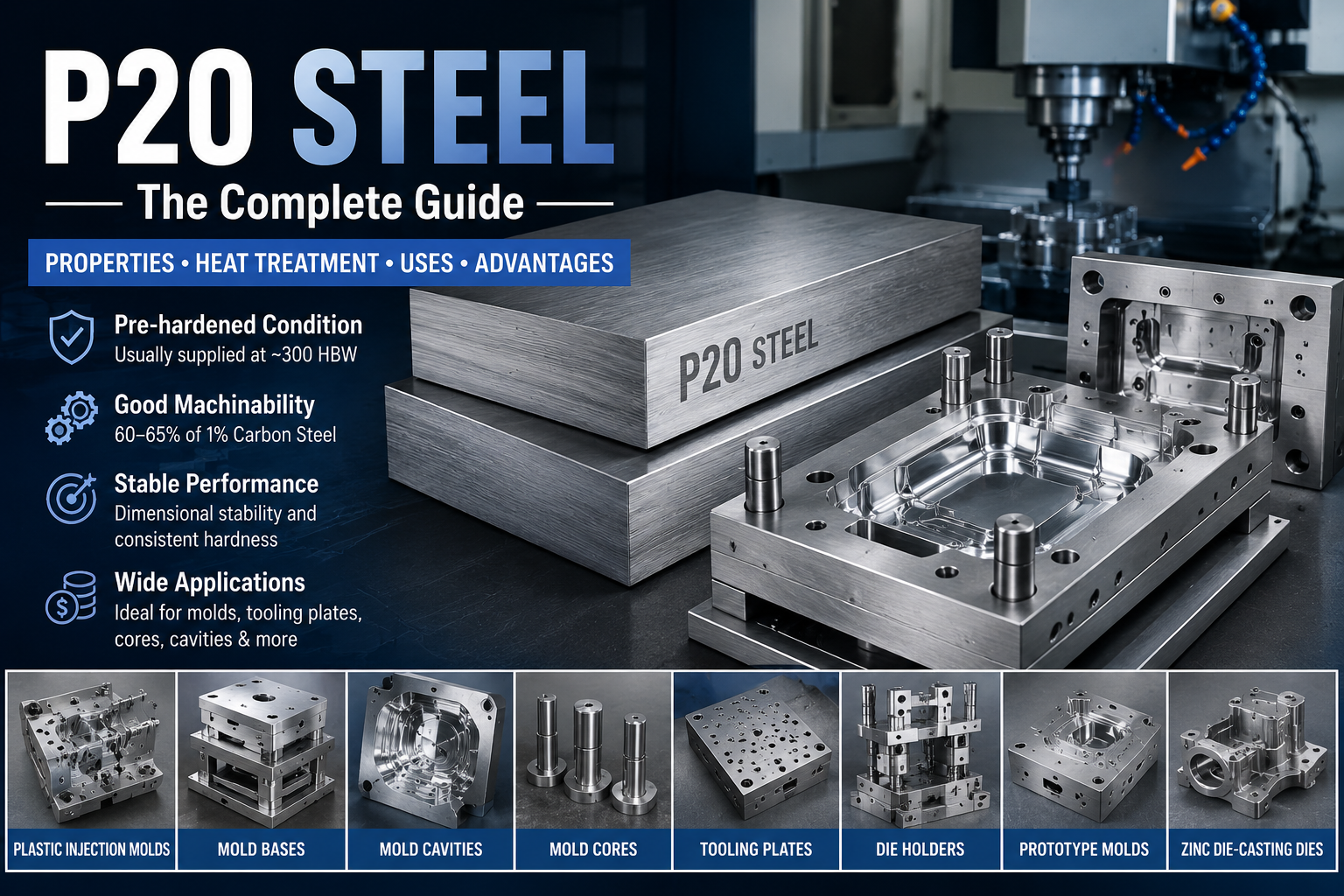
ASM International’s Alloy Digest page for AISI Type P20 mold and die steel describes AISI Type P20 as a chromium-molybdenum tool steel usually supplied in the prehardened condition, about 300 Brinell, so the cavity can be machined and the mold or die placed directly in service.
That is one big reason mold shops like it. If the steel arrives pre-hardened, the shop can often machine the cavity without sending the finished tool through a full hardening cycle afterward.
P20 Steel Composition Explained
A typical P20 steel composition includes carbon, chromium, molybdenum, manganese, and silicon. These elements work together to support strength, hardenability, toughness, and mold-making performance.
AZoM’s technical article on P20 tool steel lists a typical composition range that includes carbon, manganese, silicon, chromium, and molybdenum. It also identifies P20 as a low-carbon mold steel under UNS T51620.
Here is a simple way to understand the chemistry:
| Element | Warum es wichtig ist |
|---|---|
| Kohlenstoff | Supports hardness and strength |
| Chrom | Helps hardenability and wear resistance |
| Molybdän | Improves strength and hardenability |
| Mangan | Supports strength and processing response |
| Silizium | Helps strengthen the steel matrix |
| Low impurity control | Supports better toughness, machining, and polishing consistency |
For buyers, chemistry should not be checked only for curiosity. It matters when comparing P20 steel equivalent grades from different suppliers or standards.
P20 Steel Properties Buyers Often Search For
The most searched P20 steel properties are usually hardness, yield strength, machinability, heat treatment behavior, polishability, and mold application range.
A practical P20 steel data sheet should help answer these questions:
- Is the material supplied pre-hardened?
- What hardness range does the supplier guarantee?
- Is it suitable for plastic injection molds?
- Can it be polished for the required plastic surface?
- Can it be welded or repaired?
- Is ultrasonic testing available for thick plate or blocks?
- Is the plate size suitable for the mold design?
- What equivalent grade is being supplied?
A data sheet is useful, but it does not replace application judgment. The same material can behave differently depending on size, hardness condition, machining depth, surface finish requirements, and molding resin.
P20 Steel Hardness and Pre-Hardened Condition
P20 steel is often supplied in a pre-hardened condition. That means the steel has already been heat treated to a usable hardness range before the mold maker starts machining.
Hudson Tool Steel’s technical page for P20 mold steel states that P20 is typically sold in the pre-hardened condition at approximately 300 HBW. It also lists machinability at 60–65% of a 1% carbon steel.
In mold shops, this pre-hardened supply condition can save time. It reduces the need for hardening after the cavity is already machined, which can help reduce distortion risk and process steps.

However, buyers should not assume every supplier’s material has the same hardness. P20 steel hardness HRC can vary by grade variant, plate thickness, mill practice, and delivery condition.
P20 Steel Machinability: Why Mold Shops Like It
Good machinability is one of the main reasons P20 steel remains popular.
Plastic mold cavities often require CNC milling, drilling, EDM, polishing, texturing, cooling channel work, and finishing. A mold steel that machines predictably can reduce tool wear, machining time, and finishing difficulty.
P20 steel is not selected only because it is “easy.” It is selected because it offers workable hardness while still allowing mold shops to machine cavity geometry efficiently.
For deep cavities, large molds, or heavy machining removal, stress control still matters. Rough machining, stress relieving, and staged machining may be needed when dimensional stability is important.
Heat Treatment and Hardening: Does P20 Steel Need It?
In many mold-making projects, P20 steel does not need full hardening after machining because it is commonly supplied pre-hardened.
That is one of the material’s biggest advantages. The mold maker can machine the cavity, polish the surface, finish the tool, and put it into service without a separate hardening cycle in many normal applications.
AZoM notes that P20 tool steels can be tempered at 482–593°C to reach a Rockwell C hardness range of about 37 to 28, depending on treatment. That shows heat treatment can change hardness, but buyers should follow supplier guidance rather than applying generic cycles blindly.

For large molds or heavy machining, stress relieving may be used after rough machining. This can help reduce movement before finishing.
P20 Steel Equivalent Grades
P20 steel equivalent searches are common because buyers often compare ASTM, DIN, UNS, Chinese, Japanese, and supplier-specific grades.
AZoM lists equivalent references for P20 as ASTM A681, UNS T51620, and DIN 1.2330. In real purchasing, buyers may also see related mold steel names such as 1.2311 or 3Cr2Mo depending on market and supplier practice.
The key warning is simple: equivalent does not always mean identical.
Before replacing one grade with another, buyers should compare:
- chemical composition
- hardness condition
- pre-hardened range
- plate thickness
- ultrasonic testing requirement
- polishing requirement
- heat treatment condition
- intended mold life
- resin type
- supplier certificate
This is especially important when ordering P20 steel plate for plastic molds where surface finish and internal soundness matter.
P20 Steel vs 4140: Are They the Same?
P20 steel vs 4140 is a common comparison, but they should not be treated as the same material.
4140 is a chromium-molybdenum alloy engineering steel. It is widely used for shafts, gears, machinery parts, bolts, and components that need strength and toughness. P20 is a mold steel developed around tooling needs such as machinability, cavity finishing, moderate hardness, and mold service behavior.
| Factor | P20 Steel | 4140 Stahl |
|---|---|---|
| Main category | Mold steel / tool steel | Cr-Mo alloy engineering steel |
| Common use | Plastic molds, mold plates, cavities, cores | Shafts, gears, bolts, machinery parts |
| Supply condition | Often pre-hardened for mold making | Often annealed, normalized, or quenched and tempered |
| Mold surface focus | Better suited for cavity polishing and finishing | Not mainly selected for mold surface finish |
| Typical buyer concern | Machining, polishing, heat treatment, mold life | Strength, toughness, mechanical load |
| Best fit | Plastic injection molds and tooling | General engineering components |
4140 can be useful in many mechanical applications, but it should not be used as a simple substitute for P20 steel without checking hardness, polishability, machining behavior, and mold performance requirements.
What Is P20 Steel Used For?
P20 steel is mainly used in mold making and tooling applications where moderate hardness and good machining behavior are more important than maximum wear resistance.
Common uses include:
- plastic injection molds
- mold bases
- mold cavities
- mold cores
- tooling plates
- die holders
- prototype molds
- medium-volume production molds
- zinc die-casting dies
- plastic part tooling with moderate wear demand
The Wikipedia article on injection moulding explains that molds are expensive to manufacture and that typical molds can be made from hardened steel, pre-hardened steel, aluminum, or beryllium-copper alloy depending on cost and expected product life cycle. This helps explain why pre-hardened mold steels are often used when balancing cost and performance.

P20 Steel Price: Why Quotes Can Be So Different
P20 steel price can vary a lot. That does not always mean one supplier is simply expensive and another is cheap.
Important cost factors include:
- plate thickness
- block size
- pre-hardened condition
- cut-to-size service
- surface milling or grinding
- ultrasonic testing
- equivalent grade
- mill origin
- stock availability
- delivery time
- quantity
- export packing
- certification requirements
For a mold shop, the cheapest P20 steel quote may not be the lowest-cost option if it causes machining trouble, delivery delays, poor surface quality, or missing documents.
When P20 Steel Is a Good Choice—and When It Is Not
P20 steel is a good choice when the mold needs practical performance, good machinability, moderate wear resistance, and reliable finishing.
It is often suitable for:
- general plastic injection molds
- medium-size and large mold cavities
- mold bases and cores
- prototype and medium-volume molds
- plastic parts without severe abrasive fillers
- tools that need repairability and machining flexibility
It may not be the best choice for:
- highly corrosive plastics
- glass-filled plastics with severe abrasion
- very high-volume molds needing higher wear resistance
- transparent parts requiring extreme mirror polishing
- high-temperature die work
- molds requiring very high hardness
- applications where stainless mold steel is needed
A research paper on automatic polishing of plastic injection molds notes that polishing is important when surface roughness is critical or a mirror effect is required for transparent parts. That is a good reminder that mold surface requirements can influence steel choice, finishing process, and cost.
How to Choose a P20 Steel Supplier
A good P20 steel supplier should do more than quote a price per kilogram.
Before ordering, buyers should ask:
1.What is the guaranteed hardness range?
2.Is the material supplied pre-hardened?
3.Can the supplier provide a material certificate?
4.Is ultrasonic testing available for thick plate or blocks?
5.What equivalent grade is being supplied?
6.Can the supplier provide cut-to-size service?
7.Is the surface milled, ground, or black?
8.What thickness and width are in stock?
9.What is the expected delivery time?
10.Can the supplier support export packing?
For mold making, supplier control matters because the steel affects machining, polishing, lead time, and final mold reliability.
Schlussfolgerung
P20 steel remains a good mold steel because it solves a practical manufacturing problem: it gives mold makers enough hardness for many plastic molds while staying machinable, polishable, repairable, and cost-effective.
It is not always the best steel for every mold. But when the project needs a balanced material for plastic injection molds, mold plates, cavities, cores, and tooling, P20 steel is still common for good reasons. The smart approach is to check the data sheet, equivalent grade, hardness condition, machinability, heat treatment needs, price factors, and supplier reliability before ordering.
FAQ
What is P20 steel?
P20 steel is a low-alloy mold steel widely used for plastic injection molds, mold cavities, cores, tooling plates, and zinc die-casting dies.
Is P20 steel still good for mold making?
Yes. P20 steel is still a practical mold steel when the project needs machinability, toughness, polishability, repairability, and moderate hardness rather than maximum wear resistance.
What is P20 steel hardness?
P20 steel is often supplied pre-hardened around 300 HBW, with many suppliers offering ranges around the high-20s to low-30s HRC depending on condition.
Is P20 steel easy to machine?
Yes. P20 steel is known for good machinability in the pre-hardened condition, which is one reason mold shops continue to use it.
What is P20 steel equivalent to?
Common references include ASTM A681, UNS T51620, and DIN 1.2330, but buyers should compare chemistry, hardness, delivery condition, and supplier documentation before substitution.
Is P20 steel the same as 4140?
No. 4140 is a Cr-Mo alloy engineering steel, while P20 steel is a mold steel designed for tooling and plastic mold applications.
Does P20 steel need heat treatment?
Often no, because it is commonly supplied pre-hardened. Stress relieving may still be used after heavy machining, depending on mold size and project requirements.
Does P20 steel rust?
Yes. P20 steel is not stainless steel. It needs proper storage, surface protection, maintenance, or coating when used in humid or corrosive environments.