
Willkommen auf Mein Blog!
Bevor wir uns mit den Inhalten befassen, würde ich mich freuen, wenn Sie mich auf meinen Social-Media-Plattformen begleiten, wo ich weitere Erkenntnisse teile, mich mit der Community auseinandersetze und Updates poste. So können Sie mit mir in Kontakt treten:
Facebook:https://www.facebook.com/profile.php?id=100087990137347
LinkedIn:https://www.linkedin.com/company/89825762/admin/dashboard/
YouTube:www.youtube.com/@carbonsteelsupply-kj9lw
TikTok:www.tiktok.com/@carbonsteelsupply
Jetzt geht es los auf unsere gemeinsame Reise Ich hoffe, dass Sie die Inhalte hier aufschlussreich, ansprechend und wertvoll finden.
Einführung

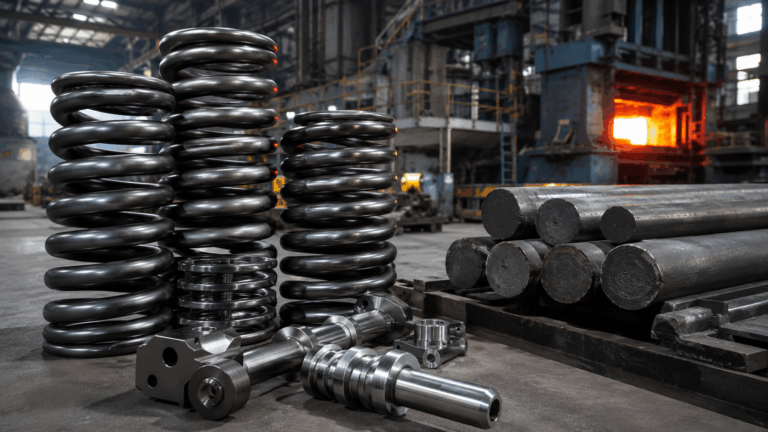
Spring steel is a versatile material, widely used in various industries for its unique set of properties. Known for its high elasticity, resilience, and tensile strength, spring steel is essential in applications requiring reliable durability and flexibility. This blog delves into the core spring steel characteristics, examining how they make this material ideal for various applications. Whether you’re involved in manufacturing, automotive, or heavy machinery, understanding these characteristics can help you choose the right material for your project.
The Composition of Spring Steel
The composition of spring steel is a carefully balanced recipe that determines its ultimate performance. Kohlenstoff emerges as a primary alloying element, contributing significantly to the steel’s hardness and elasticity. However, the symphony of properties is not solely orchestrated by carbon. Other elements, such as manganese, silicon, chromium, and molybdenum, are meticulously added to enhance specific properties. These elements work in harmony to improve the steel’s strength, toughness, wear resistance, and resistance to corrosion. The precise combination of these elements allows spring steel to adapt to a wide range of demanding applications.
Key Characteristics of Spring Steel
- High Elasticity: Spring steel’s most defining characteristic is its exceptional elasticity. This property allows the material to undergo significant deformation and then return to its original shape with remarkable precision. It is this ability to spring back that makes spring steel the ideal choice for applications requiring repeated flexing and stress.
- Excellent Fatigue Strength: Spring steel exhibits outstanding fatigue strength, enabling it to withstand countless cycles of stress without succumbing to fatigue failure. This characteristic is crucial in applications where components are subjected to continuous vibration and cyclic loading.
- Good Wear Resistance: Many spring steel alloys possess excellent wear resistance, making them suitable for applications involving friction and abrasion. This property is particularly important in components that experience sliding contact or rubbing against other surfaces.
- High Tensile Strength: Spring steel boasts a high tensile strength, which is the maximum stress a material can withstand before breaking. This characteristic ensures that spring steel components can handle significant loads without compromising their structural integrity.
- Excellent Corrosion Resistance: Certain spring steel alloys, such as those containing chromium and nickel, offer superior corrosion resistance. This property is essential in applications where the steel may be exposed to harsh environments, such as marine or industrial settings.
Applications of Spring Steel
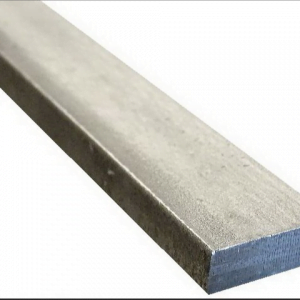
Spring steel finds extensive use in a multitude of industries, each demanding its unique set of properties:
- Automotive: Leaf springs, coil springs, and valve springs are essential components of automotive suspension systems. Spring steel’s ability to absorb shock and vibration, as well as its durability, make it an ideal choice for these critical components.
- Aerospace: Spring steel is used in landing gear, control surfaces, and other critical components of aircraft. Its lightweight, high-strength properties, and resistance to fatigue are essential for ensuring the safety and reliability of aerospace structures.
- Industrial Machinery: It is used in a wide range of industrial machinery, including compressors, pumps, and conveyors. Spring steel’s ability to withstand high loads, resist wear, and maintain its shape under harsh conditions makes it a reliable choice for these applications.
- Electrical Appliances: Spring steel is employed in electrical appliances like switches, relays, and clips. Its electrical conductivity, good wear resistance, and ability to maintain precise dimensions are essential for the reliable operation of these devices.
- Medical Devices: It is used in medical devices such as surgical instruments and orthopedic implants. Spring steel’s biocompatibility, corrosion resistance, and ability to be precisely shaped and formed make it suitable for these critical applications.
Factors Affecting the Performance of Spring Steel
Several factors can influence the performance of spring steel, including:
- Heat Treatment: Heat treatment processes, such as quenching and tempering, play a crucial role in fine-tuning the microstructure and properties of spring steel. These processes can significantly affect the steel’s hardness, strength, and ductility.
- Manufacturing Process: The manufacturing process, including cold working and hot working, can influence the microstructure and properties of the steel. Cold working can increase the strength and hardness of the steel, while hot working can improve its ductility and toughness.
- Surface Finish: The surface finish of spring steel can impact its fatigue life and corrosion resistance. A smooth surface finish can reduce stress concentrations and improve the fatigue life of the steel, while a protective coating can enhance its corrosion resistance.
Comparison Table: Federstahl Grades and Characteristics
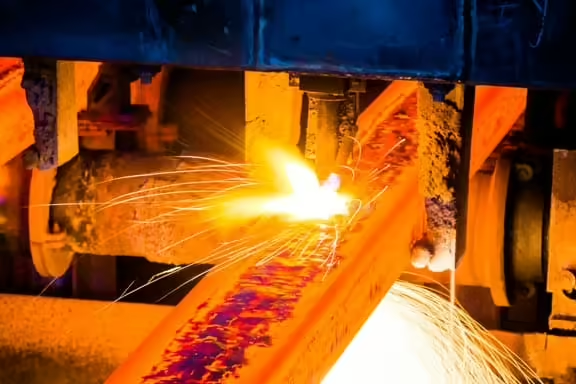
Below is a comparison of some common spring steel grades, focusing on key spring steel characteristics and their suitable applications:
| Grade | Elasticity | Zugfestigkeit | Hardness | Korrosionsbeständigkeit | Best Applications |
|---|---|---|---|---|---|
| AISI 1074 | Hoch | Mäßig | Medium | Niedrig | Automotive springs, washers |
| AISI 1095 | Very High | Hoch | Hoch | Niedrig | Blades, cutting tools, agricultural parts |
| 5160 | Mäßig | Very High | Hoch | Mäßig | Leaf springs, tools for heavy machinery |
| 301 | Mäßig | Mäßig | Medium | Hoch | Electrical components, connectors |
| 17-7PH | Hoch | Mäßig | Medium | Very High | Aerospace components, high-end tools |
Schlussfolgerung
Spring steel’s unique combination of elasticity, tensile strength, and durability makes it an invaluable material across industries. From automotive parts to aerospace components, the wide range of spring steel characteristics allows it to meet diverse needs with efficiency and cost-effectiveness. Understanding these characteristics can help in selecting the appropriate grade for specific applications, ensuring both performance and longevity.
When choosing spring steel, it’s essential to consider factors such as the environment, application requirements, and cost constraints. By doing so, you can leverage the best properties of spring steel to enhance your project’s success and durability.
FAQ
What are the most important spring steel characteristics?
The most critical characteristics of spring steel include high elasticity, tensile strength, fatigue resistance, and durability. These properties make it ideal for applications that involve repeated bending or stress cycles.
How does spring steel differ from regular steel?
Spring steel differs from regular steel in its elasticity and ability to return to its original shape after deformation. This feature is achieved through specific heat treatments and alloying processes that give spring steel its unique properties.
Which industries benefit most from spring steel characteristics?
Industries such as automotive, aerospace, construction, agriculture, and electronics benefit greatly from spring steel due to its durability, flexibility, and strength. These characteristics make it suitable for components that endure frequent use or heavy loads.
Is spring steel suitable for outdoor applications?
Some spring steel grades offer moderate corrosion resistance and can be used in outdoor applications, but additional coatings or treatments may be needed to improve durability in harsh environments.
How can I choose the right grade of spring steel for my project?
To select the appropriate spring steel grade, consider factors such as tensile strength, corrosion resistance, and the specific demands of your application. Consulting with a materials specialist or referring to a comparison table can aid in making the right choice.
Can spring steel characteristics be customized for specific applications?
Yes, spring steel characteristics can be customized by adjusting its chemical composition and through different heat treatment processes. These adjustments allow manufacturers to enhance specific characteristics like hardness, elasticity, and corrosion resistance, making spring steel highly adaptable for various industries and specialized applications.
How do high-carbon and low-carbon spring steel characteristics differ?
The spring steel characteristics of high-carbon and low-carbon types differ primarily in hardness and flexibility. High-carbon spring steel has greater hardness and tensile strength, making it ideal for heavy-duty applications like cutting tools and industrial springs. Low-carbon spring steel is more flexible and easier to shape, suitable for applications that require high flexibility and malleability.
Are there sustainable options for materials with spring steel characteristics?
Yes, sustainable options are available for materials with spring steel characteristics. Spring steel can be made from recycled steel, reducing its environmental impact. Furthermore, because it is durable and long-lasting, using spring steel results in less frequent replacements, supporting sustainable practices across industries that rely on durable materials.