
An Engineer’s Guide to Section Steel: H-Beam vs. I-Beam
Раздел Сталь: The Backbone of Modern Construction
Behind every magnificent building, every bridge spanning a river, and every vast industrial facility lies a robust skeleton composed of structural steel sections. These steel products, defined by their specific cross-sectional shapes, are the core load-bearing components in modern engineering. They support our world with their exceptional strength, toughness, and reliability.
Among the many types of section steel, H-beams and I-beams are the most widely used due to their efficient mechanical properties and broad applicability. Their names derive from their cross-sections, which resemble the letter “H” and the letter “I,” respectively. Despite their similar appearance, they possess fundamental differences that are critical in engineering applications. Mistaking one for the other is a common but potentially hazardous error, which can lead to unsafe structures or unnecessary project costs.
This guide is written specifically for engineers, architects, structural designers, and project procurement managers. It aims to provide an authoritative engineering comparison of H-beams and I-beams, delving into their distinct geometries, mechanical properties, manufacturing processes, and application scenarios to empower correct, safe, and cost-effective decisions in both design and procurement.
Among the many types of section steel, H-beams and I-beams are the most widely used due to their efficient mechanical properties and broad applicability. Their names derive from their cross-sections, which resemble the letter “H” and the letter “I,” respectively. Despite their similar appearance, they possess fundamental differences that are critical in engineering applications. Mistaking one for the other is a common but potentially hazardous error, which can lead to unsafe structures or unnecessary project costs.
This guide is written specifically for engineers, architects, structural designers, and project procurement managers. It aims to provide an authoritative engineering comparison of H-beams and I-beams, delving into their distinct geometries, mechanical properties, manufacturing processes, and application scenarios to empower correct, safe, and cost-effective decisions in both design and procurement.
H-Beam vs. I-Beam: The Authoritative Engineering Comparison
For professionals, distinguishing between H-beams and I-beams is not a matter of semantics or regional terminology; it is a matter of understanding structural mechanics. Their distinct forms dictate their unique performance characteristics and their irreplaceable roles in construction.
Structural Comparison Between H-Shaped Steel and I-Shaped Steel
The performance of a beam is dictated by its geometry. The key components are the flanges—the horizontal elements at the top and bottom—and the web, the vertical element that connects them.

I-Beam (also known as Universal Beam or Rolled Steel Joist – RSJ): An I-beam’s cross-section resembles a capital “I.” Its most defining feature is that the inner surfaces of its flanges are tapered, meaning they are thicker near the web and thinner toward the edges, often with a slope of 1:6.1 Additionally, its flanges are relatively narrow compared to the overall height of the beam.

H-Beam (also known as Wide Flange Beam or Universal Column – UC): An H-beam’s cross-section looks like a capital “H.” Its defining characteristics are that its inner and outer flange surfaces are parallel to each other, with no taper.1 Most importantly, an H-beam’s flanges are significantly
wider than those of an I-beam of a comparable height.
wider than those of an I-beam of a comparable height.
Mechanical Performance Under Load: Bending vs. Torsion
These geometric differences lead directly to a vast disparity in mechanical performance, which is the most critical factor in structural design.
● Bending (Flexural) Performance: Both beams are highly efficient at resisting bending forces applied within the plane of the web (e.g., a vertical load on a horizontal beam). In this scenario, the flanges resist the vast majority of the bending moment, while the web resists the shear forces. 14 The I-beam’s design, which concentrates material in the flanges, makes it a very economical and effective choice for its primary role as a simple beam.
● Torsional & Lateral Performance (The Key Difference): This is the core engineering distinction. The I-beam’s narrow, tapered flanges give it very poor resistance to twisting (torsion) and lateral (sideways) forces. This is an inherent structural weakness; under torsional loading, an I-beam is prone to sectional warping. 1 In contrast, the H-beam’s wide, parallel flanges dramatically increase its moment of inertia about its weaker axis. This provides excellent lateral stiffness and superior resistance to torsional forces.
● Application Suitability: This mechanical principle is the foundation of proper structural selection. The I-beam is optimized to handle unidirectional loads and is best used as a beam. The H-beam, with its exceptional stability and strength in two directions, is perfectly suited for use as an axial-load column, which must resist buckling forces from any direction. It is also the superior choice for beams that may be subjected to complex, bi-axial, or torsional loads.
● Torsional & Lateral Performance (The Key Difference): This is the core engineering distinction. The I-beam’s narrow, tapered flanges give it very poor resistance to twisting (torsion) and lateral (sideways) forces. This is an inherent structural weakness; under torsional loading, an I-beam is prone to sectional warping. 1 In contrast, the H-beam’s wide, parallel flanges dramatically increase its moment of inertia about its weaker axis. This provides excellent lateral stiffness and superior resistance to torsional forces.
● Application Suitability: This mechanical principle is the foundation of proper structural selection. The I-beam is optimized to handle unidirectional loads and is best used as a beam. The H-beam, with its exceptional stability and strength in two directions, is perfectly suited for use as an axial-load column, which must resist buckling forces from any direction. It is also the superior choice for beams that may be subjected to complex, bi-axial, or torsional loads.
From Mill to Site: Manufacturing and Fabrication
The practical aspects of manufacturing and on-site assembly also differ significantly between the two profiles.
● Manufacturing Process: I-beams are typically produced by rolling steel through a relatively simple set of horizontal rollers. The production of H-beams is more complex, requiring a “universal mill” that employs both horizontal and vertical rollers simultaneously to form the wide, parallel flanges. Alternatively, very large H-beams can be fabricated by welding three separate steel plates together into the “H” shape.
● Connection Convenience: A significant practical advantage of the H-beam is its parallel flange surfaces. This flat profile provides a perfect seating surface for high-strength bolted connections, making them simple, fast, and reliable. The tapered flanges of an I-beam complicate bolted connections, often requiring the use of special tapered washers to ensure the bolt head and nut are properly seated, which can increase labor time and complexity.
● Connection Convenience: A significant practical advantage of the H-beam is its parallel flange surfaces. This flat profile provides a perfect seating surface for high-strength bolted connections, making them simple, fast, and reliable. The tapered flanges of an I-beam complicate bolted connections, often requiring the use of special tapered washers to ensure the bolt head and nut are properly seated, which can increase labor time and complexity.
Table 2.1: Engineering Showdown: H-Beam vs. I-Beam
| Feature | I-Beam | H-Beam |
| Cross-Section Shape | “I” shape, narrow flanges | “H” shape, wide flanges |
| Flange Inner Surface | Tapered | Parallel |
| Primary Load Performance | Bending (unidirectional load) | Bending, compression, torsion (bi-directional load) |
| Torsional Resistance | Poor | Excellent |
| Connection Convenience | More complex due to taper | Simple and efficient due to parallel surfaces |
| Strength-to-Weight Ratio | Good | Excellent, more optimized section |
| Core Application | Beams | Columns, Beams, Truss Members |
The Qilu Steel Structural Portfolio: Certified Beams and Columns
Qilu Steel supplies a full range of H-beams and I-beams manufactured in strict accordance with the latest Chinese national standards, ensuring certified quality and precise dimensions for every project. Our products comply with GB/T 11263-2017 (Hot rolled H and cut T section steel) and GB/T 706-2016 (Hot rolled section steel), providing a verifiable guarantee of safety and performance.21 Adherence to these documented standards offers engineers and procurement managers the assurance that the materials meet stringent, verifiable quality control benchmarks.

H-Beams: Classifications and Specifications
In line with standard industry practice, H-beams are categorized into three main series based on the ratio of their height to flange width, with each series optimized for specific structural roles.
●HW (Wide Flange H-beam): Characterized by a height and flange width that are nearly equal. This square-like profile provides maximum stability, making it the primary choice for columns in steel structures and for steel-core columns (SRC) in reinforced concrete frames.
●HM (Medium Flange H-beam): The ratio of height to flange width is approximately 1.33 to 1.75. This is a versatile section that can be used as a frame column or as a heavy-duty frame beam, especially in structures subject to dynamic loads like equipment platforms.
●HN (Narrow Flange H-beam): The ratio of height to flange width is greater than or equal to 2. This section is primarily used for beams, where its properties are superior to those of a standard I-beam.
●HM (Medium Flange H-beam): The ratio of height to flange width is approximately 1.33 to 1.75. This is a versatile section that can be used as a frame column or as a heavy-duty frame beam, especially in structures subject to dynamic loads like equipment platforms.
●HN (Narrow Flange H-beam): The ratio of height to flange width is greater than or equal to 2. This section is primarily used for beams, where its properties are superior to those of a standard I-beam.
Core Grades: The mainstream grades for these sections are Q235B and Q355B. Q235B offers an excellent balance of performance and economy for a wide range of general building and engineering structures. Q355B provides higher yield strength and is specified for structures with greater load-bearing requirements, such as large-span bridges and heavy industrial plants.

I-Beams: The Economical Choice for Beam Applications
We provide a complete range of standard and light-duty I-beams that conform to GB/T 706-2016. These sections represent a highly cost-effective solution for traditional beam structures where the primary load is unidirectional bending, such as in floor joists and simple support beams.
Table 2.2: H-Beam Specifications & Applications (HW, HM, HN Series)
| Model ID | Common Grades (GB Standard) | Dimensions: H×B×t1×t2 (mm) | Theoretical Weight (kg/m) | Primary Application Recommendation |
| HW100x100 | Q235B / Q355B | 100×100×6×8 | 16.9 | Light-frame columns, support members |
| HW200x200 | Q235B / Q355B | 200×200×8×12 | 49.9 | Standard steel structure columns, composite columns (SRC) |
| HM300x200 | Q235B / Q355B | 300×200×9×14 | 67.3 | Heavy-duty frame beams, equipment platform columns |
| HN250x125 | Q235B / Q355B | 250×125×6×9 | 29.0 | Floor main beams, roof beams |
| HN400x200 | Q235B / Q355B | 400×200×8×13 | 65.4 | Large-span main beams, truss chord members |
Note: Theoretical weights are for reference; actual weights are governed by the standard.
Table 2.3: Common I-Beam Specifications & Applications
| Model No. | Dimensions: Height×Leg Width×Web Thickness (mm) | Theoretical Weight (kg/m) | Primary Application Recommendation |
| 10 | 100 × 68 × 4.5 | 11.2 | Light-duty platform beams, support members |
| 16 | 160 × 88 × 6.0 | 20.5 | Standard floor secondary beams, walkway beams |
| 20a | 200 × 100 × 7.0 | 27.9 | Medium-span secondary beams, equipment platform beams |
| 24b | 240 × 118 × 10.0 | 41.2 | Industrial bay secondary beams, crane rail supports |
| 30c | 300 × 130 × 13.0 | 57.4 | Medium-span main beams, frame beams |
| 40c | 400 × 146 × 14.5 | 80.1 | Large-span industrial main beams, bridge secondary beams |
Note: Suffixes a, b, c denote different flange width and thickness series for the same height. Theoretical weights are for reference.
Applications in Action: Where Qilu Steel Coils Excel
Qilu Steel’s coil products are deeply integrated into the vital arteries of the economy, providing a solid material foundation for a wide array of advanced manufacturing sectors.

High-Rise & Commercial Buildings
In steel frame structures, H-beams serve as the primary columns and girders, forming the building’s core load-bearing system. I-beams, channels, and angles are commonly used as secondary floor joists, purlins, and wall framing supports.
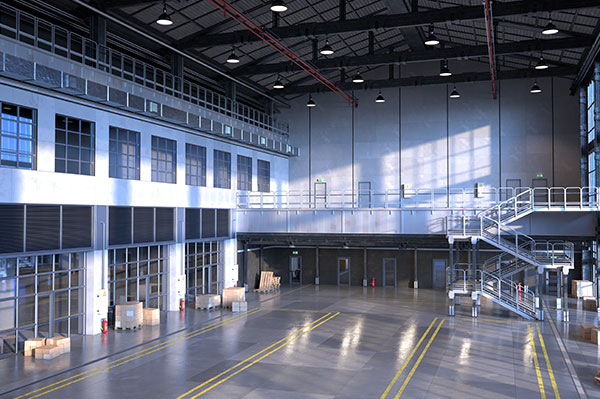
Industrial Plants & Platforms
For industrial buildings that require large, column-free open spaces, H-beams are the ideal choice for roof girders and crane runway beams. Their strength and stability also make them essential for constructing multi-level equipment platforms, operator walkways, and mezzanine structures.

Bridge Engineering
Heavy-section H-beams and custom-fabricated plate girders (which function as very large, welded I-beams) are the key materials used to construct the main longitudinal and transverse beams of highway, railway, and pedestrian bridges.

Foundation & Shoring
H-beams can be driven into the ground to act as foundation piles, providing a stable base for structures in poor soil conditions. In a related application, another crucial structural section—steel sheet pile—is widely used to build retaining walls for excavations, cofferdams, and water barriers.1 Our portfolio extends beyond just H- and I-beams to include these related structural products, offering a complete solution for complex projects.
Partner with Qilu Steel: Your Guarantee of Quality, Reliability, and Expertise
Choosing a supplier is choosing a partner. At Qilu Steel, the offering extends beyond steel products to a comprehensive promise of performance, dependability, and professional support.
● Certified Quality: The quality of the material is the foundation of a project’s success and safety. A rigorous quality control system is in place to ensure that every coil and beam leaving the facility meets or exceeds all relevant national and international standards. From raw material inspection to final product verification, a full-process quality monitoring system ensures consistent and reliable performance, with full material test certificates (MTCs) provided.
● Supply Chain Excellence: In a volatile global market, a stable and reliable supply chain is paramount to keeping projects on schedule. Leveraging strong resource integration capabilities and efficient logistics management, Qilu Steel is committed to ensuring the timely delivery of materials, helping clients navigate market fluctuations with confidence.
● Expert Consultation: The sales team consists not merely of sales professionals, but of knowledgeable material application consultants. Armed with the deep technical understanding demonstrated throughout these guides, they are equipped to comprehend specific project requirements, help find the optimal balance between performance and cost, and recommend the most suitable steel solutions.
Your next project deserves the highest quality materials and the most professional support.
Contact a Qilu Steel expert today for a personalized quote, material consultation.
● Supply Chain Excellence: In a volatile global market, a stable and reliable supply chain is paramount to keeping projects on schedule. Leveraging strong resource integration capabilities and efficient logistics management, Qilu Steel is committed to ensuring the timely delivery of materials, helping clients navigate market fluctuations with confidence.
● Expert Consultation: The sales team consists not merely of sales professionals, but of knowledgeable material application consultants. Armed with the deep technical understanding demonstrated throughout these guides, they are equipped to comprehend specific project requirements, help find the optimal balance between performance and cost, and recommend the most suitable steel solutions.
Your next project deserves the highest quality materials and the most professional support.
Contact a Qilu Steel expert today for a personalized quote, material consultation.