60Si2Mn is a silicon-manganese spring steel known for its high strength, good elastic limit, and reliable hardenability. It is commonly used in heavy-duty springs, railway vehicles, automotive suspension systems, tractors, machinery parts, and other components that need to withstand repeated stress and deformation.
For engineers and buyers, choosing 60Si2Mn is not only about selecting a steel grade. It is also about understanding how its chemical composition, heat treatment process, surface condition, and size range affect final performance. In this guide, we will break down the key properties of 60Si2Mn, explain common heat treatment methods, compare equivalent grades in different countries, and show where this spring steel is most commonly used.
Table of Contents
What is 60Si2Mn
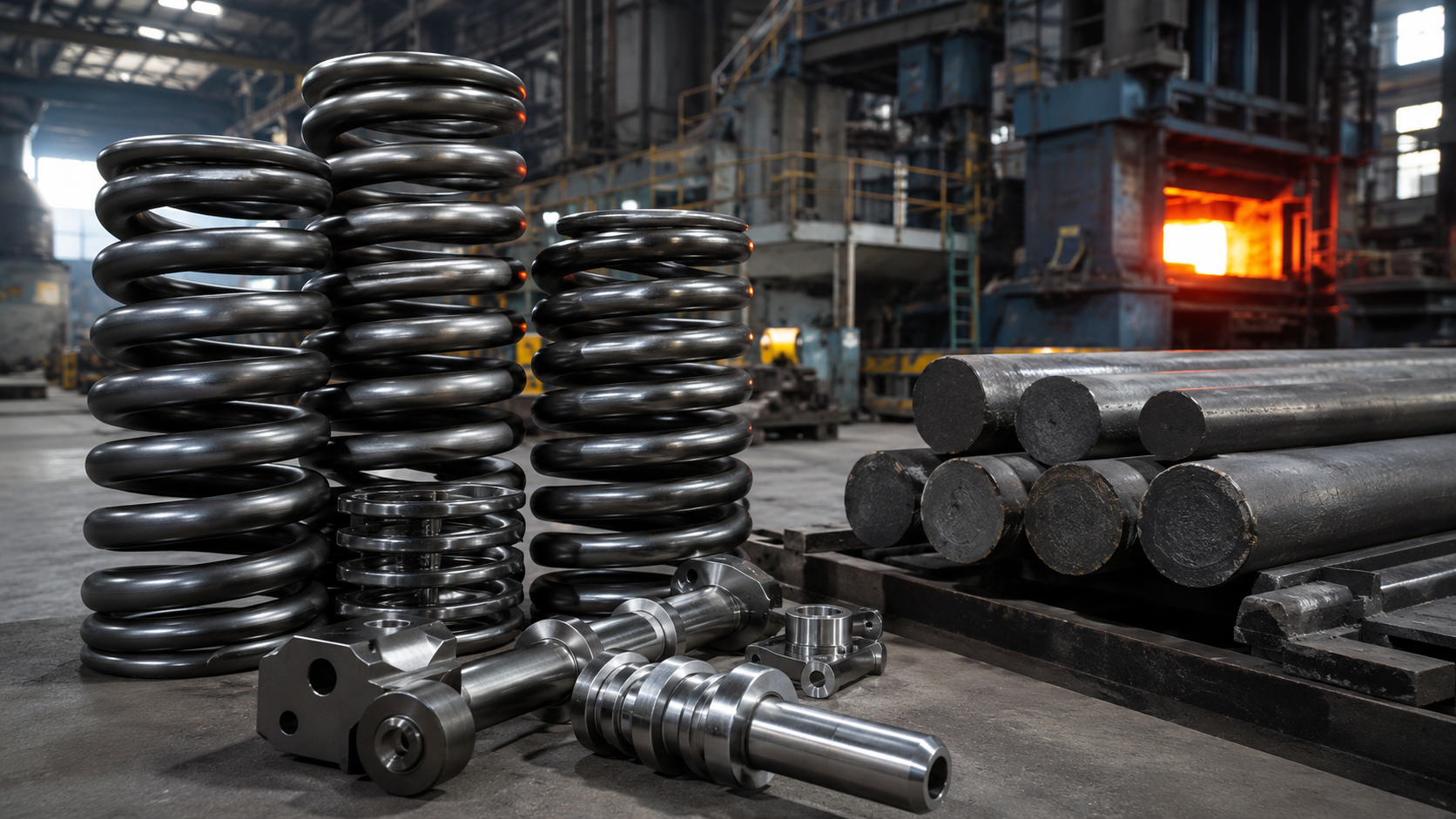
60Si2Mn steel is a kind of silicon-manganese spring steel with high strength,elastic limit and hardenability,and has slightly higher performance than 55Si2Mn steel.This kind of steel is widely used in railway vehicles,automobiles and tractor industries to manufacture flat springs that can bear heavy loads or coil springs with the xire diameter of less than 30mm.It is also suitable for manufacturing heat resistance springs in non-corrosive media with working temperature below 250℃ and large important coiled springs that can bear alternating loads and work under high stress.

Size range
Round steel:
- Range of rolled: 10-260mm
- Range of forged:70-800mm
Square steel:
Range of thickness:10-500mm,Range of width:200-810mm
Forging rings:
Max outer diameter can reach 1000mm.
Surface condition:
The surface condition of 60Si2Mn steel can be changed and optimized through different heat treatment process to meet the requirement of kinds of applications.The following are some common surface conditions and treatment methods:
- Hot rolled state:Hot rolled 60Si2Mn steel can be rolled and coiled at high temperature,there will be a iron oxide scale layer,this kind of iron oxide layer can firmly cover the surface of steel,and cover the defects on the surface of the steel.
- Pickled state:In order to obtain a clean and active surface,60Si2Mn steel usually need to pickled before cold rolling in order to remove the oxide scale of the surface to ensure the surface condition and processing performance of cold rolling steel.
- Cold rolling state:The surface state of cold rolling 60Si2Mn steel is relatively smooth,and has precise size,suitable for manufacturing components with high requirements of surface quality.
- Carburizing treatment:Carburizing treatment can enhance the hardness and wear resistance of 60Si2Mn steel surface,suitable for manufacturing components that can bear high load and abrasion.
- Surface strengthen treatment:For example shot peening,which can enhance the fatigue strength and stress corrosion resistance of the 60Si2Mn steel surface.
Isıl işlem
The heat treatment methods of 60Si2Mn steel include isothermal tempering,graded quenching,sub-temperature quenching,high temperature quenching,deformation heat treatment.These process method can improve the strength toughness and service life of 60Si2Mn spring steel effectively.
- Spherodizing annealing process:Using 850℃ heating,oil cooling quenching,short time isothermal spheroidizing process(790℃ heating 25Min,cooling rapidly to 680℃ and keep the temperature for an hour,furnace cooling to 500℃ and taking out of the furnace),then we can obtain the ideal spheroidized structure.
- The quenching temperature is usually between 850℃ to 870℃,oil cooling.The tempering temperature is depends on the hardness requirement of molds components,for example 400℃ tempering,hardness 46HRC,500℃ tempering,hardness 40HRC,600℃ tempering,hardness 34HRC.
- Annealing:Annealing can remove the inner stress of steel ingot,improve the plasticity and toughness of the steel,and provide a good material basis of subsequent forming processing.The surface condition after annealing is usually more even,and is helpful for the subsequent process.
- Normalizing:Normalizing can improve the hardness and strength of the steel,refine the steel structure,and further optimize the properties of spring steel.The surface condition is usually higher in hardness and more refine in structure.
- Quenching:Quenching is the process that cooling the material below the room temperature rapidly to obtain high hardness and high strength structure.The surface state will form martensite after quenching,to improve the hardness and strength,but it may increase the surface stress at the same time.
- Tempering:Tempering is heat the material to an appropriate temperature after quenching and keep the temperature for a while then cooling,in order to reduce the inner stress and enhance the toughness.during quenching process.The surface condition after tempering usually has better toughness and plasticity,and the inner stress is released.
- The bainitic heat treatment:The bainitic heat treatment process can significantly improve the surface hardness and wear resistance,reduce deformation and improve comprehensive mechanical properties at the same time.

The following video provides a practical overview of how alloy spring steels respond to different heat treatment processes such as quenching and tempering.
The grade name and chemical composition of different country:
| Country | Çin | ABD | Germany | Japonya | Fransa | UK |
| Name | 60Si2Mn | 60Si7 | 60SiCr7 | SUP7 | 61SiCr7 | 25II60 |
| Standard | GB/T 1222-2016 | AISI | DIN | JIS G3467 | NF A35-571 | BS |
Chemical composition:
| C | Si | Mn | S | P | Cr | Ni | Cu |
| 0.56~0.64 | 1.50~2.00 | 0.60~0.90 | ≤0.035 | ≤0.035 | ≤0.35 | ≤0.35 | ≤0.25 |
Application of 60Si2Mn
60Si2Mn steel is a kind of spring steel with excellent elasticity and ductility,and can bear deformation in a large range without cracking.Its application areas are wide,mainly including:
- Automobile manufacturing:60Si2Mn spring steel is widely used in the automobile chassis suspension systems,shock absorbers,steering systems and other components.The excellent elasticity and toughness of spring steels provide a good vehicle stability and ride comfort when driving at uneven road.
- Mechanical manufacturing:In the field of mechanical manufacturing,60Si2Mn spring steel is used for manufacturing various springs,bolts,retaining rings,pins and other connecting and fixing parts.Compare with ordinary steel,60Si2Mn spring steel has better elasticity and fatigue resistance,which makes mechanical equipment have a longer service life and higher reliability.
- Aerospace:60Si2Mn spring steel is also widely used in aerospace industry.It can be used for manufacture the aircraft engines,parachutes,composite materials and other components.The high strength and heat resistance of 60Si2Mn spring steel can bear the test of high speed flight and extreme environment of aerospace equipment.
- Railway vehicles:Suitable for flat springs that can bear heavy load of railway vehicles,automobile and tractors of industry production,or the helical spring with a wire diameter under 30mm.

Sonuç
60Si2Mn remains a practical and reliable spring steel for applications that require strength, elasticity, fatigue resistance, and stable performance under repeated loading. From automotive suspension systems and railway vehicle springs to machinery components and heat-resistant spring parts, its value comes from a strong balance of mechanical properties and process adaptability.
However, the final performance of 60Si2Mn depends heavily on correct material selection, heat treatment, surface condition, and dimensional control. For projects involving heavy-load springs or demanding mechanical parts, working with a supplier that understands both steel production and application requirements can make a significant difference in product reliability and service life.
SSS
What is 60Si2Mn used for?
60Si2Mn is commonly used in automotive suspension springs, railway vehicle springs, tractor springs, machinery parts, retaining rings, pins, and other components requiring elasticity and fatigue resistance.
Is 60Si2Mn a spring steel?
Yes. 60Si2Mn is a typical spring steel. Its high silicon and manganese content helps improve elasticity, strength, and resistance to deformation under repeated stress.
What is the chemical composition of 60Si2Mn?
The typical chemical composition of 60Si2Mn includes carbon, silicon, manganese, sulfur, phosphorus, chromium, nickel, and copper. Its carbon content is usually around 0.56–0.64%, silicon around 1.50–2.00%, and manganese around 0.60–0.90%.
What is the tempering temperature of 60Si2Mn?
The tempering temperature depends on the required hardness. For example, tempering at around 400°C can reach about 46 HRC, while higher tempering temperatures can reduce hardness and improve toughness.
Why choose 60Si2Mn instead of ordinary carbon steel?
60Si2Mn offers better elasticity, hardenability, fatigue resistance, and load-bearing performance than ordinary carbon steel. It is more suitable for parts exposed to repeated deformation and high stress.