Welcome to My Blog!
Before we dive into the content, I’d love for you to join me on my social media platforms where I share more insights, engage with the community, and post updates. Here’s how you can connect with me:
Facebook:https://www.facebook.com/profile.php?id=100087990137347
LinkedIn:https://www.linkedin.com/company/89825762/admin/dashboard/
YouTube:www.youtube.com/@carbonsteelsupply-kj9lw
TikTok:www.tiktok.com/@carbonsteelsupply
Now, let’s get started on our journey together. I hope you find the content here insightful, engaging, and valuable.
Table of Contents
Giriş

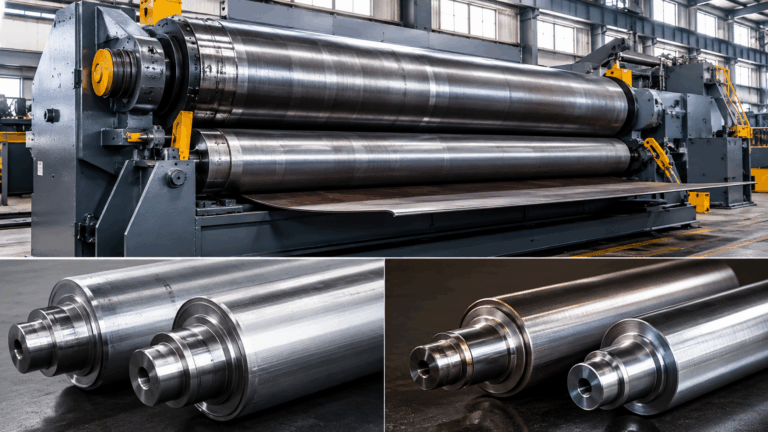
Roller shafts is the core component of rolling machine, which is used to bend the plate. Rolling machine is usually made of high strength steel, with smooth surface, a certain hardness and wear resistance.
Depending on the type of plate rolling machines, there are variations in the number and arrangement of rollers. The most common configurations include three-roller and four-roller systems. In a three-roller bending machine, an upper roller (adjustable vertically) works in tandem with two fixed lower rollers that provide rotational power. Operators achieve desired curvature in metal plates by precisely controlling roller spacing and positioning. Four-roller machines introduce an additional roller that enables pre-bending functionality, significantly enhancing both processing efficiency and dimensional accuracy. The performance characteristics of these rollers critically influence final product quality and production throughput, necessitating high-precision engineering and manufacturing standards throughout their design and fabrication processes.
How to Choose a Rolling Machine?
When choose materials of roller shafts, 42CrMo steel and 40Cr are very commonly used alloy structural steel, The specific choice should be made based on actual working conditions and performance requirements. Below is a comparative analysis of the two materials.
Properties Comparison
42CrMo steel has higher yield strength and tensile strength than 40Cr, its has higher load capacity, is more suitable for applications which has high load requirement.
40Cr has better toughness, but under high strength requirement, 42CrMo steel has excellent comprehensive properties.
42CrMo steel has better wear resistance than 40Cr, after heat treatment, its surface hardness will be higher, more suitable for high wear environments.
42CrMo steel has better hardenability, can achieve a more uniform hardness distribution, making it suitable for parts with larger cross-section.
Application Scenario
40Cr is suitable for medium strength and toughness scenario, such as general mechanical parts, small roller shafts.
42CrMo is suitable for environment that has strength, wear resistance and toughness requirements, such as big roller shafts, heavy mechanical components, etc.
Cost
The price of 42CrMo steel is relatively high, primarily due to its molybdenum content. Molybdenum is an expensive alloying element that significantly enhances the material’s properties, such as strength and hardenability, but also increases the cost. On the other hand, 40Cr is more cost-effective. It has a lower price, making it a more economical choice for applications where its properties are sufficient. For example, the price of 40Cr steel is generally lower than that of 42CrMo steel, with 40Cr4 round bars priced at around US $600-700 per ton, while 42CrMo round bars can cost around US $706-744 per ton depending on the size and manufacturer.
Select Suggestion
If the rollers in a plate rolling machine must handle heavy loads and high wear, with strong demands for strength and wear resistance, use 42CrMo. For milder working conditions where cost is a priority and strength/wear resistance needs are lower, 40Cr is suitable.
SSS
Why is 42CrMo more suitable than 40Cr for rollers in thick plate rolling machines?
Thick plate rolling requires rollers to withstand greater bending forces and pressure. 42CrMo’s high strength and hardenability ensure the rollers maintain stable performance under heavy loads, while its superior wear resistance reduces wear and extends service life. Although 40Cr has better toughness, its lower load-bearing capacity and wear resistance may fail to meet the demands of thick plate rolling.
If surface hardening is required for the rollers, which is more suitable: 42CrMo or 40Cr?
42CrMo is more suitable. Its excellent hardenability and higher hardness allow for greater surface hardness and wear resistance after hardening, significantly extending roller lifespan. While 40Cr can also undergo surface hardening, its lower hardenability results in inferior hardness and wear resistance compared to 42CrMo.
How do 42CrMo and 40Cr affect processing precision in high-precision rolling machines?
42CrMo’s higher strength and hardenability ensure stable shape and dimensional accuracy during processing, reducing machining errors, especially for maintaining arc and size precision. 40Cr’s lower strength and wear resistance may lead to minor deformations or wear during operation, affecting precision.