If you buy or work with forged steel parts—machinery, oilfield gear, construction equipment, that kind of thing—this is for you.
Table of Contents
First, the short version
Both 4130 and 4140 are chromium-molybdenum steels. Tough, respond well to heat treatment, good for high-load parts. People use them everywhere—drilling rigs, heavy machinery, automotive.
But here’s the thing: a lot of buyers and even engineers mix them up. Pick the wrong one and you either overpay, or worse—something breaks down the line. This isn’t just theory. I’ve seen it happen.
So let’s walk through the chemistry, the strength numbers, how they behave when you forge or weld them, where each one actually belongs, and what you’ll likely pay.
What’s inside—chemical composition
Carbon: 0.38–0.45%
Silicon: ≤0.40%
Manganese: 0.60–0.90%
Chromium: 0.90–1.20%
Molybdenum: 0.15–0.30%
Carbon: 0.28–0.33%
Silicon: 0.15–0.35%
Manganese: 0.40–0.60%
Chromium: 0.80–1.10%
Molybdenum: 0.15–0.25%
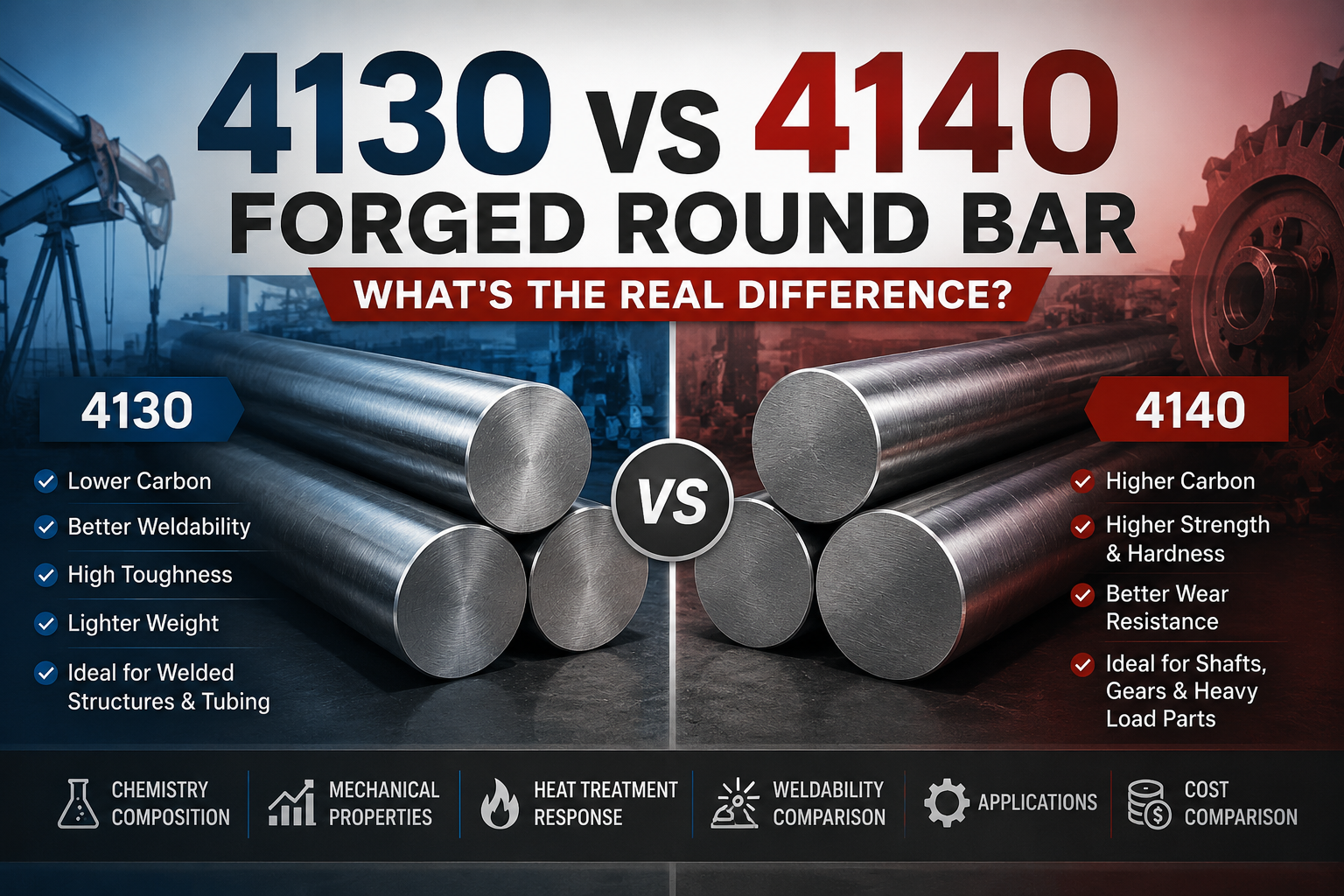
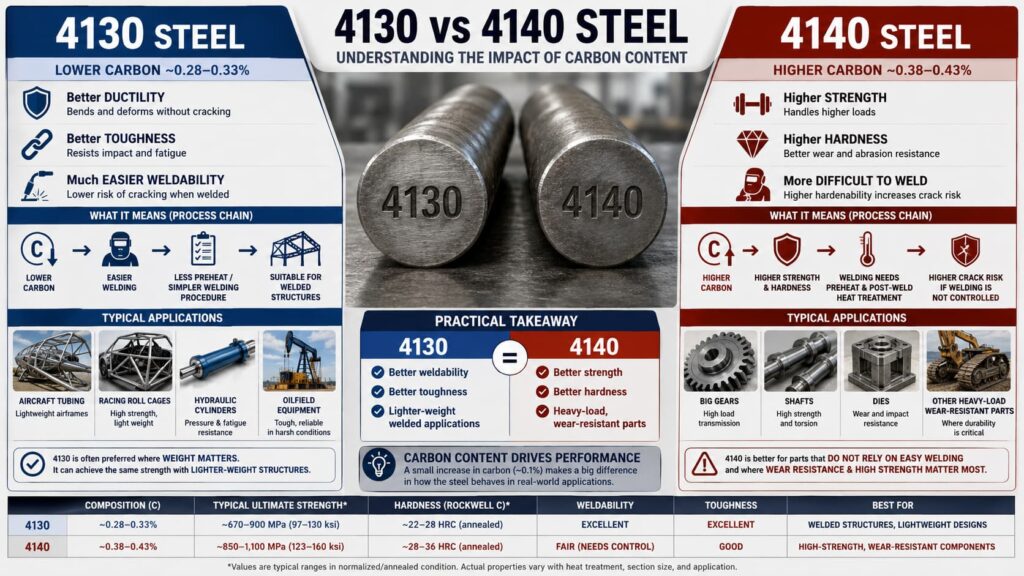
The big difference? Carbon. 4140 has more. That changes everything.
How they perform—mechanical properties (typical)
| Property | 4140 | 4130 |
| Tensile strength (MPa) | 655–1100 | 560–860 |
| Yield strength (MPa) | 415–930 | 360–700 |
| Elongation (%) | 12–25.7 | 18–28.2 |
| Hardness (annealed, HB) | 197–302 | 156–217 |
| Hardness (Q&T, HRC) | 28–55 | 28–32 |
| Fatigue strength (MPa) | ~735 | ~620 |
And here’s a practical table—different heat treatment, different numbers:
| Condition | 4140 Tensile | 4140 Yield | 4130 Tensile | 4130 Yield |
| Annealed | 655 MPa | 415 MPa | 560 MPa | 360 MPa |
| Normalized | — | — | 670 MPa | 460 MPa |
| Q&T | 850–1480 MPa | 665–1275 MPa | 860 MPa | 700 MPa |
So what does that actually mean?
4140 has more carbon → higher strength, higher hardness. But welding it is a pain. You’ll need preheat and post-weld heat treatment, otherwise it’ll crack on you. So use 4140 for parts that don’t need welding anyway—big gears, shafts, dies, that sort of thing. Heavy loads, wear resistance matters.
4130 has less carbon → better ductility, better toughness, and way easier to weld. You can weld it without jumping through hoops. That’s why people use it for welded structures where weight is a concern—aircraft tubing, racing roll cages, hydraulic cylinders, oilfield equipment. At the same strength level, 4130 can be about 20% lighter than 4140. That’s not a typo.
Where does each one go?
4140 is for:
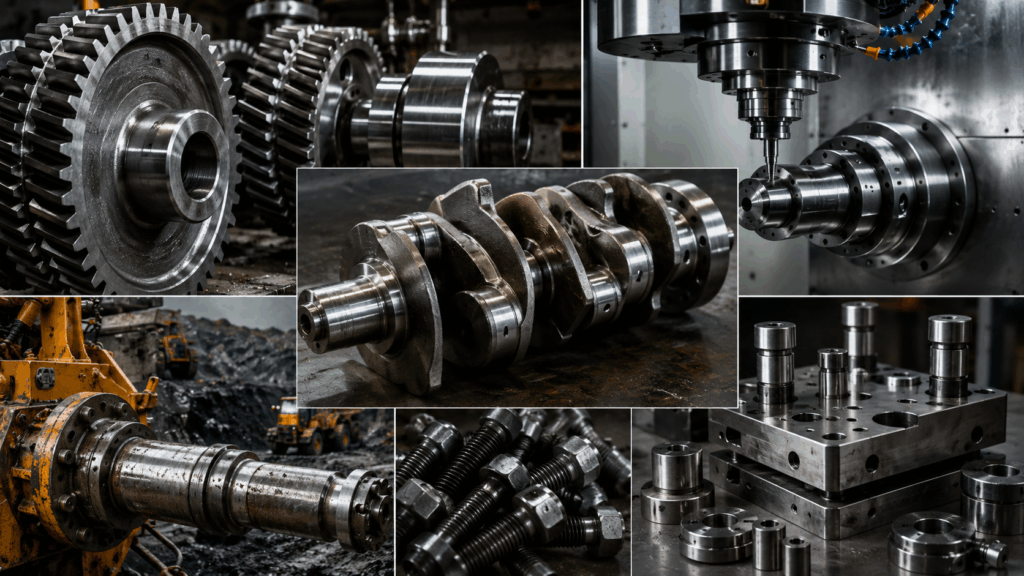
Big gears and crankshafts
Machine tool spindles
Mining equipment shafts
High-strength bolts
Cold work dies
These parts need hardness and fatigue resistance after quench and tempering. And honestly, you’re not welding on a big gear anyway.
4130 is for:
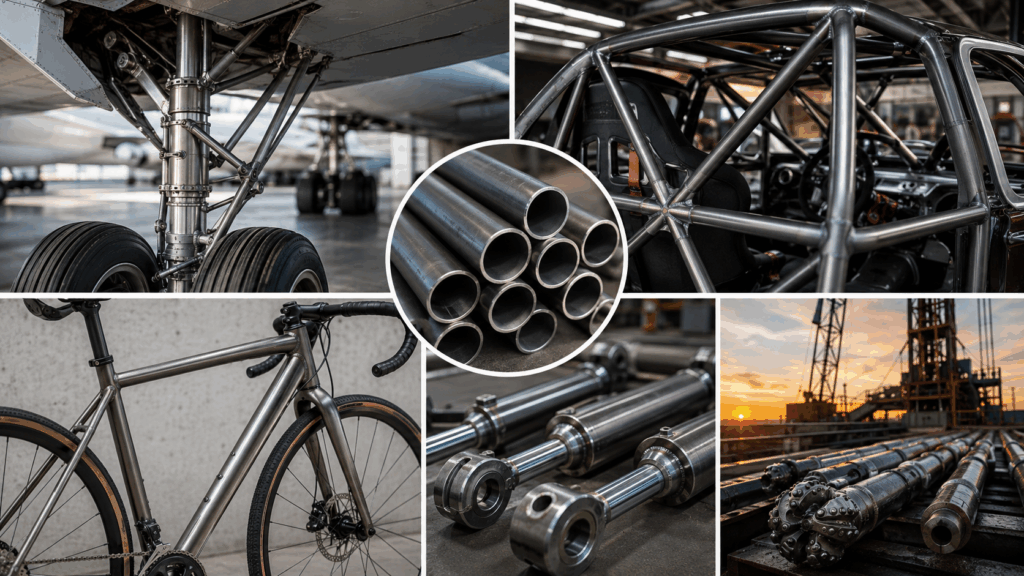
Aircraft landing gear tubing
Racing roll cages (very common)
High-end bicycle frames
Hydraulic cylinders
Oil & gas drilling tools
The selling point? It stays tough after welding. That matters when safety isn’t optional.
What about price?
Honestly? Both are in the same ballpark—they’re both medium-alloy Cr-Mo steels. Raw material cost is close. For standard industrial grades, prices overlap. 4140 might be slightly higher sometimes because of the higher carbon and strength.
But here’s something people miss: 4130 can actually cost more—if you buy it to aerospace specs like AMS 6348. That means extra ultrasonic testing, tighter cleanliness, specific grain size requirements. All that adds up, and suddenly 4130 is more expensive than standard 4140.
Other things that move the price: domestic vs imported, large diameters, and just plain supply and demand.
Bottom line—don’t assume one is always cheaper. Get a quote for your exact spec and quantity.
Final Takeaway
4130 vs 4140 forged round bar is not a question of which steel is “better.” It is a question of which one fits the job.
Choose 4140 when the part needs higher strength, higher hardness, better fatigue resistance, and wear performance after heat treatment. It is the safer choice for heavy shafts, gears, spindles, mining parts, dies, and other components that will see high load but do not need much welding.
Choose 4130 when weldability, toughness, ductility, and weight control matter more. It is the better fit for welded structures, tubing, roll cages, hydraulic parts, aircraft-related components, and oilfield tools where cracking after welding cannot be accepted.
The real mistake is treating 4130 and 4140 as interchangeable just because both are Cr-Mo steels. They are close, but not the same. Carbon content changes strength, hardness, weldability, heat treatment behavior, and final cost.
Before you order forged round bar, check the drawing, required strength, heat treatment condition, welding needs, inspection requirements, and final working environment. If the part is safety-critical, do not choose by price alone. Choose by application, specification, and risk.
SSS
Is 4130 stronger than 4140?
No. In most heat-treated conditions, 4140 is stronger and harder than 4130 because it has higher carbon content. If the part needs higher strength, wear resistance, and fatigue performance, 4140 is usually the better choice.
Is 4130 easier to weld than 4140?
Yes. 4130 is generally easier to weld because it has lower carbon content. 4140 can be welded, but it usually needs more careful preheating, controlled cooling, and sometimes post-weld heat treatment to reduce cracking risk.
Can I replace 4130 with 4140 forged round bar?
Not automatically. 4140 may give higher strength, but it is less friendly for welding and may change toughness, hardness, machining, and heat treatment behavior. Always check the drawing, welding requirement, heat treatment condition, and final application before substitution.
Can I replace 4140 with 4130 forged round bar?
Only if the required strength, hardness, fatigue resistance, and wear performance can still be met. 4130 is tougher and easier to weld, but it may not reach the same strength level as 4140 in demanding heavy-duty parts.
Which is better for shafts, 4130 or 4140?
For heavy-load shafts, mining shafts, machine tool spindles, and power transmission parts, 4140 is often preferred because it can provide higher strength and hardness after quenching and tempering. For welded or lighter structural shaft applications, 4130 may be more suitable.
Which is better for welded structures?
4130 is usually better for welded structures. It has better weldability and ductility than 4140, which makes it more suitable for aircraft tubing, roll cages, bicycle frames, hydraulic parts, and some oilfield structures.
Why does 4140 have higher hardness than 4130?
The main reason is carbon content. 4140 has more carbon than 4130, so it can reach higher hardness after heat treatment. That higher hardness also means welding and cracking control become more important.
Is 4130 cheaper than 4140?
Not always. For standard industrial material, 4130 and 4140 can be close in price. But aerospace-grade 4130, such as material ordered to strict AMS requirements, can cost more because of tighter inspection, cleanliness, grain size, and certification requirements.
Which one is better for oilfield equipment?
It depends on the part. 4140 may be better for high-strength shafts, couplings, and heavily loaded parts. 4130 may be better for welded oilfield structures or components where toughness and weldability matter more.
What should buyers confirm before ordering 4130 or 4140 forged round bar?
Buyers should confirm the steel grade, forged size, heat treatment condition, mechanical properties, hardness range, ultrasonic testing requirement, certification standard, welding needs, machining allowance, and final working environment.