Table of Contents
Welcome to My Blog!
Before we dive into the content, I’d love for you to join me on my social media platforms where I share more insights, engage with the community, and post updates. Here’s how you can connect with me:
Facebook:https://www.facebook.com/profile.php?id=100087990137347
LinkedIn:https://www.linkedin.com/company/89825762/admin/dashboard/
YouTube:www.youtube.com/@carbonsteelsupply-kj9lw
TikTok:www.tiktok.com/@carbonsteelsupply
Now, let’s get started on our journey together. I hope you find the content here insightful, engaging, and valuable.
Introduction
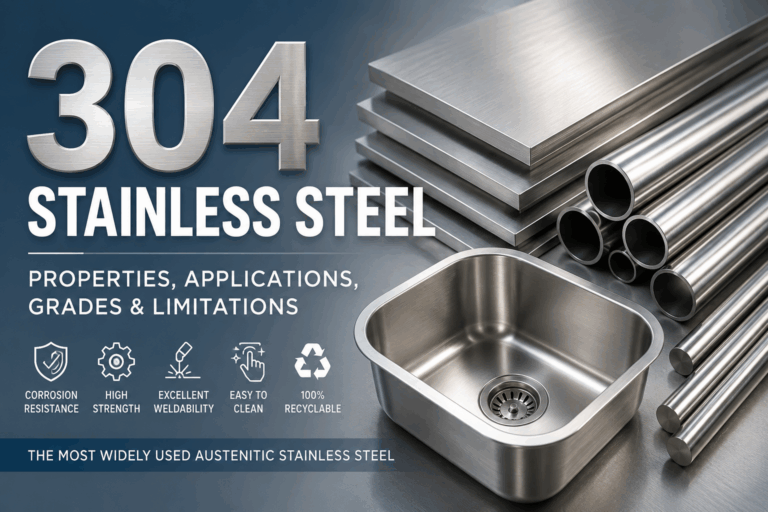
If you’ve ever used a kitchen sink, walked past a shiny building facade, or handled surgical tools, chances are you’ve encountered 304 stainless steel.
Known for its excellent corrosion resistance, high-temperature tolerance, and non-magnetic properties, 304 stainless steel is the most widely used austenitic stainless steel in the world. It strikes the perfect balance between performance, durability, and cost, making it a go-to material across industries—from food processing to medical devices, construction, and chemical equipment.
What is 304 Stainless Steel?
304 stainless steel is an austenitic chromium-nickel alloy containing approximately:
| Element | Percentage (%) |
|---|---|
| Chromium | 18–20 |
| Nickel | 8–10.5 |
| Carbon | ≤0.08 |
| Manganese | ≤2.0 |
| Silicon | ≤1.0 |
| Phosphorus | ≤0.045 |
| Sulfur | ≤0.03 |
| Iron | Balance |
This composition gives 304 stainless steel its corrosion-resistant, non-magnetic, and formable characteristics.
Top Advantages of 304 Stainless Steel
1. Excellent Corrosion Resistance
304 stainless steel resists oxidation and corrosion in most atmospheric environments and many corrosive media. It performs especially well in:
- Fresh water
- Food processing environments
- Mild chemical exposures
2. High-Temperature Resistance
It can withstand temperatures up to 800°C (1472°F) without scaling or losing strength, making it ideal for kitchen appliances, heat exchangers, and industrial furnaces.
3. Superior Formability and Weldability
304 is easily formed into complex shapes and welded without becoming brittle. This makes it a favorite in manufacturing, fabrication, and construction.
4. Non-Magnetic Properties
Thanks to its austenitic structure, 304 is essentially non-magnetic in the annealed condition—ideal for electronic, medical, and scientific applications.
5. Aesthetic Appeal
Its smooth, shiny surface is easy to clean and maintain, making it perfect for architectural and decorative uses.
6. Cost-Effective
Compared to higher-grade alloys like 316L, 304 offers excellent performance at a lower price point, making it a cost-efficient choice for many applications.

Limitations of 304 Stainless Steel
While 304 is versatile, it’s not perfect for every situation. Here are some limitations:
| Limitation | Details |
|---|---|
| Chloride Corrosion | Susceptible to pitting and crevice corrosion in chloride-rich environments (e.g., seawater, salt spray). |
| Lower Strength | Not ideal for high-stress structural applications. |
| Work Hardening | It can become hard and brittle during cold working. |
| High-Temperature Scaling | Not as resistant as 310 or 316 grades in extreme heat. |
| Cost | Higher nickel content makes it more expensive than ferritic stainless steels. |
| Post-Weld Corrosion | May suffer from intergranular corrosion in the heat-affected zone if not properly treated. |
Applications of 304 Stainless Steel
Thanks to its balanced properties, 304 is used in a wide range of industries:
| Industry | Common Applications |
|---|---|
| Food Processing | Storage tanks, pipelines, kitchen equipment, food prep surfaces |
| Construction & Architecture | Curtain walls, handrails, door frames, cladding |
| Medical Devices | Surgical instruments, hospital equipment, trays |
| Home Appliances | Refrigerator panels, dishwasher drums, microwave interiors |
| Chemical Industry | Reactors, storage tanks, piping systems |
| Automotive | Exhaust systems, trim, grills |
| Water Treatment | Filters, pumps, valves |
| Household Items | Cutlery, sinks, cookware, furniture |

304 vs 316L Stainless Steel: What’s the Difference?
One of the most common questions is: Should I use 304 or 316L stainless steel?
| Property | 304 Stainless Steel | 316L Stainless Steel |
|---|---|---|
| Corrosion Resistance | Good | Excellent, especially in chloride environments |
| Molybdenum Content | None | 2–3% (improves chloride resistance) |
| Carbon Content | ≤0.08% | ≤0.03% (better weldability) |
| Cost | Lower | Higher |
| Magnetic | Non-magnetic | Non-magnetic |
| Common Uses | Kitchens, architecture, general use | Marine, chemical, medical implants |
How to Maintain 304 Stainless Steel
To keep your 304 stainless steel looking and performing its best:
- Clean regularly with mild detergent and water
- Avoid chloride-based cleaners (like bleach)
- Use non-abrasive tools to prevent scratching
- Rinse and dry after cleaning to prevent water spots
- For outdoor use, consider protective coatings in marine environments
FAQ
Is 304 stainless steel magnetic?
No, 304 is essentially non-magnetic in its annealed state due to its austenitic structure. However, it may become slightly magnetic after cold working.
Can 304 stainless steel be used outdoors?
Yes, but with caution. It performs well in mild outdoor environments, but not recommended for coastal or high-chloride areas unless regularly maintained.
What’s the difference between 304 and 304L?
304L has a lower carbon content (≤0.03%), which reduces the risk of carbide precipitation during welding—making it better for welded structures.
Is 304 food-grade stainless steel?
Yes. 304 is FDA-approved and widely used in food processing, kitchen equipment, and restaurants due to its hygienic surface and corrosion resistance.