Welcome to My Blog!
Before we dive into the content, I’d love for you to join me on my social media platforms where I share more insights, engage with the community, and post updates. Here’s how you can connect with me:
Facebook:https://www.facebook.com/profile.php?id=100087990137347
LinkedIn:https://www.linkedin.com/company/89825762/admin/dashboard/
YouTube:www.youtube.com/@carbonsteelsupply-kj9lw
TikTok:www.tiktok.com/@carbonsteelsupply
Now, let’s get started on our journey together. I hope you find the content here insightful, engaging, and valuable.
Table of Contents
Introduction
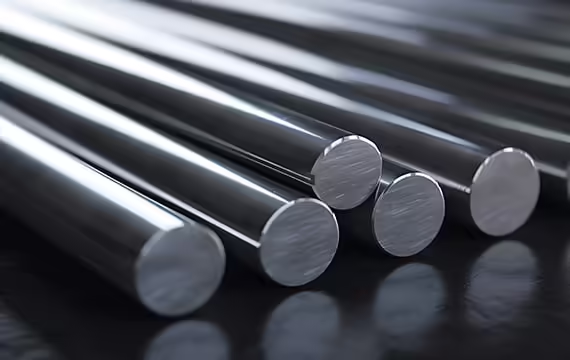
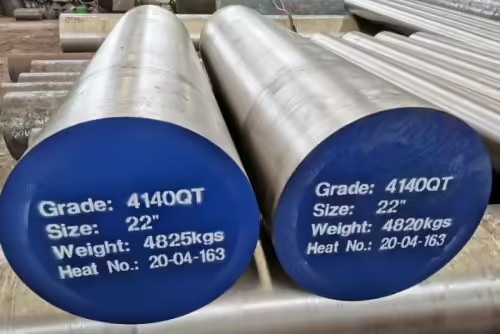
4140 alloy steel bar is a versatile and widely used material in various industries. It is a chromium-molybdenum alloy steel, known for its excellent strength, toughness, wear resistance, and fatigue strength. This combination of properties makes 4140 steel bars suitable for a broad range of applications, from automotive components to aerospace parts. This blog post will delve into the properties, applications, benefits, and other important aspects of 4140 alloy steel bars.
Chemical Composition and Properties of 4140 Alloy Steel Bar
The chemical composition of 4140 alloy steel bar plays a crucial role in determining its mechanical properties. The key elements and their approximate percentages are:
- Carbon (C): 0.38 – 0.43%
- Chromium (Cr): 0.80 – 1.10%
- Molybdenum (Mo): 0.15 – 0.25%
- Manganese (Mn): 0.75 – 1.00%
- Silicon (Si): 0.20 – 0.35%
- Sulfur (S): 0.04% (max)
- Phosphorus (P): 0.035% (max)
These elements contribute to the following key properties of 4140 alloy steel bar:
- High Strength: 4140 steel exhibits high tensile and yield strength, making it suitable for load-bearing applications.
- Excellent Toughness: It possesses good impact resistance and can withstand shock loading.
- Good Wear Resistance: 4140 steel resists abrasion and wear, extending the service life of components.
- High Fatigue Strength: It can endure repeated stress cycles without failure.
- Hardenability: 4140 steel can be heat-treated to achieve a wide range of hardness levels.
- Machinability: In its annealed condition, 4140 steel offers reasonable machinability.
Heat Treatment of 4140 Alloy Steel Bar
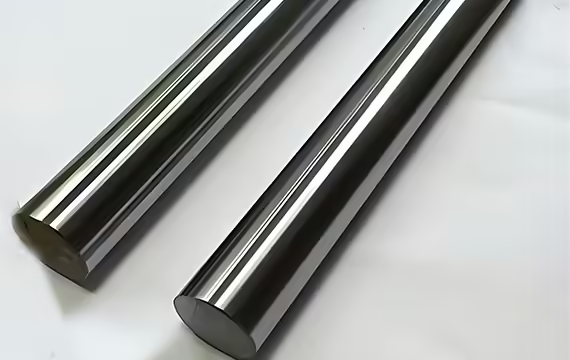
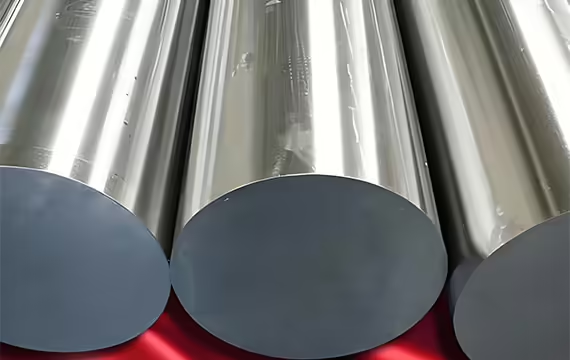
Heat treatment is a critical process for 4140 alloy steel bar, as it significantly influences its mechanical properties. Common heat treatment processes include:
- Annealing: This process softens the steel, improves machinability, and relieves internal stresses.
- Normalizing: This process refines the grain structure and improves strength and toughness.
- Hardening: This process increases the hardness and strength of the steel. It typically involves austenitizing followed by quenching in oil or water.
- Tempering: This process reduces brittleness and improves toughness after hardening. It involves heating the hardened steel to a specific temperature below its critical temperature.
The specific heat treatment parameters depend on the desired properties for the final application of the 4140 alloy steel bar.
Applications of 4140 Alloy Steel Bar Across Industries
4140 alloy steel bar finds extensive use in various industries due to its versatile properties. Some key applications include:
- Automotive Industry: Axles, gears, crankshafts, connecting rods, steering components.
- Aerospace Industry: Landing gear components, aircraft structural parts, engine components.
- Oil and Gas Industry: Downhole tools, drilling equipment, valves.
- Manufacturing and Machinery: Machine parts, tooling, molds, dies.
- Defense Industry: Weapon components, military vehicle parts.
The specific application determines the required dimensions, tolerances, and heat treatment of the 4140 alloy steel bar.
Benefits of Using 4140 Alloy Steel Bar
-
![31CrMoV9/1.8519 Alloy Steel]() 31CrMoV9/1.8519 Alloy Steel
31CrMoV9/1.8519 Alloy Steel -
![17CrNiMo6/1.6587 Alloy Steel]() 17CrNiMo6/1.6587 Alloy Steel
17CrNiMo6/1.6587 Alloy Steel -
![25CrMo4/1.7218/SCM430 Alloy Steel]() 25CrMo4/1.7218/SCM430 Alloy Steel
25CrMo4/1.7218/SCM430 Alloy Steel -
![8620/1.6523/20CrNiMoA/SNCM220 alloy steel]() 8620/1.6523/20CrNiMoA/SNCM220 Alloy Steel
8620/1.6523/20CrNiMoA/SNCM220 Alloy Steel -
![18CrNiMo7-6/17CrNiMo6/1.6587 Alloy Steel]() 18CrNiMo7-6/17CrNiMo6/1.6587 Alloy Steel
18CrNiMo7-6/17CrNiMo6/1.6587 Alloy Steel -
![18CrMo4/1.7243 Alloy Steel]() 18CrMo4/1.7243 Alloy Steel
18CrMo4/1.7243 Alloy Steel -
![30CrNiMo8/1.6580 Alloy Steel]() 30CrNiMo8/1.6580 Alloy Steel
30CrNiMo8/1.6580 Alloy Steel -
![36CrNiMo4/1.6511/SNCM439/EN24 Alloy Steel]() 36CrNiMo4/1.6511/SNCM439/EN24 Alloy Steel
36CrNiMo4/1.6511/SNCM439/EN24 Alloy Steel -
![34CrNiMo6/1.6582 Alloy Steel]() 34CrNiMo6/1.6582 Alloy Steel
34CrNiMo6/1.6582 Alloy Steel


The use of 4140 alloy steel bar offers several significant advantages:
- Cost-Effectiveness: 4140 steel offers a good balance of properties and cost, making it a cost-effective material choice for many applications.
- Versatility: Its wide range of properties and heat treatment options makes it suitable for diverse applications.
- Availability: 4140 steel is readily available in various sizes and forms from steel suppliers.
- Reliability: Its consistent properties and performance ensure reliable operation of components.
- Improved Machinability (with proper heat treatment): In the annealed condition, it offers reasonable machinability, reducing manufacturing time and cost.
Comparing 4140 Alloy Steel Bar with Other Materials

While 4140 alloy steel bar is a popular choice, it’s essential to compare it with other materials to detrmine the best fit for a specific application. Here’s a comparison table highlighting key differences with some other common steels:
| Property | 4140 Alloy Steel Bar | 4130 Alloy Steel Bar | 1045 Carbon Steel Bar | Stainless Steel 304 |
|---|---|---|---|---|
| Strength | High | Medium High | Medium | Medium |
| Toughness | Excellent | Good | Good | Good |
| Wear Resistance | Good | Medium | Medium | Medium |
| Corrosion Resistance | Fair | Fair | Poor | Excellent |
| Machinability | Good (Annealed) | Good (Annealed) | Good | Fair |
| Hardenability | High | Medium | Medium | Low |
| Cost | Moderate | Slightly Lower | Lower | Higher |
| Typical Applications | Gears, Axles | Aircraft parts | Shafts, Bolts | Food processing, Chemical equipment |
This table provides a general overview. The specific requirements of an application should always guide material selection.
Conclusion
4140 alloy steel bar stands out as a versatile and reliable material in modern manufacturing. Its combination of strength, toughness, wear resistance, and fatigue strength, coupled with its cost-effectiveness and availability, makes it a preferred choice across diverse industries. Understanding the properties, heat treatment options, and applications of 4140 steel is crucial for engineers and designers in selecting the optimal material for their specific needs. By carefully considering the requirements of each application, engineers can leverage the benefits of 4140 alloy steel bar to create durable, high-performance components. Further research and consultation with material experts are encouraged for specialized applications. This in-depth look at 4140 alloy steel bar should provide a comprehensive understanding of its capabilities and advantages. This detailed information aims to be a valuable resource for those seeking knowledge about this widely used material.
FAQ
Q: Is 4140 alloy steel bar weldable?
A: Yes, 4140 steel can be welded using conventional welding techniques. However, pre- and post-weld heat treatment is usually required to avoid cracking and maintain desired mechanical properties.
Q: What is the difference between 4140 and 4130 steel?
A: The primary difference lies in the carbon content. 4140 has a slightly higher carbon content than 4130, resulting in higher strength and hardenability.
Q: What is the typical hardness of hardened and tempered 4140 steel?
A: The hardness can vary depending on the specific heat treatment parameters. Typically, it can range from 28-32 HRC (Rockwell C hardness).
Q: Where can I purchase 4140 alloy steel bars?
A: 4140 steel bars are available from various steel suppliers and distributors. It’s important to choose a reputable supplier who can provide material certifications and quality assurance.