Welcome to My Blog!
Before we dive into the content, I’d love for you to join me on my social media platforms where I share more insights, engage with the community, and post updates. Here’s how you can connect with me:
Facebook:https://www.facebook.com/profile.php?id=100087990137347
LinkedIn:https://www.linkedin.com/company/89825762/admin/dashboard/
YouTube:www.youtube.com/@carbonsteelsupply-kj9lw
TikTok:www.tiktok.com/@carbonsteelsupply
Now, let’s get started on our journey together. I hope you find the content here insightful, engaging, and valuable.
Table of Contents
Introduction
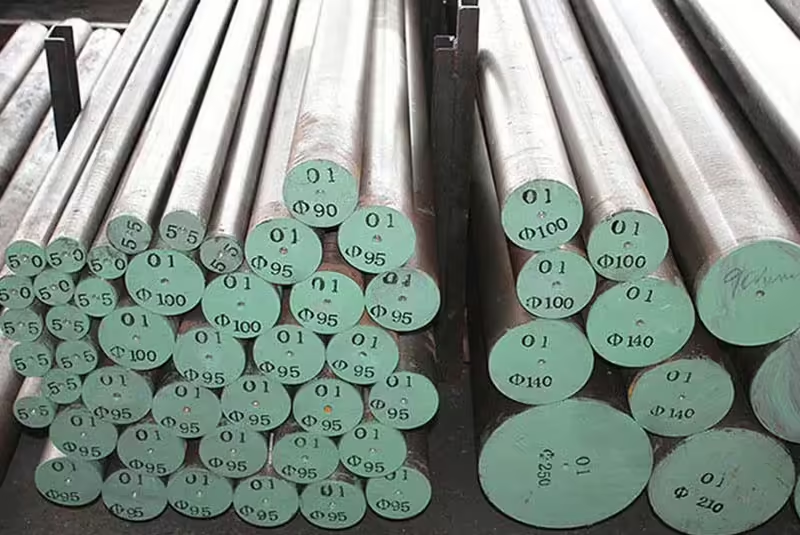
O1 steel is a classic oil-hardening tool steel with good processing performance,quenching dimensional stability, high hardness and wear resistance. It is widely used in the fields of tool manufacturing and mold processing. Although it is not stainless steel, the chromium content gives it some corrosion resistance. O1steel has good comprehensive properties, with high performance and reasonable price, it is suitable for various processing and applications.
Why Choose O1 Tool Steel?
Advantages
- Good hardenability and dimensional stability
O1 steel has good hardenability,small deformation during quenching,and can effectively control dimensional changes.This is very important for manufacturing high precision tools and molds,especially in situations where strict dimensional tolerances need to be maintained.
- High hardness and wear resistance
After heat treatment,the hardness of O1 steel can reach HRC 60-62,and with good wear resistance.This makes it excellent in the manufacture of cutting tools,punching dies and cutting tools,which can effectively resist abrasion and extend service life.
- Good toughness
Although O1 steel has higher hardness,its toughness is also excellent.It can bear
some impact in a certain degree.This makes it performs excellent when manufacture tools which meed to bear a certain amount of impact,such as blanking dies and shear knives.
- Good quenching properties
The quenching properties makes O1 steel maintain its good hardness and toughness during oil cooling.This property allows it to maintain small deformation after quenching,making it suitable for manufacturing precision tools.
Limitation
- Weak toughness and impact resistance
O1 steel has higher hardness, but toughness is relatively low, and is prone to fracture or chipping when subject to large impact loads. Therefore, it is not suitable for tools and molds that require high toughness.
- Poor corrosion resistance
O1 steel has low chromium content(0.5%-0.7%) and is not belongs to stainless steel, so its corrosion resistance is limited.It need regular maintenance to prevent rust when using in wet or corrosive environment.
- Limited dimensional stability after heat treatment
Although the quenching deformation of O1 steel is relatively small, a certain degree of dimensional change may still occur during the complex heat treatment process, which may limit its application in high precision molds.
- Higher difficulty in processing
O1 steel has high hardness and require higher cutting force and more wear resistant tools during processing. In addition ,its hardness after heat treatment further increase the difficulty of processing.
- Hard to grind
The high hardness and wear resistance of O1 steel makes it easy to generate during the grinding process, which may cause grinding cracks or surface burns.
Application
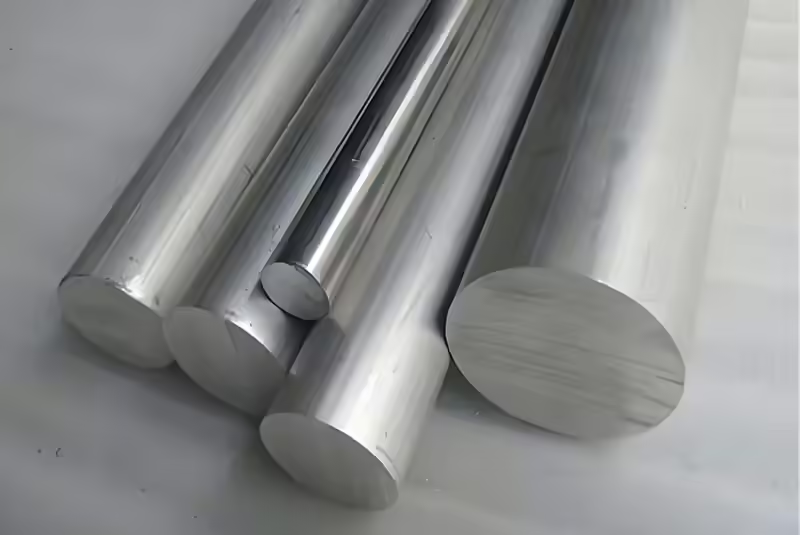
- Mold manufacturing
O1 steel is commonly used to manufacture various cold working dies, such as blanking dies, stamping dies, bending dies, drawing dies, piercing punches and finishing dies, etc. Its high hardness and wear resistance can ensure that the mold maintain accuracy and stability during long-term use.
- Tool and cutting tool manufacturing
O1 steel is widely used to manufacture various cutting tools, such as turning tools, milling cutters, reamers, shear cutters, threading tools, etc. Its high hardness and strong edge retention make it competent for daily and precision machining tasks.
- Machining parts
O1 steel can be used to manufacture high precision mechanical parts such as bearings, gears, cams, etc. Its good wear resistance and fatigue make it performs well in the filed of machining.
- Automotive Industry
In automobile manufacturing, O1 steel is often used to manufacture parts that require high wear resistance, such as shift forks and synchronizers. Its stable performance can meet the high precision and durability requirements of automotive parts.
- Other Industry applications
Cold extrusion die: used to manufacture cold extrusion dies for materials such as aluminum and magnesium alloys.
Wear-resistance parts: such as wear resistance parts of conveyor belts,mixers,crushers and other equipment.
Woodworking tools: Due to its good processing properties and wear resistance,O1 steel is also suitable for making woodworking tools.
Conclusion
O1 steel is an oil-quenched tool steel with high hardness, wear resistance and good processing performance.It has high hardness, wear resistance and good processing performance. It is widely used in mold manufacturing,cutting tools, machined parts,automotive parts and other fields. It has high heat treatment stability and small quenching deformation, it is suitable for manufacturing high precision tools and molds.However, O1 steel has weak toughness and is not suitable for high impact load scenarios.
At the same time, its corrosion resistance is limited, so attention should be paid to rust prevention and maintenance. In general, O1 steel is an indispensable and important material in industrial manufacturing due to its high cost-effectiveness and comprehensive performance. It is especially suitable for applications with high requirements for wear resistance and dimensional accuracy.
FAQ
What are the main features of O1 steel?
High hardness: After heat treatment,the hardness can reach above HRC 60.
High wear resistance: The addition of chromium and tungsten makes it excellent in wear resistance.
Good processing properties: Easy to form and polish.
Heat treatment stability: Small quenching deformation,suitable for molds with complex shapes.
What is the heat treatment of O1 steel?
Quenching: Usually heated at 1050-1100°C and oil cooled.
Tempering: Tempering at 150-200°C to optimize hardness and toughness.
What are the differences between O1 steel and other tool steels?
Compare to D2 steel, O1 steel has better toughness, but wear resistance and corrosion resistance is a little poor. Compare to A2 steel, O1 steel has better process property but lower toughness.