Welcome to My Blog!
Before we dive into the content, I’d love for you to join me on my social media platforms where I share more insights, engage with the community, and post updates. Here’s how you can connect with me:
Facebook:https://www.facebook.com/profile.php?id=100087990137347
LinkedIn:https://www.linkedin.com/company/89825762/admin/dashboard/
YouTube:www.youtube.com/@carbonsteelsupply-kj9lw
TikTok:www.tiktok.com/@carbonsteelsupply
Now, let’s get started on our journey together. I hope you find the content here insightful, engaging, and valuable.
Table of Contents
Introduction
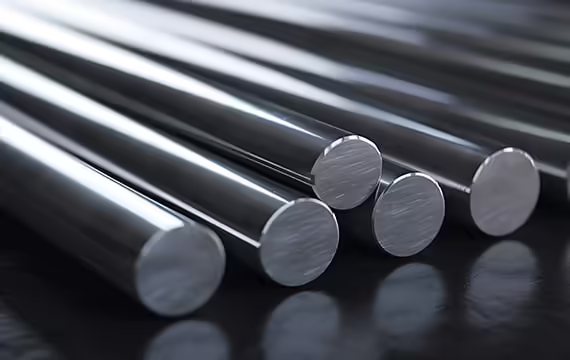
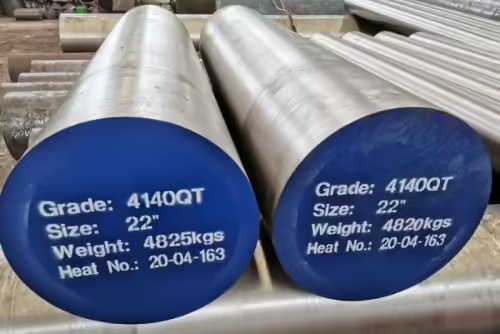
Alloy 4140 steel is a versatile and widely used low-alloy steel known for its exceptional toughness, high fatigue strength, and excellent wear resistance. This chromium-molybdenum steel is a popular choice across various industries due to its desirable mechanical properties and relative ease of machinability. This comprehensive guide will delve into the characteristics, applications, heat treatment processes, and other essential aspects of alloy 4140 steel.
What is 4140 Alloy Steel?
Alloy 4140 steel belongs to the family of low-alloy steels, meaning it contains small amounts of alloying elements in addition to iron and carbon. The key alloying elements in 4140 steel are chromium (Cr) and molybdenum (Mo), which contribute significantly to its enhanced properties. The designation “4140” is derived from the AISI (American Iron and Steel Institute) and SAE (Society of Automotive Engineers) naming system, where:
- The first two digits (41) indicate the main alloying elements: chromium and molybdenum.
- The last two digits (40) represent the approximate carbon content (0.40%).
Chemical Composition of 4140 Alloy Steel
The specific chemical composition of 4140 alloy steel is crucial to its performance. The typical composition ranges are as follows:
- Carbon (C): 0.38 – 0.43%
- Manganese (Mn): 0.75 – 1.00%
- Silicon (Si): 0.20 – 0.35%
- Chromium (Cr): 0.80 – 1.10%
- Molybdenum (Mo): 0.15 – 0.25%
- Sulfur (S): 0.040% max
- Phosphorus (P): 0.035% max
The presence of chromium improves hardenability, wear resistance, and corrosion resistance, while molybdenum enhances strength, toughness, and high-temperature performance.
Mechanical Properties of 4140 Alloy Steel
4140 alloy steel exhibits a desirable combination of mechanical properties, making it suitable for demanding applications. These properties can be further tailored through heat treatment processes.
Strength and Hardness of 4140 Alloy Steel
4140 alloy steel possesses high tensile and yield strength, allowing it to withstand significant loads and stresses. Its hardness can be varied through heat treatment, achieving a wide range of values depending on the specific application requirements.
Toughness and Impact Resistance of 4140 Alloy Steel
One of the key advantages of 4140 alloy steel is its excellent toughness, meaning it can absorb energy without fracturing. This makes it suitable for applications involving impact loading or dynamic stresses.
Fatigue Strength of 4140 Alloy Steel
4140 alloy steel exhibits high fatigue strength, meaning it can withstand repeated cycles of stress without failure. This is crucial for components subjected to cyclic loading, such as shafts, gears, and fasteners.
Heat Treatment of 4140 Alloy Steel
Heat treatment is essential for optimizing the mechanical properties of 4140 alloy steel. Various heat treatment processes can be applied to achieve specific desired properties.
Annealing 4140 Alloy Steel
Annealing is a heat treatment process used to soften the steel, improve machinability, and relieve internal stresses. It involves heating the steel to a specific temperature, holding it for a certain time, and then slowly cooling it.
Hardening 4140 Alloy Steel
Hardening increases the hardness and strength of the steel. It involves heating the steel to its austenitizing temperature, holding it for sufficient time, and then quenching it rapidly in a suitable medium, such as oil or water.
Tempering 4140 Alloy Steel
Tempering is performed after hardening to reduce brittleness and improve toughness. It involves heating the hardened steel to a lower temperature, holding it for a specific time, and then cooling it.
Applications of 4140 Alloy Steel
-
 31CrMoV9/1.8519 Alloy Steel
 -
 17CrNiMo6/1.6587 Alloy Steel
 -
 25CrMo4/1.7218/SCM430 Alloy Steel
 -
 8620/1.6523/20CrNiMoA/SNCM220 Alloy Steel
 -
 18CrNiMo7-6/17CrNiMo6/1.6587 Alloy Steel
 -
 18CrMo4/1.7243 Alloy Steel
 -
 30CrNiMo8/1.6580 Alloy Steel
 -
 36CrNiMo4/1.6511/SNCM439/EN24 Alloy Steel
 -
 34CrNiMo6/1.6582 Alloy Steel
4140 alloy steel finds widespread use in various industries due to its versatile properties.
Aerospace Applications of 4140 Alloy Steel
In the aerospace industry, 4140 alloy steel is used for critical components such as landing gear parts, aircraft structural members, and engine components due to its high strength-to-weight ratio and fatigue resistance.
Automotive Applications of 4140 Alloy Steel
In the automotive sector, 4140 alloy steel is used for components like axles, gears, connecting rods, and crankshafts, where high strength, toughness, and fatigue resistance are essential.
Oil and Gas Applications of 4140 Alloy Steel
The oil and gas industry utilizes 4140 alloy steel for downhole tools, valves, and other components that require high strength, toughness, and resistance to harsh environments.
General Engineering Applications of 4140 Alloy Steel
Alloy 4140 steel is also employed in a wide range of general engineering applications, including tooling, machinery parts, and structural components.
Machining and Welding of Alloy 4140 Steel
Alloy 4140 steel offers reasonable machinability, especially in its annealed condition. It can be machined using conventional methods, although appropriate cutting tools and parameters should be selected.
Machining 4140 Alloy Steel
Proper cutting speeds, feeds, and tool geometry are crucial for achieving good surface finish and tool life when machining 4140 alloy steel.
Welding 4140 Alloy Steel
4140 alloy steel can be welded using various welding processes, such as gas metal arc welding (GMAW) and gas tungsten arc welding (GTAW). Preheating and post-weld heat treatment are often recommended to prevent cracking and ensure optimal weld properties.
Comparison of 4140 Alloy Steel with Other Steels
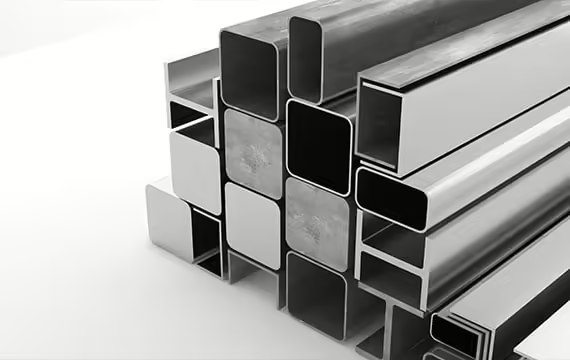
Alloy 4140 steel is often compared to other alloy steels based on specific application requirments.
| Property | Alloy 4140 Steel | Alloy 4340 Steel | Alloy 4130 Steel |
|---|---|---|---|
| Carbon Content (%) | 0.38-0.43 | 0.38-0.43 | 0.28-0.33 |
| Chromium Content (%) | 0.80-1.10 | 0.70-0.90 | 0.80-1.10 |
| Molybdenum Content (%) | 0.15-0.25 | 0.20-0.30 | 0.15-0.25 |
| Nickel Content (%) | – | 1.65-2.00 | – |
| Tensile Strength | High | Very High | Medium High |
| Toughness | High | Very High | High |
| Hardenability | Medium | High | Medium |
| Cost | Medium | Higher | Medium |
This table highlights some key differences in composition and properties between alloy 4140 steel and other commonly used alloy steels. Alloy 4340 steel has higher nickel content which contributes to increased toughness and hardenability. Alloy 4130 has lower carbon content, making it more readily weldable.
Alloy 4140 Steel vs. Alloy 4340 Steel
Alloy 4340 steel offers higher strength and toughness compared to alloy 4140 steel, making it suitable for more demanding applications. However, it is also more expensive.
Alloy 4140 Steel vs. Alloy 4130 Steel
Alloy 4130 steel has lower carbon content than alloy 4140 steel, resulting in improved weldability but slightly lower strength.
Conclusion
Alloy 4140 steel is a highly versatile and widely used low-alloy steel offering an excellent combination of strength, toughness, wear resistance, and fatigue strength. Its adaptability through heat treatment and relative ease of machinability make it a popular choice across various industries. While specific applications may require consideration of alternative materials, alloy 4140 steel remains a reliable and cost-effective solution for many demanding engineering needs. Its balance of properties ensures its continued use in diverse applications.
FAQ
What are the main advantages of alloy 4140 steel?
The main advantages of alloy 4140 steel include its high strength, toughness, wear resistance, fatigue strength, and relative ease of machinability.
Is alloy 4140 steel weldable?
Yes, alloy 4140 steel can be welded using various welding processes. However, preheating and post-weld heat treatment are often recommended to prevent cracking and ensure optimal weld properties.
How is alloy 4140 steel heat treated?
Alloy 4140 steel can be heat treated using various processes, including annealing, hardening, and tempering, to achieve specific desired properties.
What is the difference between alloy 4140 steel and alloy 4340 steel?
Alloy 4340 steel offers higher strength and toughness compared to alloy 4140 steel due to the addition of nickel, making it suitable for more demanding applications. However, it is also more expensive.