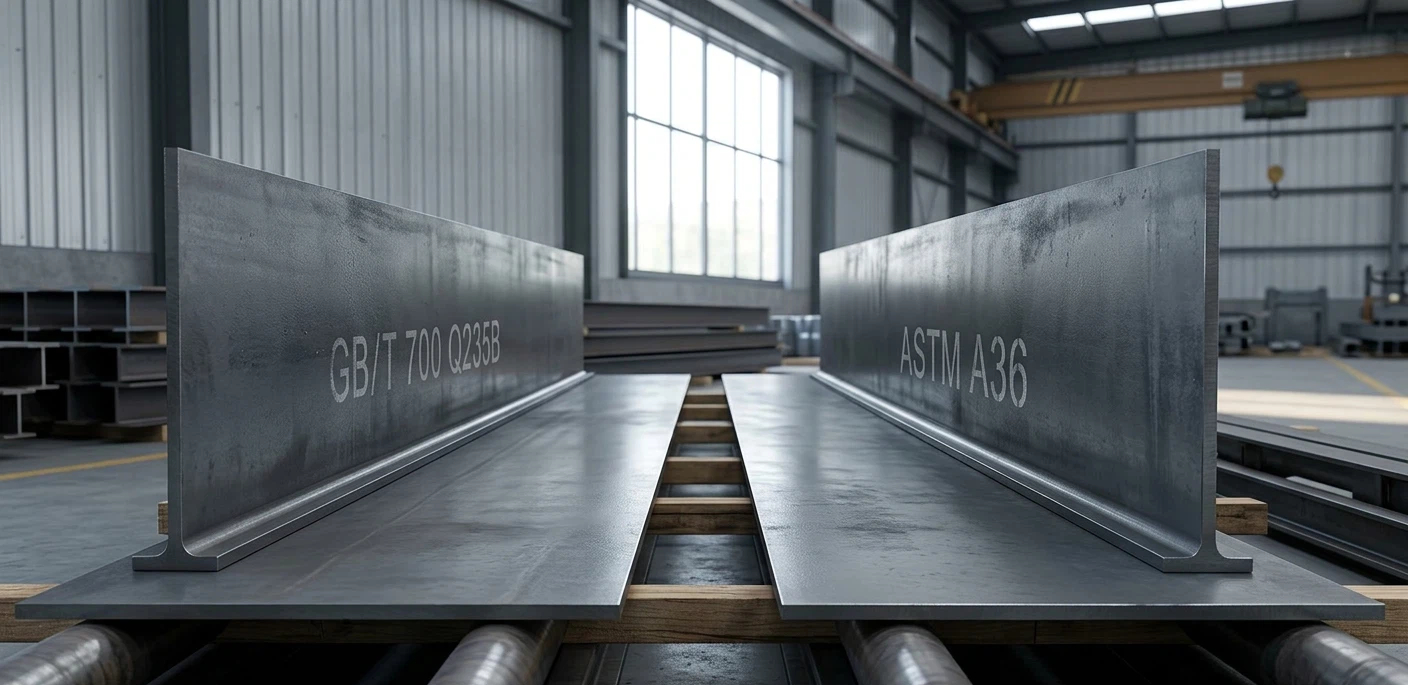
For procurement managers and structural engineers sourcing from overseas markets, comparing Q235B vs ASTM A36 Steel is a standard procedure during the material selection phase. These two grades are the backbones of the global construction and manufacturing industries, representing the Chinese (GB/T 700) and American (ASTM) standards respectively.
While many consider Q235B vs ASTM A36 Steel to be interchangeable, subtle differences in chemical limits and mechanical requirements can impact project certification and structural performance.
To understand the fundamental grade definitions before this comparison, read our pillar article on Q235B Steel Properties and Applications.
Table of Contents
Regulatory Standards: GB/T 700 vs. ASTM A36
The debate over Q235B vs ASTM A36 Steel begins with their governing bodies. Q235B is defined by the Chinese National Standard GB/T 700, where “Q” signifies yield strength and “235” indicates the minimum value in megapascals (MPa).
In contrast, ASTM A36 is maintained by ASTM International. It is one of the most widely used carbon structural steels due to its predictable welding and machining characteristics. When analyzing Q235B vs ASTM A36 Steel, engineers must verify if the specific project code (such as AISC or Eurocode) permits standard substitution.
Chemical Composition: Q235B vs A36 Steel
The weldability of carbon steel is largely determined by its Carbon Equivalent (CE). In the Q235B vs ASTM A36 Steel analysis, both materials fall into the “mild steel” category, meaning they contain less than 0.3% carbon.
According to data from the World Steel Association, controlling trace elements like Phosphorus and Sulfur is essential to prevent “hot shortness” during fabrication.
Comparison Table: Q235B vs ASTM A36 Steel (Chemical Limits %)
| Elemento | Q235B (GB/T 700) | ASTM A36 |
| Carbono (C) | ≤ 0.20% | ≤ 0.26% |
| Manganeso (Mn) | ≤ 1.40% | 0.80 – 1.20% |
| Silicio (Si) | ≤ 0.35% | ≤ 0.40% |
| Fósforo (P) | ≤ 0.045% | ≤ 0.040% |
| Azufre (S) | ≤ 0.045% | ≤ 0.050% |

The slightly higher manganese content allowed in Q235B can improve grain refinement, while the carbon limit in the Q235B vs ASTM A36 Steel comparison shows that A36 allows for a marginally harder material.
Mechanical Performance and Yield Strength
The most critical functional difference in the Q235B vs ASTM A36 Steel comparison is the minimum yield strength requirement.
- Yield Strength: Q235B requires ≥ 235 MPa. ASTM A36 requires ≥ 250 MPa (36 ksi).
- Tensile Strength: Q235B typically ranges from 370–500 MPa, whereas A36 ranges from 400–550 MPa.
Because A36 has a slightly higher yield floor (250 vs 235), it is often considered the “stronger” of the two. However, most modern Chinese mills produce Q235B that regularly tests above 250 MPa, effectively bridging the gap in the Q235B vs ASTM A36 Steel performance delta.
Practical Substitution: Q235B vs A36 Steel in Construction
Can you use Q235B where A36 is specified? For non-critical structural components—such as base plates, brackets, and simple frames—the answer is almost always yes.
When managing the Q235B vs ASTM A36 Steel substitution process, buyers should request a Mill Test Certificate (MTC). This document proves that the specific batch of Q235B meets the 250 MPa yield requirement of A36. This is a common practice for international projects where cost-efficiency is prioritized without sacrificing safety.
Weldability and Fabrication Costs
Fabricators favor both grades because they do not require expensive pre-heating or post-weld heat treatment (PWHT) in standard thicknesses. In the Q235B vs ASTM A36 Steel fabrication workflow, standard E6010 or E7018 electrodes are sufficient for high-quality joints.
The primary driver for choosing Q235B vs ASTM A36 Steel in global markets is often logistics and raw material costs. Q235B is typically more abundant and cost-effective in the Asia-Pacific region, while A36 remains the domestic standard for North American projects.
Final Verdict
Understanding the nuances of Q235B vs ASTM A36 Steel allows companies to optimize their supply chains. While A36 provides a higher guaranteed strength floor, Q235B offers unmatched versatility and cost-performance for global infrastructure projects.
If your project requires high-precision material sourcing, always consult with a certified metallurgist to verify that your choice of Q235B vs ASTM A36 Steel aligns with local building codes.
PREGUNTAS FRECUENTES
Is Q235B an equivalent to ASTM A36?
Yes, they are considered functional equivalents for most structural applications, though A36 has a slightly higher minimum yield strength requirement.
What does the “B” in Q235B represent?
It refers to the quality grade. Grade B involves impact testing at 20°C, providing better reliability than Grade A.
Which is better for welding: Q235B vs A36 Steel?
Both offer excellent weldability. The low carbon content in Q235B vs ASTM A36 Steel ensures minimal risk of cracking during the cooling phase.
Can I get A36 certified steel from China?
Yes, many high-end Chinese mills produce steel that is dual-certified to meet both GB/T 700 and ASTM A36 standards.