Welcome to My Blog!
Before we dive into the content, I’d love for you to join me on my social media platforms where I share more insights, engage with the community, and post updates. Here’s how you can connect with me:
Facebook:https://www.facebook.com/profile.php?id=100087990137347
LinkedIn:https://www.linkedin.com/company/89825762/admin/dashboard/
YouTube:www.youtube.com/@carbonsteelsupply-kj9lw
TikTok:www.tiktok.com/@carbonsteelsupply
Now, let’s get started on our journey together. I hope you find the content here insightful, engaging, and valuable.
Table of Contents
Introducción
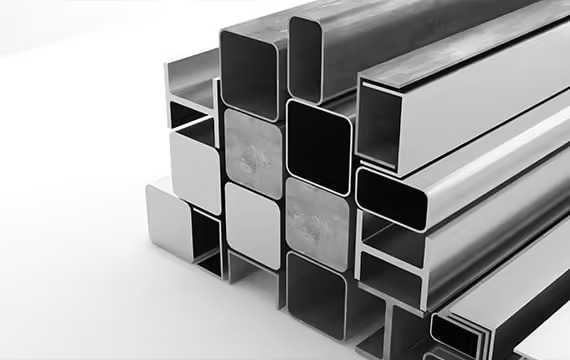
In the realm of materials science and engineering, 10250 Steel stands as a versatile and widely used alloy. Its widespread adoption stems from its ability to provide a reliable balance of strength and ductility. This medium-carbon steel, known for its balance of strength and ductility, finds applications across various industries. Understanding its properties and uses is crucial for engineers, manufacturers, and anyone involved in material selection and design. This article delves into the intricacies of 10250 Steel, exploring its composition, mechanical properties, heat treatment processes, and diverse applications. By the end of this article, you’ll have a thorough understanding of why 10250 Steel is chosen for so many different projects.
Chemical Composition and Material Characteristics of 10250 Steel
The chemical composition of 10250 Steel plays a significant role in determining its properties. Primarily, it is a medium-carbon steel, meaning it contains a moderate amount of carbon. This carbon content, typically ranging from 0.22% to 0.29%, provides a good balance between strength and formability. The presence of manganese, usually between 0.40% and 0.70%, further enhances its strength and hardness. Trace amounts of other elements like silicon, phosphorus, and sulfur are also present, each contributing to the overall characteristics of the material. The careful control of these elements during the manufacturing process ensures the consistency and reliability of 10250 Steel. This precise control also allows for predictable outcomes when the steel is subjected to various manufacturing or heat treatment processes.
This specific chemical make up leads to a few material characteristics. 10250 alloy steel exhibits good machinability, making it suitable for various manufacturing processes. It also possesses reasonable weldability, although preheating and post-welding heat treatment may be necessary depending on the application. The material’s response to heat treatment, such as hardening and tempering, allows for tailoring its properties to meet specific requirements. This adaptability is one of the key reasons why 10250 Steel is so widely used across different sectors.
Propiedades mecánicas de 10250 Alloy Steel
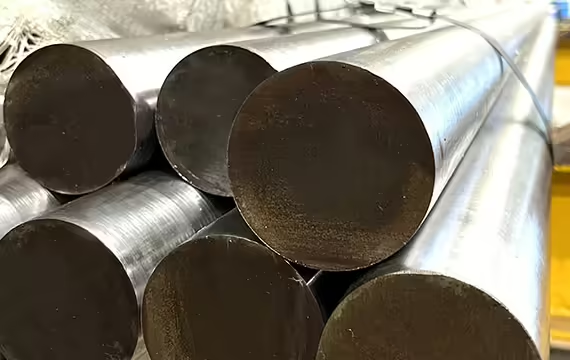
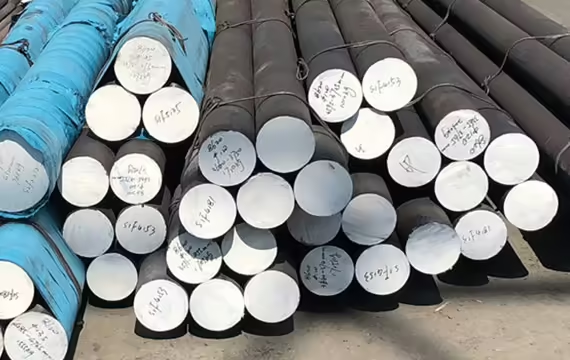
The mechanical properties of 10250 Steel are essential for understanding its performance in different applications. These properties include tensile strength, yield strength, elongation, and hardness. Each of these properties plays a crucial role in determining how the material will behave under stress and strain.
- Tensile Strength: This measures the maximum stress the material can withstand while being stretched or pulled before breaking. 10250 Steel exhibits a moderate tensile strength, making it suitable for applications where strength is required but not at extreme levels. This balance of strength allows for a wide range of use cases.
- Yield Strength: This indicates the stress at which the material begins to deform plastically. 10250 alloy Steel possesses a reasonable yield strength, providing resistance to permanent deformation under load. This means that the material can withstand a certain amount of stress without permanently changing shape.
- Elongation: This measures the material’s ability to stretch or elongate before fracturing. 10250 alloy Steel demonstrates good ductility, allowing it to deform without breaking, which is crucial for applications involving bending or forming. This flexibility is essential in applications where the material might be subjected to impact or bending.
- Hardness: This measures the material’s resistance to indentation or scratching. 10250 Steel can achieve various hardness levels through heat treatment, allowing for customization based on specific needs. This adaptability makes it suitable for applications requiring different levels of surface hardness.
Heat Treatment of 10250 Steel
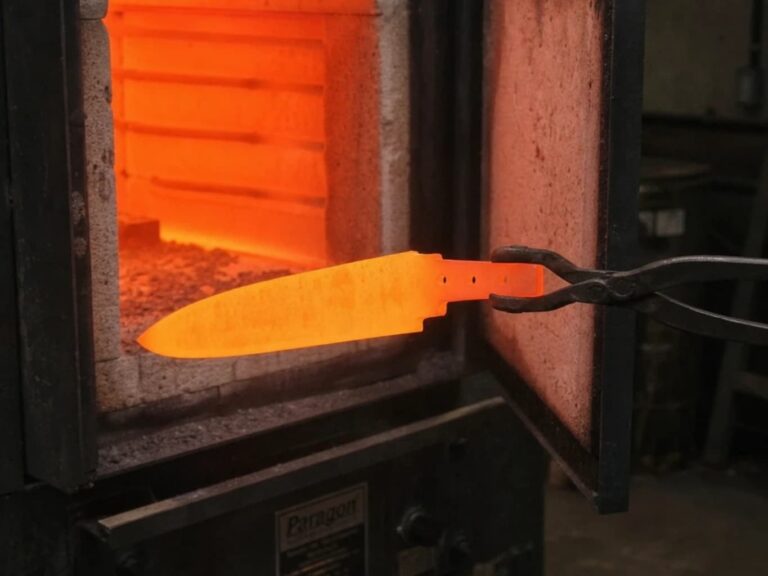
Heat treatment is a critical process for modifying the mechanical properties of 10250 steel. Common heat treatment methods include: These processes are crucial for tailoring the material’s characteristics to specific application requirements.
- Annealing: This process involves heating the steel to a specific temperature and then cooling it slowly to relieve internal stresses and improve ductility. This ensures the material is more malleable and less prone to cracking.
- Normalizing: This process refines the grain structure of the steel, enhancing its strength and toughness. This results in a more uniform and robust material.
- Hardening: This involves heating the steel to a high temperature and then quenching it in water or oil to increase its hardness. This process makes the material more resistant to wear and abrasion.
- Tempering: This process follows hardening and involves reheating the steel to a lower temperature to reduce brittleness and improve toughness. This balances the hardness achieved during hardening with the required level of ductility.
These heat treatment methods allow manufacturers to tailor the properties of 10250 alloy steel to meet the demands of various applications. The ability to fine-tune the material’s properties through heat treatment is a significant advantage.
Aplicaciones de 10250 Steel
10250 Steel finds diverse applications across multiple industries due to its versatile properties. Some common applications include: The balance of strength and formability makes it a popular choice for many engineering tasks.
- Automotive Industry: Used in the production of various components, such as gears, shafts, and axles. These parts require a material that can withstand significant stress and wear.
- Construction Industry: Employed in the manufacturing of structural components, bolts, and fasteners. The reliability and strength of 10250 steel makes it a valuable material for building projects.
- Machinery Manufacturing: Utilized in the production of machine parts, tools, and equipment. This includes components that require both durability and precision.
- Agricultural Equipment: Used in the manufacturing of agricultural machinery components. Its ability to handle tough conditions makes it suitable for farm equipment.
- General Engineering: Suitable for a wide range of general engineering applications requiring a balance of strength and ductility. From simple tools to complex mechanisms, 10250 steel provides a reliable solution.
10250 Steel: Detailed Material Properties Table.
To further illustrate the properties of 10250 Steel, here’s a table summarizing its key characteristics: This table provides a quick reference for engineers and designers when considering 10250 steel for their projects.
| Propiedad | Value | Unit |
|---|---|---|
| Resistencia a la tracción | 500-600 | MPa |
| Límite elástico | 300-400 | MPa |
| Elongation | 20-30 | % |
| Hardness (HB) | 150-180 | HB |
| Carbon Content | 0.22-0.29 | % |
| Manganese Content | 0.40-0.70 | % |
| Densidad | 7.85 | g/cm^3 |
Factors Affecting 10250 Steel Performance
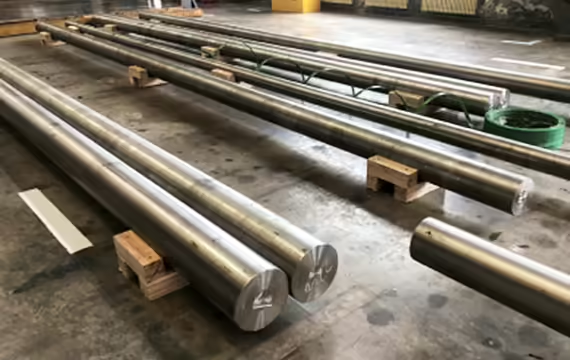
Several factors can influence the performance of 10250 Steel in various applications. These include: Understanding these factors is crucial for ensuring the material performs as expected in its intended environment.
- Heat Treatment: The specific heat treatment process used can significantly impact the material’s mechanical properties. This allows for fine-tuning the material for specific applications.
- Manufacturing Processes: Processes like machining, welding, and forming can affect the material’s integrity and performance. Care must be taken to ensure these processes do not introduce defects.
- Environmental Conditions: Exposure to extreme temperatures, corrosive environments, or high stress levels can influence the material’s durability. Choosing the correct protective coatings and considering the environment that the steel will be in, is very important.
- Load Conditions: The magnitude and type of load applied to the material can determine its suitability for a particular application. Engineers must accurately calculate the loads that will be applied to the material.
- Material Impurities: Excess impurities within the steel, can degrade the steels overall performance. High quality manufacturing processes are important to limit these impurities.
Understanding these factors is crucial for ensuring the reliable performance of 10250 Steel in diverse applications. Careful consideration of these factors will lead to successful use of the material.
Conclusión
10250 Steel is a versatile and reliable material that finds applications across various industries. Its balance of strength, ductility, and machinability, combined with its ability to be heat-treated, makes it a valuable choice for numerous engineering applications. By understanding its properties, applications, and limitations, engineers and manufacturers can effectively utilize 10250 Steel to meet their specific needs.
PREGUNTAS FRECUENTES
Q: What is 10250 Steel used for?
A: 10250 Steel is used for a variety of applications, including automotive components, construction materials, machinery parts, and agricultural equipment.
Q: Can 10250 Steel be welded?
A: Yes, 10250 Steel can be welded, but preheating and post-welding heat treatment may be required depending on the application.
Q: How does heat treatment affect 10250 Steel?
A: Heat treatment can significantly alter the mechanical properties of 10250 Steel, allowing for customization of its strength, hardness, and ductility.