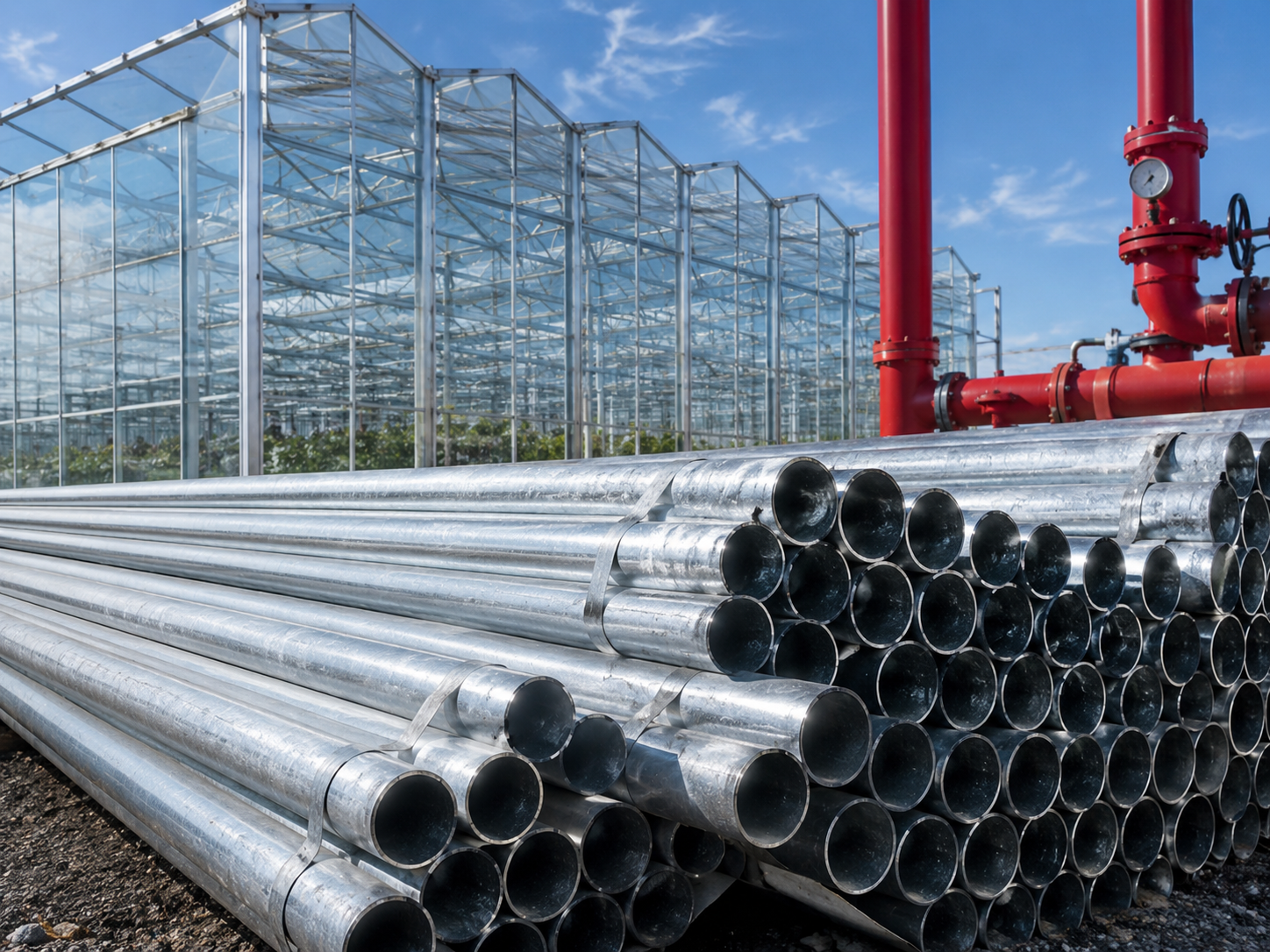
In the rigorous world of industrial infrastructure and structural engineering, selecting a material that balances structural integrity with long-term resilience is paramount. For decades, the Galvanized Steel Pipe has remained the backbone of municipal, agricultural, and commercial construction projects globally. Whether it’s supporting the skeletal framework of a high-tech greenhouse or serving as the critical lifeline for fire protection systems, this versatile material offers a unique synergy of high mechanical strength and superior corrosion resistance.
However, as engineering standards evolve, simply “buying steel” is no longer enough. Procurement managers and contractors must understand the nuances of coating thickness, the chemical bond of the zinc layer, and the specific environmental limitations of the product. This guide provides a comprehensive breakdown of the Galvanized Steel Pipe, exploring its dual-nature manufacturing (hot-dip vs. cold), its strategic advantages in high-load applications, and the vital audit checkpoints every construction team needs to consider before bulk procurement.
Table of Contents
What is galvanized steel pipe

A galvanized steel pipe is a pipe with a layer of zinc coating on the surface of an ordinary steel pipe.It comes in two types:hot-dip galvanized and cold galvanized.
Relying on the zinc layer to isolate air and moisture,it prevents the steel pipe from rusting and corrosion,thereby enhancing durability and service life.
It features uniform wall thickness,good strength,easy installation,and high cost-effectiveness.It is commonly used for supply and drainage pipelines,fire protection piping,gas transmission,greenhouse steel frames,electrical conduit,and general building hardware supports.It is widely used metal pipe material in both engineering and daily life.
Advantages and limitations of galvanized steel pipe
Advantages
The surface zinc coating provides strong protection,making it resistant to rust and corrosion,and extending its service life.
High overall hardness,strong compression resistance,and mechanical performance.
Easy to process and install,with simple connection methods,affordable and cost-effective.
Strong versatility,suitable for applications such as water supply and drainage,fire protection,and cable protection.
Limitations
Poor high-temperature resistance,the zinc coating is easily damaged and peels off in high-temperature environments.
When the pipe diameter is large,the self-weight becomes relatively heavy,increasing the burden of transportation and installation.
In long-term damp or acidic/alkaline environments,the coating is easy to oxidation (whitening),aging,and peeling.
The inner wall is rough,resulting in high fluid resistance,making it unsuitable for high-pressure pure water or precision conveying pipelines.
What’s the applications of galvanized steel pipe?
Galvanized steel pipes are corrosion-resistant,durable,and cost-effective,making them extremely versatile.
They are widely used for indoor and outdoor water supply and drainage,as well as fire protection water supply pipelines.They are also commonly used for low-pressure gas transmission and as protective conduits for electrical wires and cables.
In agriculture,they can be used to build greenhouse frames and fence protection.
In engineering,they serve as steel structural supports,handrails,municipal protective facilities.
They are also commonly applied in factory ventilation,general process fluid conveyance,and other scenarios.


Conclusion
Navigating the complexities of modern building codes requires materials that deliver predictable performance over a multi-decade lifecycle. As we have explored, the Galvanized Steel Pipe remains an unrivaled cost-effective solution for fire protection, electrical conduit, and structural supports, provided the environment matches the coating’s specifications. While the shift away from potable water applications is a historical reality, its dominance in industrial fluid conveyance and municipal infrastructure continues to grow.
Ultimately, the longevity of your project depends on the quality of the protective zinc barrier and the precision of the manufacturing process. Choosing a high-grade Galvanized Steel Pipe is more than a procurement decision—it is an investment in safety and reduced maintenance overhead. For steel structure contractors and engineering teams looking to optimize their 2026 supply chain, understanding these technical boundaries is the first step toward building structures that truly stand the test of time.
FAQ
What is the difference between hot-dip galvanizing and cold galvanizing?
Hot-dip galvanizing produces a thick,firmly bonded coating with strong corrosion resistance,it is suitable for long-term outdoor and engineering use.
Cold galvanizing results in a thinner coating with a bright appearance but weaker corrosion resistance,often used for indoor,temporary,or light-duty applications.
Can it be used as drinking water pipe?
Old-style galvanized pipes are easy to scale buildup and impurities on the inner wall.They have now been largely phased out and no longer recommended for use as drinking water pipelines.
Where are they mainly used?
They are widely used in fire protection pipelines,electrical conduit,outdoor support railings,greenhouse construction,
municipal protection,and general low-pressure fluid conveyance.
What is the approximate service life?
In dry indoor environments,the service life is relatively long.In outdoor open-air environments,it deteriorates faster and requires regular maintenance for corrosion protection.