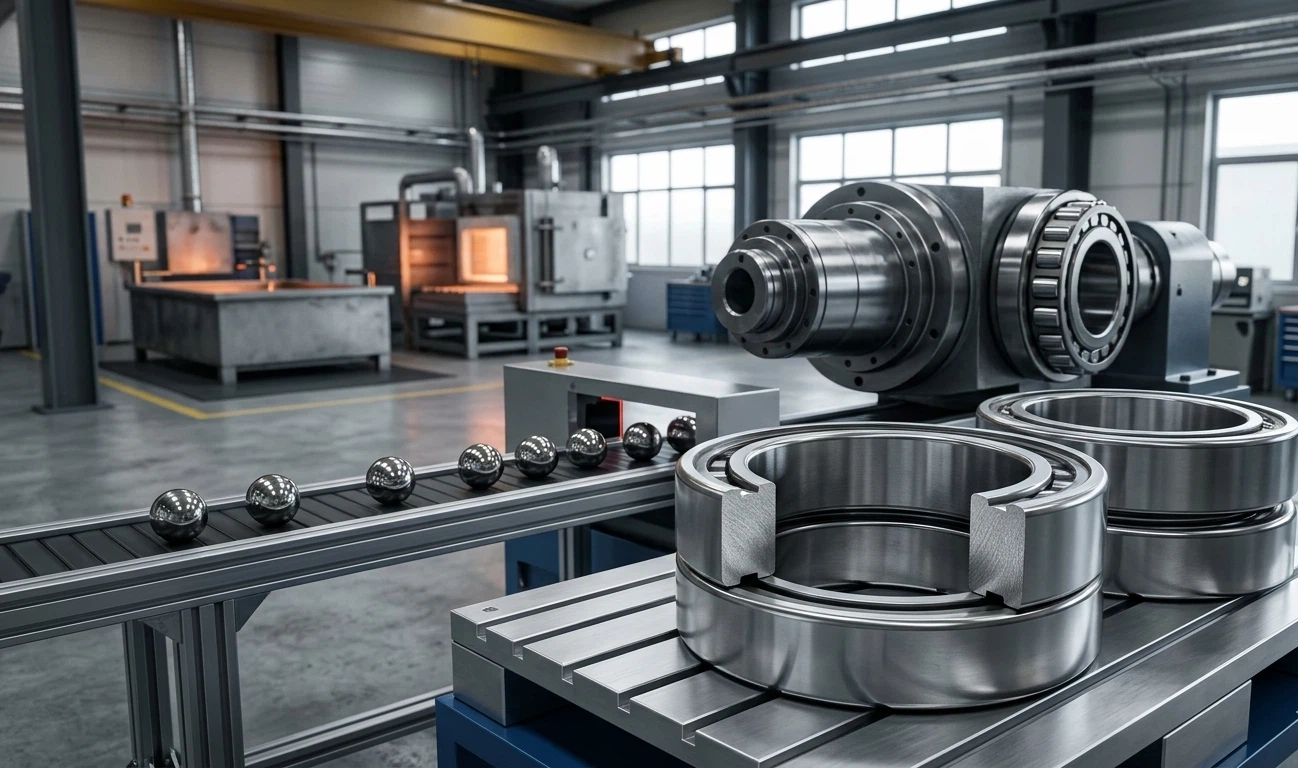
If you’ve ever torn down a machine tool spindle that’s been humming for tens of thousands of hours or swapped out a set of deep-groove ball bearings, you’ve likely held GCr15 Bearing Steel in your hands without even realizing it.
In the world of precision manufacturing, we don’t often waste time discussing flashy, exotic alloys. Why? Because GCr15 Bearing Steel has spent over half a century proving itself as the absolute “industrial backbone” of rotating machinery. It isn’t a high-priced “special forces” material packed with rare elements; instead, it is an elite “all-around warrior” that strikes a near-perfect balance between high hardness, exceptional fatigue strength, and rock-solid dimensional stability. From standard electric motors to high-load mining equipment, this steel covers more than 80% of the world’s rolling bearing applications.
But is this ubiquitous “old friend” as easy to handle as it looks? Not quite. To truly unlock the potential of GCr15 Bearing Steel, you need to respect its narrow heat treatment window and its zero-tolerance policy toward impurities. Today, we’re breaking down why this “mid-tier priced” steel remains the irreplaceable MVP of precision engineering.
Table of Contents
What the name actually means
GCr15. The “G” stands for rolling bearing steel. “Cr15” means roughly 1.5% chromium. Carbon sits at 0.95% to 1.05%, with a dash of silicon and manganese thrown in. Nothing exotic. Just a formula that works.
Same material as AISI 52100 in the US, SUJ2 in Japan. Different labels, identical chemistry. It’s the most widely produced bearing steel on the planet for a reason.
Made in electric arc furnaces, then cleaned up through electroslag remelting or vacuum refining. Sulfur and phosphorus get kept tight. The purity matters — impurities kill bearing life.
Heat treat it right and you get consistent high hardness across the whole piece. That’s what precision manufacturing demands.
Where it shines
Wears like iron
Chromium teams up with carbon to form complex carbides. After quench and temper, you’re at HRC 61-66. Compared to plain carbon tool steel, wear resistance jumps 30% to 50%. It takes the rubbing and keeps going.
Handles the load cycle after cycle
Contact fatigue life hits 10 million cycles and beyond. High-speed rotation, heavy loads — it doesn’t flinch. No pitting, no spalling, no surprise failures.
Stays put once you machine it
Uniform microstructure after heat treatment. Add cryogenic treatment and dimensional stability gets ridiculous — micron-level precision. Doesn’t wander on you over time. Critical when you’re making precision components.
Won’t break the bank
Moderate alloy content, mature production, reasonable price tag. Cheaper than specialty bearing steels. Covers 80% plus of normal applications worldwide. Sometimes the standard choice is the smart choice.
Tough enough for most environments
Runs from -40°C up to 150°C without drama. Corrosion resistance runs 3 to 4 times better than plain carbon steel. Dry shop, humid climate, whatever — it adapts.
Where it falls short
Not fun to machine
Cold workability is middling. Cutting takes effort. You need the right inserts, the right speeds and feeds. Tooling costs add up. Not impossible, just picky.
Don’t even think about welding it
Cracks. Embrittlement. Problems everywhere. Standard practice: don’t weld it. If you absolutely must, special pretreatment first. Most shops just avoid the headache.
Brittle side
Sensitive to white spot formation. First-stage temper brittleness is a thing. Low-temperature impact toughness is only so-so. Heavy shock loads? Look elsewhere. It’ll snap before it bends.
Heat treatment is make-or-break
Temperature control, soak time, cooling rate — miss any of it and you get soft spots, bad microstructure, wasted material. The process window isn’t forgiving. Experienced heat treater required.
Where it actually goes
Bearings, obviously
Wall thickness up to 12mm, outer diameter under 250mm — that’s your bearing ring territory. Steel balls from 25.4mm to 50.8mm. Rollers under 22mm. Motors, automotive, machine tools. The usual suspects.
Precision machinery
Machine tool spindles, ball screws. Anything needing rotational accuracy and stiffness. It holds the tolerances.
General rotating equipment
Fans, pumps, gearboxes. Mining machinery wear parts. Rolling mill components. The heavy stuff that turns and turns and turns.
Oddball applications
Precision measuring tools, cold work dies. Aircraft engine nozzles, plungers, anything where abrasion resistance is the main game. Versatile material if you respect its limits.


Заключение
The bottom line is that the global popularity of GCr15 Bearing Steel isn’t because it hits a physical limit in any single category. Rather, it’s because it finds the “sweet spot” between cost, machinability, and mechanical service life. It is the definitive “80/20 rule” material: it solves 80% of your rotational design headaches at less than half the price of specialty alloys.
Of course, this material has its “moods.” It hates being welded, it’s hyper-sensitive to heat treatment fluctuations, and it will snap before it bends under extreme shock loads. But if you respect those physical boundaries—giving it a clean melting environment and a precise tempering cycle—GCr15 Bearing Steel will maintain micron-level accuracy across millions of rotation cycles.
ЧАСТО ЗАДАВАЕМЫЕ ВОПРОСЫ
What hardness should I expect, and how do I keep it uniform?
HRC 61-66 after quenching and low-temperature tempering. For consistency, control the process tight. Spheroidizing anneal first to kill residual stress. Even heating, stable cooling during quench.For precision parts, throw in cryogenic treatment. The extra step pays off.
What’s the real difference from plain carbon steel?
Night and day. GCr15 has the carbon and chromium to deliver hardness, wear resistance, contact fatigue strength. Plain carbon steel is soft, wears fast, only good for low-stress structural pieces with zero abrasion. Plus GCr15 holds dimensions way better.
Why is my GCr15 coming out soft?
Three usual suspects. One: quench temperature too low or cooling too slow — not enough martensite forms. Two:tempertemperature too high — you gave away the hardness. Three: surface decarburization during heating. Check the decarb layer per spec, fix your furnace atmosphere or machining allowances.