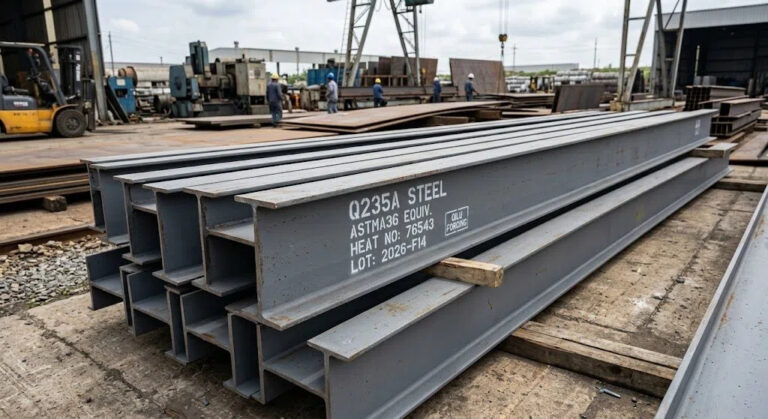

An H-beam, also known as H-section steel, is a structural member with a cross-section shaped like the capital letter “H.” It consists of two wide, parallel flanges joined by a central vertical web. Both flanges and the web usually have similar thicknesses, creating a highly efficient geometry for carrying bending and shear loads.
H-beams are valued for their superior strength-to-weight ratio, stability, and ability to bear large loads over long spans. They are extensively used in modern buildings, bridges, shipbuilding, and machinery manufacturing, forming the backbone of many large-scale engineering structures.
Table of Contents
Understanding H-Beam Design and Structural Composition
The structural design of an H-beam focuses on the relationship between the flange and web dimensions. The flanges resist most of the bending moment, while the web handles shear stress. This efficient material distribution allows engineers to achieve high strength with minimal weight. The result is a component that offers excellent rigidity and load distribution while remaining cost-effective. Proper selection of flange width, web height, and thickness is critical to ensure that the beam performs safely under bending, compression, and torsion forces.
Common H-Beam Dimensions and Size Standards
H-beams are produced in many standard sizes to meet different design needs. Height generally ranges from 100 mm for light-duty structures to more than 900 mm for heavy industrial applications. Flange widths typically vary between 50 mm and 400 mm, with thickness depending on required load capacity. Manufacturers follow standards such as ASTM, EN, or JIS to guarantee uniformity and reliability. Engineers choose beam dimensions according to project span, load type, and deflection criteria, ensuring optimal efficiency and safety in both static and dynamic environments.
H-Beam Types and Classifications Explained
H-beams can be classified according to several characteristics that determine their performance and suitability for different environments and applications. The following table provides a clear overview of the main classifications and their practical uses:
| Classification | Type | Description and Typical Use |
|---|---|---|
| By Flange Width | Wide Flange (HW), Medium Flange (HM), Narrow Flange (HN) | Wide flange beams are used for heavy columns and large spans; medium and narrow flange beams are suited for lighter frameworks. |
| By Production Process | Hot-Rolled H-Beam, Welded H-Beam | Hot-rolled beams are economical and mass-produced; welded beams offer higher precision and can be customized for special structures. |
| By Application | Building, Bridge, Machinery, Shipbuilding | Each beam type is selected based on environmental exposure, load type, and performance requirements. |
| By Material | Carbon Steel, High-Strength Low-Alloy Steel, Weathering Steel, Stainless Steel | Carbon steel is cost-effective; weathering and stainless steel provide enhanced corrosion resistance. |
Understanding these categories helps designers and engineers choose the most appropriate H-beam for each project, balancing strength, cost, and long-term durability.
H-Beam vs. I-Beam: Understanding the Key Differences

Although similar in appearance, H-beams and I-beams serve different structural purposes. H-beams have wider, thicker flanges and a uniform cross-section, which gives them greater section modulus and higher bending resistance. This makes them suitable for heavy loads and long spans. I-beams, with narrower flanges, are more economical for smaller beams and secondary structures. In general, H-beams provide better stability and performance where stiffness and strength are priorities, while I-beams are chosen when lightweight economy is more important.
Advantages of Using H-Beams in Engineering Projects
H-beams offer a wide range of advantages that make them indispensable in structural design. Their high strength and stiffness enable them to support substantial loads without deformation. Their excellent workability allows for easy cutting, drilling, and welding, reducing fabrication time. The superior weldability of H-beams ensures strong, reliable joints, which is essential for structural safety. Because they are lighter relative to their load capacity, H-beams reduce foundation requirements and transportation costs. They are also highly cost-effective due to efficient material use and have strong environmental credentials since steel is recyclable and reusable.
Limitations and Design Challenges of H-Beams
Despite their many strengths, H-beams have certain limitations. Standard carbon steel types have poor corrosion resistance and need surface treatments or coatings in damp or chemically aggressive environments. The thin web and flanges may experience local buckling under extreme stress if not adequately reinforced. Manufacturing precision is critical—small deviations in size or alignment can affect structural behavior. Welding requires strict quality control to prevent cracking or warping, and long or heavy beams can be difficult to transport and install without special equipment. Understanding and addressing these challenges ensures that H-beams perform safely and efficiently.
Major Applications of H-Beams in Modern Engineering
H-beams play an essential role in almost every structural and industrial field. In building construction, they are used for columns, beams, and roof trusses in high-rise and industrial facilities. In bridge engineering, they serve as main girders and support members exposed to heavy traffic and environmental forces. In machinery manufacturing, they form equipment frames, machine bases, and support structures. In shipbuilding, H-beams strengthen keels, ribs, and decks to enhance rigidity and safety. They are also critical in power transmission towers, communication towers, railway vehicles, offshore platforms, and other large infrastructure projects.
Selecting the Right H-Beam for Your Project
Choosing the appropriate H-beam requires careful evaluation of load type, span, and environmental factors. Wide-flange beams are best for heavy columns and long spans, while medium and narrow flanges work well for lighter frames and secondary members. Material selection is equally important—weathering steel is ideal for outdoor structures exposed to the elements, while stainless steel suits marine and chemical environments. Considering production method, corrosion protection, and fabrication requirements helps optimize performance, reduce costs, and extend the lifespan of the final structure.
Sustainable Benefits of H-Beams in Green Construction
H-beams contribute significantly to sustainable building practices. Modern steel manufacturing minimizes waste and energy consumption, and all H-beam steel is fully recyclable. Using H-beams helps reduce the overall quantity of material needed for a project, lowering carbon emissions during both production and transportation. They are also ideal for modular and prefabricated construction, allowing faster assembly and easier disassembly or reuse. As green construction standards evolve, H-beams remain a preferred choice for developers seeking long-term performance and environmental responsibility.

Future Trends and Innovations in H-Beam Technology
Advances in material science and digital fabrication are reshaping the future of H-beam production. Emerging high-strength alloys and precision-rolled sections are enabling lighter, stronger beams with improved resistance to fatigue and corrosion. Automated welding and smart monitoring systems are enhancing manufacturing accuracy and quality assurance. The integration of H-beams with hybrid materials such as concrete and composite fiber is creating new possibilities for sustainable, high-performance structures. These innovations ensure that H-beams will continue to play a central role in the evolution of modern infrastructure worldwide.
Заключение
The H-beam stands as one of the most reliable and efficient components in structural design. Its optimized shape, superior load-bearing performance, and flexibility in fabrication make it essential across industries. While corrosion protection, stability, and precision remain key considerations, proper design and quality control can easily overcome these challenges.
H-beams offer long-term durability, economic efficiency, and environmental advantages that align perfectly with the demands of twenty-first-century construction. For engineers, architects, and builders alike, understanding how to leverage H-beams effectively is fundamental to achieving safe, sustainable, and high-performance structures.
ЧАСТО ЗАДАВАЕМЫЕ ВОПРОСЫ
What is an H-beam used for?
An H-beam is mainly used in construction, bridges, shipbuilding, and machinery manufacturing to support heavy loads and provide structural stability.
What is the difference between an H-beam and an I-beam?
H-beams have wider flanges and a thicker web, giving them higher strength and better load distribution, while I-beams are lighter and suited for smaller spans.
What are the advantages of using H-beams?
H-beams offer excellent strength-to-weight ratio, easy fabrication, high weldability, and lower material costs, making them ideal for modern steel structures.
What materials are H-beams made of?
Common materials include carbon steel, high-strength low-alloy steel, weathering steel, and stainless steel, depending on the environment and load requirements.
Are H-beams suitable for sustainable construction?
Yes. H-beams are recyclable, durable, and efficient in material use, helping reduce waste and carbon emissions in green building projects.
Need Help Choosing the Right H-Beam for Your Project?
If you’re not sure which H-beam type, size, or material is best for your construction or engineering project, our structural steel experts are ready to assist. Contact us today for a personalized consultation and get professional guidance on selecting the most efficient and cost-effective H-beam solution. Don’t leave your project’s strength to chance—reach out now to build smarter, stronger, and safer!