Welcome to My Blog!
Before we dive into the content, I’d love for you to join me on my social media platforms where I share more insights, engage with the community, and post updates. Here’s how you can connect with me:
Facebook:https://www.facebook.com/profile.php?id=100087990137347
LinkedIn:https://www.linkedin.com/company/89825762/admin/dashboard/
YouTube:www.youtube.com/@carbonsteelsupply-kj9lw
TikTok:www.tiktok.com/@carbonsteelsupply
Now, let’s get started on our journey together. I hope you find the content here insightful, engaging, and valuable.
Table of Contents
Введение
–1.2343
1.2343 mould steel belongs to electroslag remelting hot work mould steel, with material uniformity and superior machinability and polishability, with good high toughness and high plasticity, high abrasion resistance at high and low temperatures and overall hardenability are excellent, with resistance to thermal cracking and provide good thermal conductivity.
–1.2344
1.2344 steel is a hot work mould steel with good temper resistance and high temperature toughness, high thermal shock resistance and excellent hardenability. This steel is treated with electroslag remelting to ensure homogeneity of the material, enabling it to perform well in high temperature working environments.
Chemical Composition
| Grade | C | Si | Mn | P | S | Cr | Mo | V |
| 1.2343 | 0.36-0.42 | 0.80-1.2 | 0.30-0.50 | ≤ 0.015 | ≤ 0.002 | 4.8-5.2 | 1.10-1.40 | 0.30-0.50 |
| Grade | C | Si | Mn | P | S | Cr | Mo | V |
| 1.2344 | 0.37-0.42 | 0.90-1.2 | 0.30-0.50 | ≤ 0.030 | ≤ 0.030 | 4.8-5.5 | 1.20-1.50 | 0.90-1.1 |
1.2343 vs. 1.2344 Mould Steels

Common Point
Both 1.2343 and 1.2344 are hot work mould steels that share many common characteristics and are suitable for similar application scenarios. Here are some of the things they have in common:
Chemical composition: Both steels contain high levels of chromium (Cr), molybdenum (Mo) and vanadium (V). The addition of these alloying elements improves the steel’s thermal stability, wear resistance and temper resistance.
-Heat treatment: Both 1.2343 and 1.2344 can be heat treated to optimise their properties, including quenching and tempering processes to obtain the required hardness and toughness.
High strength and toughness: Both steels have excellent strength and toughness and are capable of working under conditions of high loads and temperature variations.
-Areas of application: They are both widely used in the manufacture of moulds requiring high wear, heat and compression resistance, such as die casting moulds, hot extrusion moulds, hot stamping moulds and so on.
-Corrosion resistance: Both steels have a certain degree of corrosion resistance and, although not specifically designed for corrosion resistance, they provide adequate corrosion resistance in many industrial applications.
-Machinability: Both 1.2343 and 1.2344 have good machinability and can be fabricated and shaped by conventional metal working methods.
-International standards: Both steels have international counterparts, with 1.2343 generally conforming to EN 10083/1-1991 and 1.2344 to EN 10083/1-1991 and ISO 683-18-2014.
-Corresponding grades: Both steels have corresponding grades in different countries and regions, such as H11 and H13 in the US ASTM standard and SKD61 in the Japanese JIS standard.
Differences
1.2343 and 1.2344 are both hot work mould steels, they have many similarities but there are some key differences:
Chemical composition: Although both steels have a similar chemical composition, 1.2344 typically has a higher vanadium (V) content than 1.2343, which makes 1.2344 superior in terms of wear resistance.
-Wear resistance: 1.2344 is more wear resistant than 1.2343, which generally means that 1.2344 will last a little longer.
-Areas of application: 1.2343 is mainly used in die casting moulds, hot extrusion dies for aluminium-copper-magnesium alloys, plastic injection moulds, cold punched cutting edges, hot shears, tight rings and wear parts. While 1.2344 is more used in die casting moulds, extrusion moulds, hot pressing moulds (such as aluminium, magnesium, copper alloys), plastic moulds (injection moulds), and cold shear, flying edge, hot shear, pre-tightening rings, wear-resistant parts, and so on.
-Price: Under the same process conditions, the price of 1.2344 is usually about $10/KG higher than 1.2343.
-Heat Treatment Properties: Both can be heat treated to adjust their hardness and organisation to meet the needs of different moulds.
-Purity: Both steels have high purity requirements, which are usually controlled according to ASTM E45 Method A or DIN 50602 standards.
Application scenarios for 1.2343 and 1.2344
-1.2343 mould steel is an electroslag remelted hot work mould steel with the following application scenarios:
-Die casting moulds: including die nuts, inserts, cores, diverter cones, nitrided ejector pins, etc.
Extrusion moulds: including die nuts, die pads, flow stops, etc.
-Hot press forming dies: for aluminium, copper, magnesium and other materials.
Cold punching and loading, hot shearing, tightening rings and wear-resistant parts: due to its high wear resistance and strength, 1.2343 is also suitable for manufacturing cold punching and cutting, hot shearing, tightening rings and wear-resistant parts.
-Plastic moulds: 1.2343 mould steel is able to withstand working environments at high temperatures and pressures, ensuring the stability and durability of the mould.
-Stamping and hot pressing moulds: The excellent mechanical properties of 1.2343 mould steel ensure the stability and precision of the mould.
-Corrosion-resistant environment: 1.2343 steel also has good corrosion resistance, suitable for possible exposure to corrosive media environment
-1.2344 mould steel, also known as H13 steel, is a hot work mould steel with the following application scenarios:
-Plastic injection moulds: 1.2344 steel is suitable for the manufacture of injection moulds, which are subject to high temperatures and pressures in the production of plastic products, due to its heat and wear resistance.
-Die casting moulds: This steel is suitable for the manufacture of die casting moulds, including die nuts, fixings, upper moulds, nozzles, nitrided ejector pins, etc.
-Hot work moulds: The heat-resistant properties of 1.2344 steel make it suitable for the manufacture of hot work moulds, which can withstand hot pressing and deformation at high temperatures.
-Extrusion dies: 1.2344 steel is also commonly used to make hot extrusion dies for aluminium, copper and magnesium alloys.
-Corrosion-resistant environments: Due to the presence of elements such as vanadium and molybdenum, 1.2344 mould steel has good corrosion resistance and is suitable for corrosive environments, such as tools used in pickling shops.
-Forgings: 1.2344 steel is also suitable for the manufacture of large forging dies, hot forging dies and cold forging dies.
-Plates and rounds: 1.2344 steel can also be used to manufacture mould plates, structural plates as well as mould rounds and tool rounds.
Which should I use, 1.2343 or 1.2344?
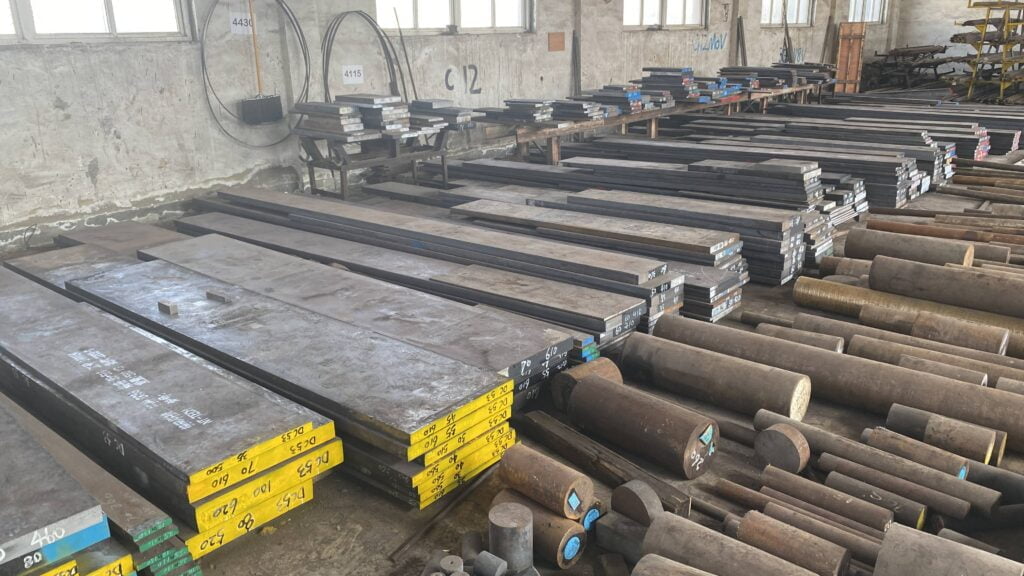
Whether you choose 1.2343 or 1.2344 mould steel depends largely on your specific needs:
-Wear resistance: If your application requires higher wear resistance, 1.2344 may be the better choice as it is generally more wear resistant and has a longer service life than 1.2343.
-Cost: If you are cost sensitive, 1.2343 is about $10/KG less than 1.2344 for the same process.
-Areas of application: 1.2343 is mainly used in die casting moulds, hot extrusion dies, plastic injection moulds, as well as in cold blanking, hot shears, tight rings and wear parts, while 1.2344, in addition to the above mentioned applications, is particularly suitable for highly loaded extrusion moulds and hot press moulds, as well as in situations where higher wear resistance is required.
-Chemical composition: The vanadium (V) content of 1.2344 is generally higher than that of 1.2343, making 1.2344 superior in terms of wear resistance.
-Heat Treatability: Both have good heat treatability and can be heat treated to adjust their hardness and organisation to meet the needs of different moulds.
Заключение
Both 1.2343 and 1.2344 are high quality hot work die steels suitable for the manufacture of demanding moulds. 1.2343 is widely used in die casting, hot extrusion and plastic injection moulds for its good toughness and high temperature properties, whilst 1.2344, with its higher vanadium content, offers improved wear resistance and is suitable for use in moulds that require greater resistance to abrasion and carry higher loads. Whilst 1.2344 is slightly more costly, its longer service life tends to provide better value for money, particularly in high wear environments. The choice of material should be based on specific application requirements, cost budget and desired mould life.
Frequently Asked Questions
-Which is tougher and more malleable, 1.2343 or 1.2344?
When comparing the two hot work steels 1.2343 and 1.2344, 1.2343 is generally considered to have better plasticity and toughness. 1.2343 mould steel is an electroslag remelted hot work steel, which is homogeneous and has superior machinability and polishability, good high toughness and high plasticity.
-What are the significant differences in chemical composition between 1.2343 and 1.2344 and how do these differences affect their performance?
The main differences in chemical composition between 1.2343 and 1.2344 are in the vanadium (V) and carbon (C) content. 1.2344 has a higher vanadium content, which makes it superior in terms of wear resistance, and generally gives it a longer service life compared to 1.2343. 1.2343 has a relatively high carbon content, which contributes to the steel’s hardness and strength, but may reduce its toughness.
-How do 1.2343 and 1.2344 behave differently in terms of wear resistance?
1.2343 and 1.2344 are different in terms of wear resistance. 1.2344, with its higher content of carbon and vanadium, offers greater wear resistance but is relatively less tough. 1.2344 has a number of chemistries that are well proportioned to give 1.2344 mould steel its excellent heat and wear resistance.