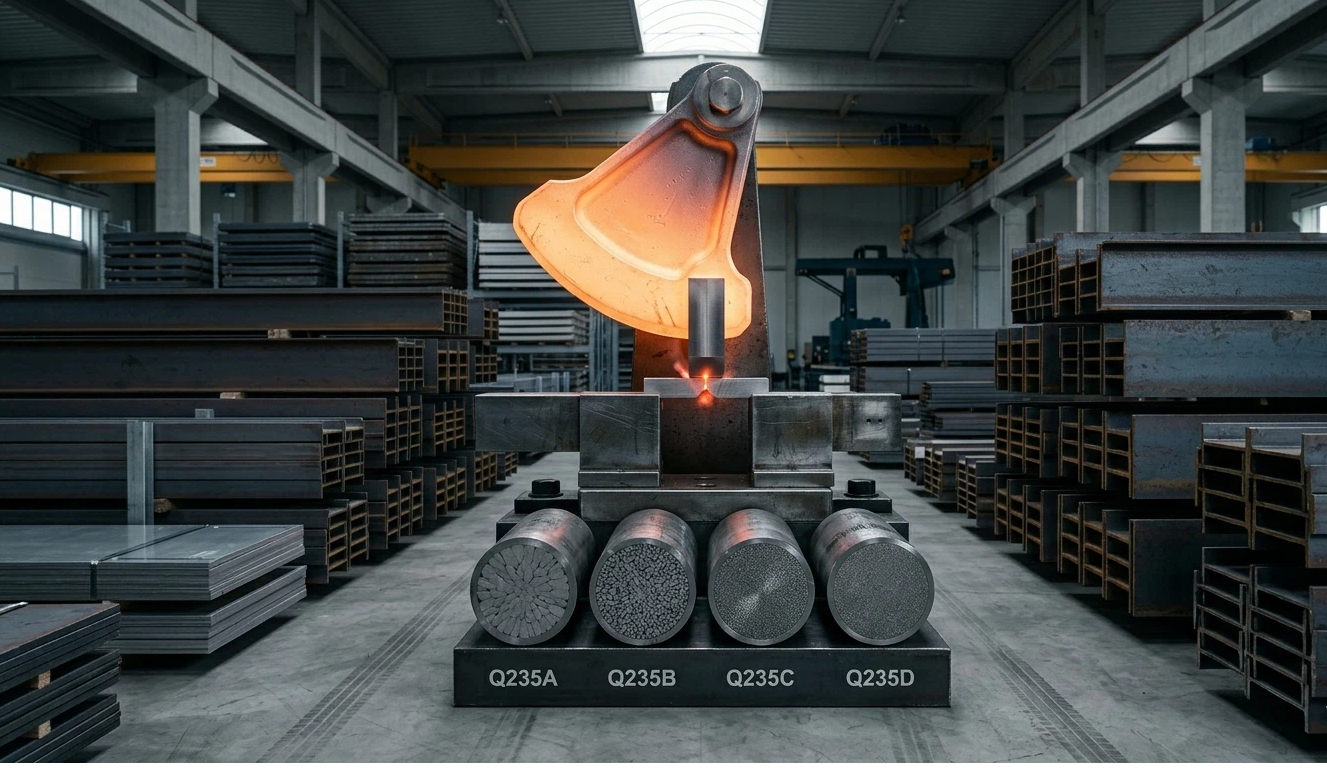
In the global steel trade, many buyers make the mistake of simply searching for “Q235 Steel.” However, this broad term hides significant engineering risks. As the most fundamental carbon structural steel under the Chinese GB/T 700 standard, Q235 is not a single material but a spectrum of quality grades.
Choosing the right grade—Q235A vs Q235B vs Q235C vs Q235D—determines whether your project remains structurally sound under stress or suffers a catastrophic brittle fracture during winter. This guide provides a deep dive into Charpy impact testing, chemical precision, and deoxidation processes to help you make an informed procurement decision.
Table of Contents
The Core Differentiator: Charpy Impact Testing
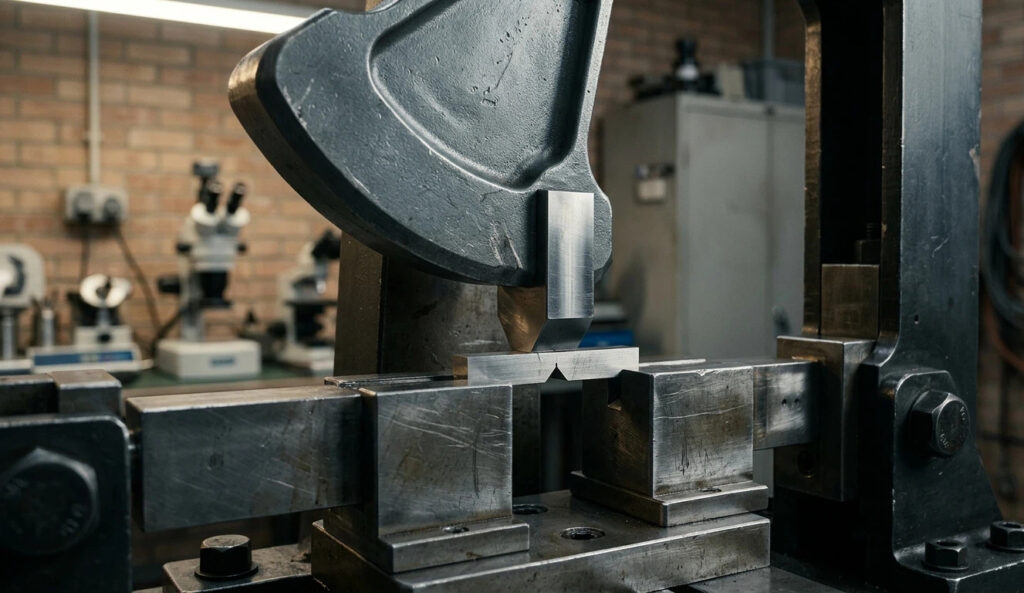
The most fundamental technical gap in Q235A vs Q235B vs Q235C vs Q235D lies in their impact toughness requirements. Impact toughness measures a steel’s ability to absorb energy and resist fracture when subjected to sudden loading.
- Q235A: No impact testing is required. This grade is typically reserved for secondary structures where environmental temperatures are stable and stress is minimal.
- Q235B: Requires a Charpy V-notch impact test at 20°C (ambient temperature), with an
- impact energy value of Agv > 27J.
- Q235C: The threshold is raised to 0°C for the impact test.
- Q235D: The most stringent grade, requiring Agv > 27J even in harsh -20°C environments.
This gradient is based on a strict engineering logic: the lower the temperature, the more “brittle” steel becomes. If you are constructing an outdoor frame in high-latitude regions like Northern Europe or Canada, choosing Q235A instead of Q235D could lead to structural failure as soon as temperatures drop.
Chemical Purity: Controlling Phosphorus and Sulfur
While the primary elements—Carbon (C), Manganese (Mn), and Silicon (Si)—remain relatively consistent, the true hallmark of quality in Q235A vs Q235B vs Q235C vs Q235D is the control of harmful impurities: Phosphorus (P) and Sulfur (S).
Excessive Phosphorus leads to “cold shortness” (brittleness at low temperatures), while high Sulfur causes “hot shortness” (cracking during welding or hot working).
| Quality Grade | Phosphorus P (%) | Sulfur S (%) | Technical Impact |
| Q235A | $\le 0.045$ | $\le 0.050$ | Base grade with slightly higher impurities. |
| Q235B | $\le 0.045$ | $\le 0.045$ | Balanced performance; most common industrial grade. |
| Q235C | $\le 0.040$ | $\le 0.040$ | Enhanced purity for better crack resistance. |
| Q235D | $\le 0.035$ | $\le 0.035$ | Highest purity; superior welding and low-temp performance. |
The tighter tolerances in Q235D ensure that the material remains reliable in high-stress industrial applications. For a broader overview of the base material’s characteristics, you can refer to this link: Q235B Steel Properties & Applications.
Deoxidation Methods and Internal Grain Structure
The method used to remove oxygen during the melting process further distinguishes Q235A vs Q235B vs Q235C vs Q235D.
- Q235A and Q235B: Can be produced as Rimmed Steel (F), Semi-killed Steel (b), or Killed Steel (Z). Rimmed steel is cost-effective but has a less uniform internal structure.
- Q235C and Q235D: Must be Killed Steel (Z) or Special Killed Steel (TZ).
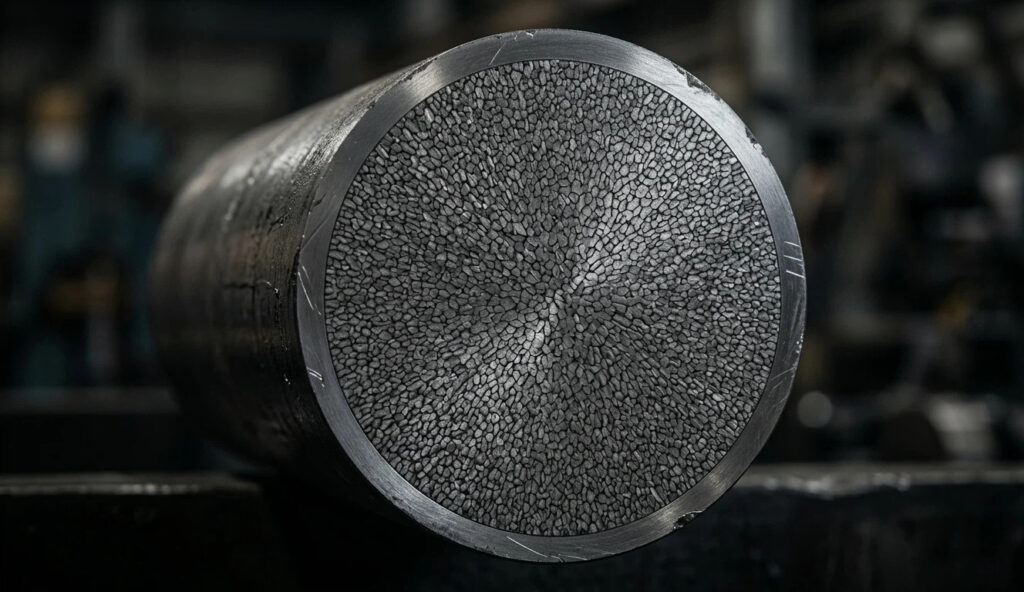
Killed steel is fully deoxidized, resulting in a dense, uniform grain structure with minimal segregation. For projects involving precision CNC cutting or heavy-duty welding, the consistency offered by C and D grades is far superior to Q235A.
Selection Guide: When to Use Which Grade?
Understanding the technical nuances of Q235A vs Q235B vs Q235C vs Q235D allows for cost-effective engineering.
1.Non-Structural Parts: For covers, brackets, or decorative railings, Q235A is sufficient and the most economical.
2.General Building Structures: For indoor beams, columns, and standard warehouse frames, Q235B is the “Gold Standard” in international trade.
3.Dynamic Load Projects: For bridges or crane jibs subject to frequent vibration, we recommend at least Q235C.
4.Extreme Cold Environments: For low-temperature piping or power grid towers in alpine regions, Q235D is the only safe option.
According to the Standardization Administration of China (SAC) in the official GB/T 700 documentation, these classifications are mandatory to prevent structural fractures caused by climate extremes.
International Equivalents: Q235A vs Q235B vs Q235C vs Q235D
For overseas engineers, navigating the Q235A vs Q235B vs Q235C vs Q235D landscape often requires referencing ASTM or EN standards.
While ASTM A36 is frequently cited as an equivalent to Q235B, they are not identical. A36 does not have the same mandatory impact test tiers as the Chinese grades. According to the ISO 630-2:2021 international standard, Q235D is more chemically pure and aligns closely with the European S235J2 grade.
Заключение
When analyzing Q235A vs Q235B vs Q235C vs Q235D, the data is clear. Engineering safety should never be compromised for marginal cost savings. Always ensure your supplier provides a comprehensive Mill Test Certificate (MTC), paying close attention to the impact test data and P/S levels.
By selecting the precise grade, you optimize both project longevity and procurement budgets.
Do you need a comparison between Q235B and other international grades like SS400? [Contact our technical team today for a tailored material consultation.]
ЧАСТО ЗАДАВАЕМЫЕ ВОПРОСЫ
Can Q235B replace Q235D?
While mechanical properties are similar at room temperature, Q235B cannot guarantee safety at temperatures below -20°C.
Is there a significant price difference?
Yes. Due to the specialized deoxidation and raw material purity, Q235D usuallycosts 5% – 10% more than Q235A.
Does the grade affect weldability?
Yes. Q235D has lower P/S content, which significantly reduces the risk of “hot cracking” in the heat-affected zone (HAZ) of a weld.
Which grade is most common for export?
Q235B is the most exported grade as it offers the best balance of safety and cost for general construction.