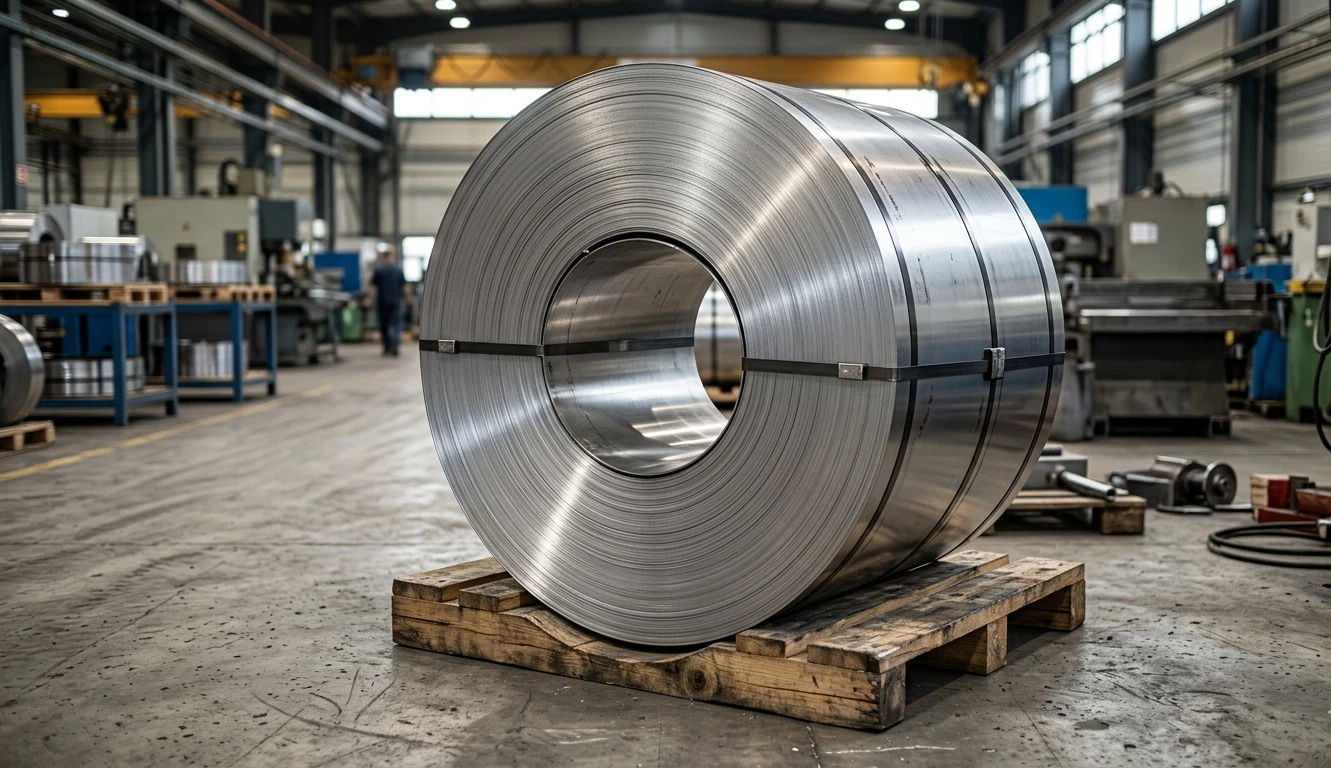
An SS coil is a cylindrical raw material formed by coiling Stainless Steel strip after hot rolling or cold rolling processes. It features corrosion resistance, high mechanical strength, and excellent surface finish. The main material grades are 304, 316, etc., and specifications can be customized to meet the processing and production needs of various industries. The Stainless Steel Coil design enhances convenience in transportation and storage while improving material utilization, making it a fundamental core material in fields such as architectural decoration, kitchenware manufacturing, chemical equipment, and machinery production.
Table of Contents
Stainless Steel Coil Applications
The applications of SS coils are clearly segmented based on processing techniques and thickness specifications to meet the mechanical requirements of different scenarios. They are mainly divided into two dimensions: process classification and thickness classification.
By processing technique:
- Hot-rolled Stainless Steel Coil products have a rougher surface finish and uniform mechanical properties. They are suitable for applications with low surface precision requirements but certain formability needs, such as building steel structures, bridge guardrails, and industrial storage tanks.
- Cold-rolled Stainless Steel Coil units offer higher surface smoothness, thickness accuracy, and superior mechanical properties. They are used in fields with strict quality requirements, such as medical devices, surgical instruments, and high-end precision manufacturing.
By thickness specification:
- Thin coil (0.1mm-0.3mm): They are light, flexible, and easy to process with high precision. They are used for home appliance panels, mobile phone casings, and Stainless Steel tableware.
- Medium-thick coil (3mm-10mm): Offers a balance of strength and toughness for chemical pipelines and automotive exhaust pipes.
- Thick coils (>10mm): Features high hardness for heavy engineering such as ship decks and offshore platforms.
Core Advantages of SS Coils
The inherent properties of Stainless Steel provide outstanding corrosion resistance, ensuring stable performance in complex environments such as humid conditions and exposure to mild acids or alkalis, significantly reducing long-term maintenance costs.
Furthermore, Stainless Steel Coil processability is a major advantage. Hot-rolled coils are suitable for manufacturing structural components, while cold-rolled coils can be precisely formed into high-precision products, meeting the requirements of various processing techniques. The flexible and customizable specifications also improve overall material utilization.
Limitations of SS Coil Applications
High production cost is a notable factor, as the Stainless Steel smelting process requires the addition of precious metal alloying elements such as nickel and chromium. Additionally, deep processing like cold rolling further increases costs, limiting application in price-sensitive sectors.
Заключение
In conclusion, the Stainless Steel Coil remains an indispensable asset in modern industrial and architectural sectors. Its ability to balance high-strength performance with aesthetic versatility makes it the material of choice for demanding environments. By understanding the specific processing techniques and grade characteristics, manufacturers can optimize their production workflows and ensure the long-term durability of their final products. Whether for heavy-duty engineering or precision instruments, choosing the right coil specification is key to achieving superior results.
ЧАСТО ЗАДАВАЕМЫЕ ВОПРОСЫ
Can hot-rolled and cold-rolled Stainless Steel Coil products be used as substitutes for one another?
Direct substitution is generally not recommended. Hot-rolled coils are better for structural components, while cold-rolled versions are ideal for precision manufacturing. If substitution is necessary, secondary processing such as polishing and leveling is required, which will incur additional costs.
Stainless Steel thin coils are easy to deform during processing. What are some techniques to address this?
Ensure the material remains flat before processing and use precision molds with low-speed processing methods to reduce stress. Perform stress relief treatments in a timely manner and add support during handling to prevent warping.
What protective measures should be taken during the transportation of SS coils?
Wrap the coil surface with moisture-proof film and bubble film to avoid scratches. Place cushioning pads between coils to prevent friction and ensure the vehicle is protected against rain and salt spray.