In the modern industrial supply chain, Hot Rolled Steel Coils are far more than just raw material; they are the fundamental building blocks of global infrastructure. Produced through a high-temperature rolling process that reconfigures the grain structure of the metal, these coils offer a unique combination of strength, formability, and economic value. For project managers and procurement officers, understanding the nuances of Hot Rolled Steel Coils is critical for ensuring both structural integrity and budget optimization.
Table of Contents
What Is a Hot Rolled Steel Coils?
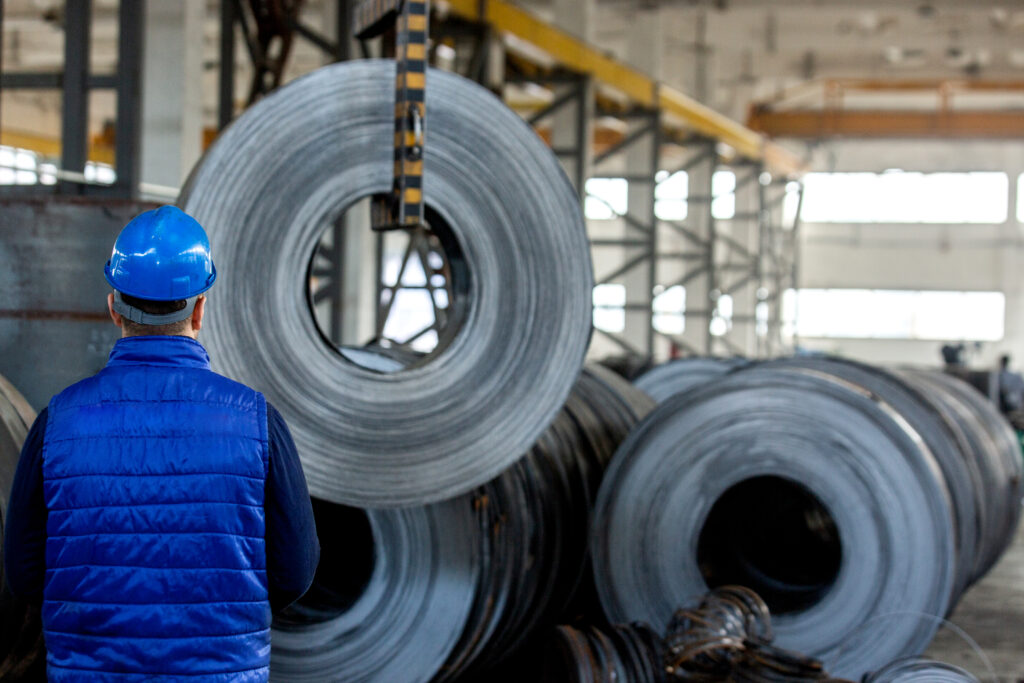
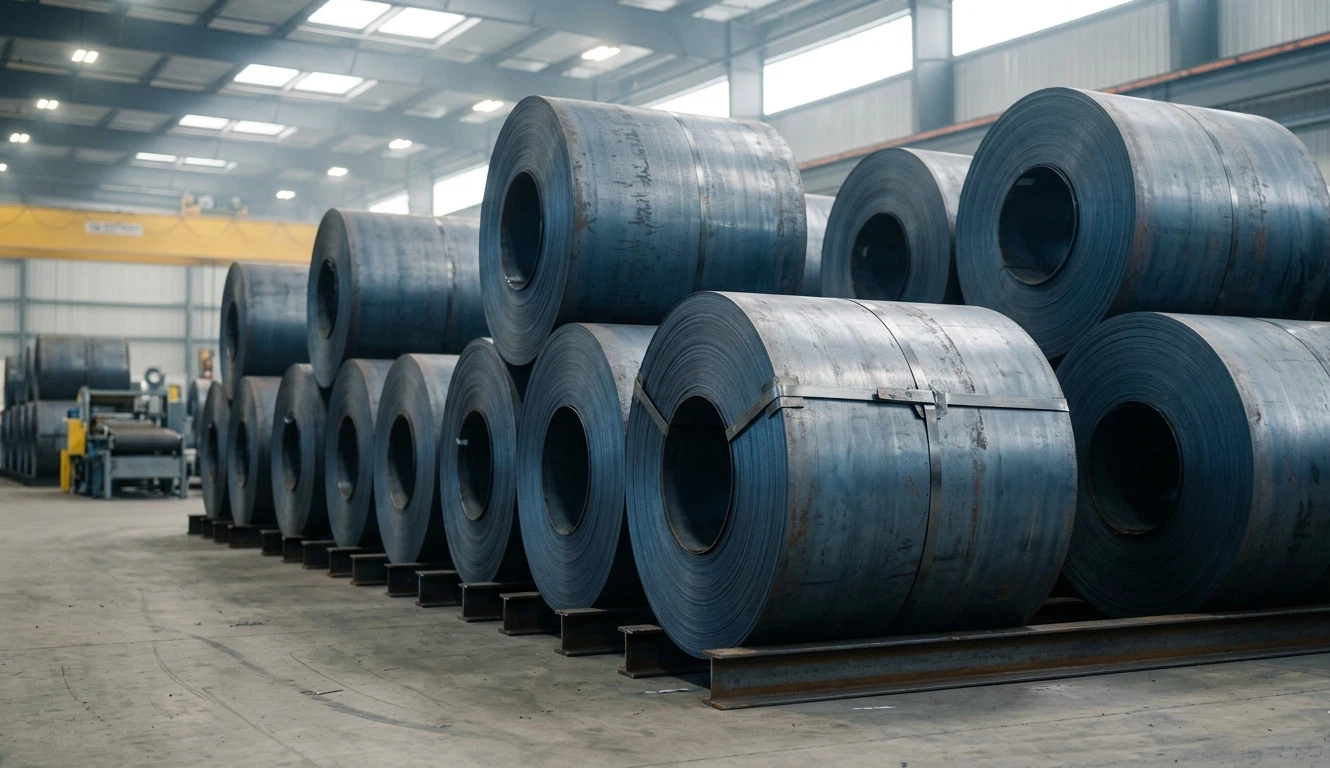
Hot rolled steel coils start as slabs heated to over 1,000℃, then passed through rolling mills to achieve the desired thickness. The resulting sheet is wound into coils for storage and transport. These coils sit at the heart of the steel supply chain, connecting upstream smelting with downstream manufacturing.
Why Choose Hot Rolled Coils?
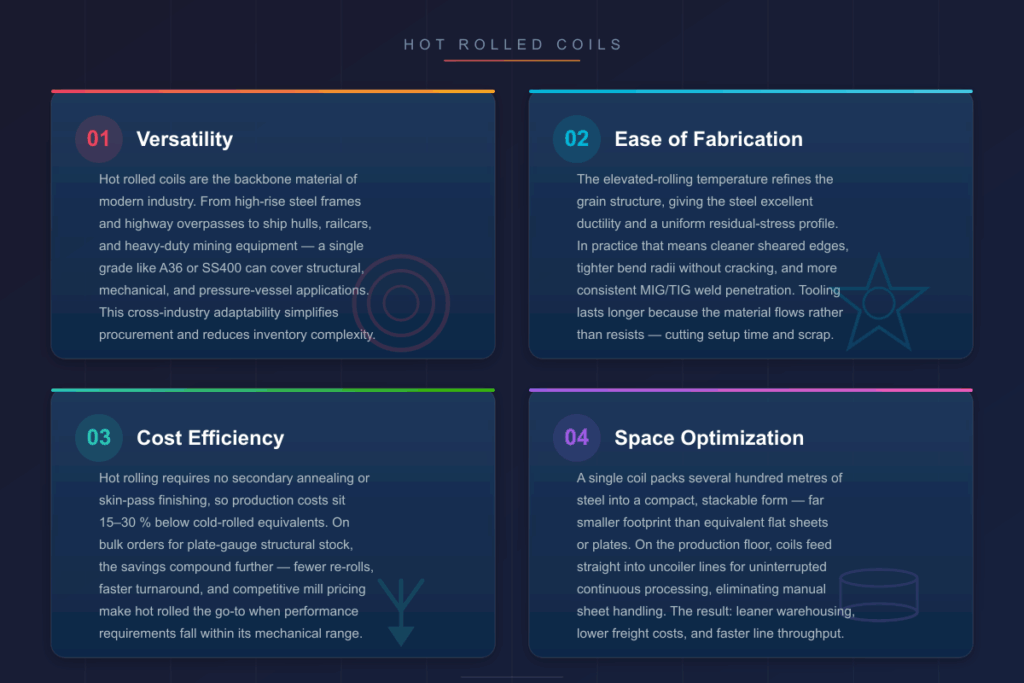
Versatility
From industrial buildings and bridges to vehicles, ships, and even surgical instruments, hot rolled steel is used across virtually every sector. A single specification can often serve multiple application needs.
Ease of Fabrication
The hot rolling process leaves the steel with good formability. It shears, stamps, bends, and welds reliably, which helps reduce tool wear and keeps fabrication straightforward.
Cost Efficiency
Hot rolled coils are significantly more economical than cold rolled alternatives, especially in bulk quantities. For thicker gauges, hot rolled material delivers solid performance without the cost premium, making it a practical choice for many projects.
Space Optimization
Coils take up less floor space than sheets or plates, and they’re easier to transport. In production, they can be fed directly into decoiling lines for continuous processing, helping to lower warehousing and logistics costs.
Hot Rolled Steel Coils Applications
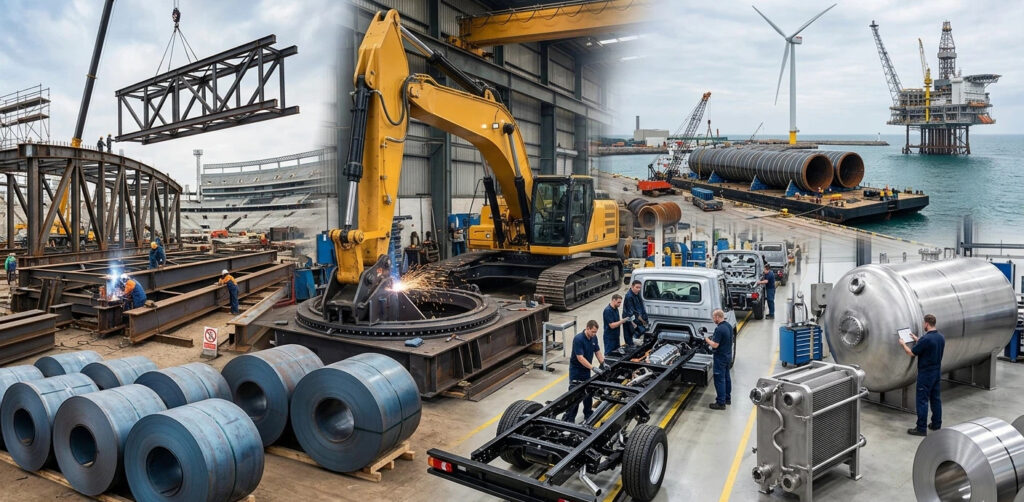
Construction & Infrastructure
Structural frames, columns, beams, bridge girders, stadium trusses. Grades like Q235 offer cost-effective solutions, while Q355 provides higher strength-to-weight ratios for larger infrastructure projects.
Heavy Machinery
Excavator arms, crane turntables, concrete pump chassis. Low-alloy high-strength grades deliver toughness in demanding conditions, with variants available for cold climates or abrasive environments like mining.
Automotive
Truck chassis rails, crossmembers, wheel discs. Frame-grade steels are designed to withstand high fatigue loads, and advanced high-strength grades support lightweighting efforts in electric vehicles.
Energy & Marine
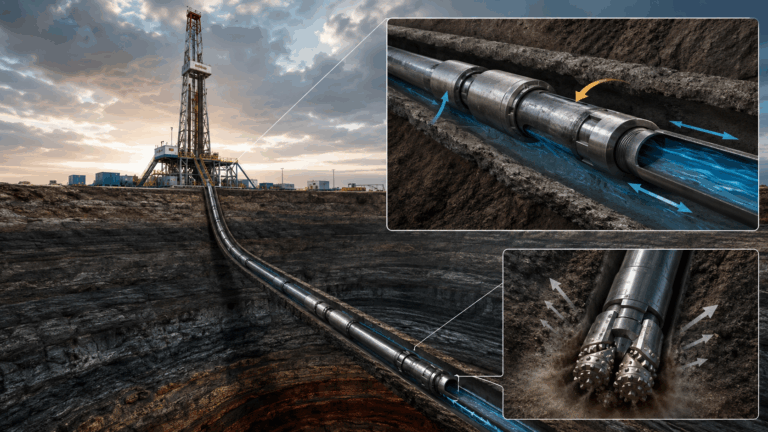
Oil and gas pipelines, ship deck plating, wind turbine towers, offshore platforms. Line pipe grades resist high pressure and corrosion, while marine steels are formulated for seawater exposure.
Chemical & Precision Engineering
Pressure vessels, food processing equipment, medical devices, architectural finishes. 304 and 316 stainless hot rolled coils offer heat and corrosion resistance for more demanding service conditions.
Global Standards and Quality Control
When specifying Hot Rolled Steel Coils, adherence to international standards is non-negotiable. Whether it is ASTM A1011 in the United States or EN 10025 in Europe, these standards dictate the chemical composition and mechanical testing required to ensure safety. Quality audits focus on dimensional tolerances (thickness and flatness) and the absence of surface slivers or cracks that could compromise the final weld.
FAQ
How do I choose between hot rolled and cold rolled?
It comes down to what you need from the material.
Hot rolled coils retain their as-rolled structure, offering good ductility and formability–ideal for parts that will be bent, drawn, or welded. They also come at a lower cost.
Cold rolled products go through additional annealing and skin passing, resulting in a cleaner surface, tighter tolerances, and more consistent mechanical properties. They’re a better fit for visible cosmetic parts or components that require precise dimensions.
In short: go with hot rolled if you’ll be doing further processing; choose cold rolled if you need a finished surface and tight tolerances right away.
What’s the issue with mill scale?
Mill scale is a natural oxide layer that forms during hot rolling. If the surface isn’t uniform, it can interfere with paint adhesion or cause weld defects in precision applications. Most fabricators remove it through shot blasting, pickling, or mechanical descaling before further processing. However, for applications like concrete-embedded parts or components that will be hot-dip galvanized, the oxide layer can actually provide added protection and doesn’t need to be removed.
How do I evaluate coil quality?
Four main factors to consider:
Surface condition–Look for consistent oxidation without cracks, slivers, or other defects.
Dimensional accuracy–Check thickness and width tolerances, along with flatness indicators like edge wave or camber.
Mechanical properties–Confirm that yield strength, tensile strength, and elongation meet applicable standards.
Winding quality–Poorly wound coils (telescoping or loose winding) can cause issues during decoiling.
For automotive grades, line pipe steels, and other premium applications, additional testing may include impact toughness, grain size, and inclusion ratings.