
Welcome to My Blog!
Before we dive into the content, I’d love for you to join me on my social media platforms where I share more insights, engage with the community, and post updates. Here’s how you can connect with me:
Facebook:https://www.facebook.com/profile.php?id=100087990137347
LinkedIn:https://www.linkedin.com/company/89825762/admin/dashboard/
YouTube:www.youtube.com/@carbonsteelsupply-kj9lw
TikTok:www.tiktok.com/@carbonsteelsupply
Now, let’s get started on our journey together. I hope you find the content here insightful, engaging, and valuable.
Introduction
AISI 1045 carbon steel is a medium carbon, medium tensile steel often used for its excellent strength, hardness, and machinability. It has a wide array of applications across various industries due to its favorable mechanical properties, ease of processing, and compatibility with heat treatments. As an intermediate between low-carbon steels and high-carbon steels, AISI 1045 offers a balance that suits industries where strength and wear resistance are crucial.
In this article, we will explore the diverse applications of AISI 1045 carbon steel, the reasons why industries choose it, and a breakdown of its mechanical properties and advantages. The intent is to provide comprehensive insight into how and why AISI 1045 carbon steel is selected, its typical uses, and important considerations for its application.

What is AISI 1045 Carbon Steel?
AISI 1045 is a carbon steel that belongs to the family of medium carbon steels, with a carbon content typically around 0.45%. Its balance of strength and ductility, along with compatibility with standard processing methods, makes it versatile for applications requiring a moderate level of strength and hardness. Here is a quick overview of 1045’s key properties:
| Property | Value |
|---|---|
| Carbon Content | 0.43% – 0.50% |
| Tensile Strength | 570 – 700 MPa |
| Yield Strength | 320 MPa |
| Hardness (Brinell) | 170 – 210 HB |
| Modulus of Elasticity | 205 GPa |
Due to these properties, 1045 steel is commonly used in various forms, such as round bars, flat bars, and sheets, making it accessible and adaptable.
Why Choose AISI 1045 Carbon Steel?
Strength and Durability
One of the primary reasons industries choose 1045 steel is its strength-to-cost ratio. It provides high tensile and yield strength without the high cost associated with high-alloy steels.
Heat Treatment Compatibility
AISI 1045 carbon steel is highly adaptable to heat treatment processes, such as quenching and tempering. These treatments enhance the steel’s hardness and strength, allowing it to be used in applications that experience high levels of wear and fatigue.
Cost-Effectiveness
For industries that require robust materials but are also budget-conscious, 1045 steel offers a cost-effective solution. While it doesn’t have the extreme properties of some high-alloy steels, it provides a good balance that suits many standard applications.
Machinability
The moderate carbon content in 1045 steel makes it machinable, allowing for easier shaping, cutting, and forming processes compared to high-carbon steels. This machinability factor is beneficial in reducing manufacturing time and costs.
Common Industrial Applications of AISI 1045 Carbon Steel
AISI 1045 finds extensive use across multiple industries. Here are some notable applications:
Automotive Industry
In the automotive sector, 1045 steel is used for parts like crankshafts, gears, bolts, and connecting rods. Its balance of strength and machinability makes it ideal for components that must endure high levels of stress and strain.
Machinery Manufacturing
For machinery applications, 1045 steel is utilized in components like shafts, axles, spindles, and hydraulic cylinders. These parts require strength and durability as they handle loads and movement in various types of equipment.
Construction Industry
The construction sector often uses 1045 steel for structural components and support structures. Its high tensile strength makes it suitable for applications where load-bearing is crucial.
Agriculture Equipment
In the agricultural industry, 1045 steel is used in equipment parts, such as gears and spindles, which must endure constant wear and tear. Its hardness after heat treatment allows for better durability in demanding environments.
Tool Manufacturing
AISI 1045 is often used to manufacture hand tools and industrial tools, including wrenches, jigs, and fixtures. Its moderate hardness allows for reliable durability without being overly brittle.

Heat Treatment Processes for AISI 1045
Heat treatment is essential in optimizing the performance of AISI 1045 carbon steel. Here’s a breakdown of common processes used to enhance its properties:
| Heat Treatment Process | Temperature Range | Key Result |
|---|---|---|
| Annealing | 790 – 870°C | Improves ductility |
| Quenching | 820 – 870°C | Increases hardness |
| Tempering | 540 – 680°C | Balances hardness and toughness |
Each process serves a different purpose, allowing manufacturers to tailor the properties of 1045 steel for specific applications. For example, quenching followed by tempering results in a high-strength material with controlled toughness, suitable for mechanical components.
Mechanical Properties and Testing of AISI 1045
For many industrial applications, it’s essential to test the mechanical properties of 1045 steel to ensure they meet specific requirements. Here are some key mechanical properties and standard tests used to evaluate 1045 carbon steel:
- Tensile Strength Test: Measures the maximum stress AISI 1045 can withstand before breaking. It typically falls between 570 and 700 MPa.
- Hardness Test: Often conducted using the Brinell hardness test, AISI 1045 usually has a hardness range of 170–210 HB.
- Impact Test: Determines how much energy AISI 1045 can absorb during fracture, an important factor for parts subjected to dynamic loads.
Testing ensures that AISI 1045 components will perform as expected in their designated applications.
Advantages and Limitations of AISI 1045 Carbon Steel
Advantages:
- Good balance between strength and machinability
- Compatible with a wide range of heat treatments
- Cost-effective for various industrial applications
- Moderate hardness without being overly brittle
Limitations:
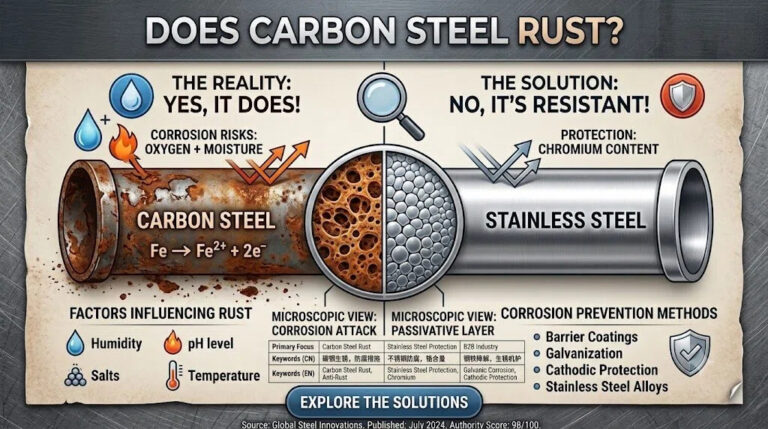
- Susceptible to corrosion unless treated or coated
- Not ideal for very high-strength or fatigue-prone applications
- Limited weldability due to higher carbon content, which may require preheating and post-weld heat treatment
FAQ
What is the difference between AISI 1045 and 1018 carbon steel?
AISI 1045 has higher carbon content than 1018, providing more strength and hardness, but also making it less ductile and less weldable. AISI 1018, with lower carbon content, is more malleable and easier to weld.
Can AISI 1045 carbon steel be welded?
Yes, but it requires careful preheating and post-weld heat treatment to avoid cracking due to its carbon content. It’s best suited for welding when heat treatment procedures are properly followed.
Is AISI 1045 suitable for high-temperature applications?
AISI 1045 can withstand moderate temperatures, but it may not be ideal for high-temperature applications. Prolonged exposure to high temperatures can affect its structural integrity.
How is AISI 1045 compared to stainless steel?
Unlike stainless steel, AISI 1045 is not resistant to corrosion. It has higher strength but requires protective coatings or surface treatments for corrosion resistance.
What surface treatments work best with AISI 1045?
Surface treatments like nitriding, carburizing, and coating can enhance the surface hardness and corrosion resistance of AISI 1045.
Conclusion
AISI 1045 carbon steel is a versatile and robust material that serves many industrial needs, from automotive parts to construction and machinery components. Its strength, heat treatment compatibility, and cost-effectiveness make it a popular choice in industries that require a balance between durability and machinability. However, like all materials, it has limitations and should be selected based on the specific demands of the application. With careful consideration of its properties and correct processing techniques,1045 steel proves to be a reliable material across a wide array of industrial applications.
This article explored the various uses of 1045 steel, including its properties, heat treatment processes, advantages, and limitations. With its adaptable nature and extensive applications, 1045 steel carbon steel continues to be a preferred choice for many industrial applications worldwide.