
Welcome to My Blog!
Before we dive into the content, I’d love for you to join me on my social media platforms where I share more insights, engage with the community, and post updates. Here’s how you can connect with me:
Facebook:https://www.facebook.com/profile.php?id=100087990137347
LinkedIn:https://www.linkedin.com/company/89825762/admin/dashboard/
YouTube:www.youtube.com/@carbonsteelsupply-kj9lw
TikTok:www.tiktok.com/@carbonsteelsupply
Now, let’s get started on our journey together. I hope you find the content here insightful, engaging, and valuable.
Table of Contents
Introduction
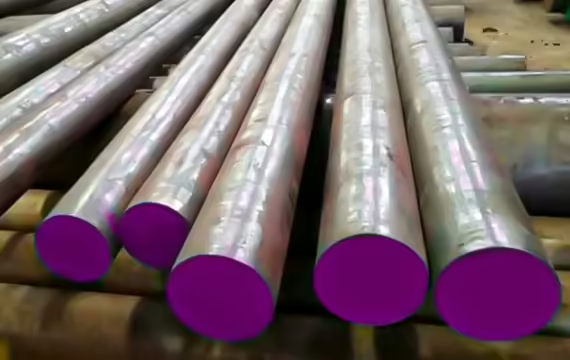
Alloy steel 8620 is a versatile, low-alloy, nickel-chromium-molybdenum case hardening steel. It is commonly used in applications requiring a combination of high surface hardness and good core strength. This makes it a popular choice in industries such as automotive, aerospace, and general engineering. This comprehensive guide delves into the properties, applications, heat treatment processes, and other essential aspects of alloy steel 8620.
What Makes 8620 Alloy Steel Unique?
The unique combination of alloying elements in 8620 provides several advantages. The nickel content enhances toughness and hardenability, while chromium contributes to wear resistance and core strength. Molybdenum further improves hardenability and reduces temper brittleness. This carefully balanced composition gives 8620 alloy steel its excellent overall performance.
Chemical Composition and Mechanical Properties of Alloy Steel 8620
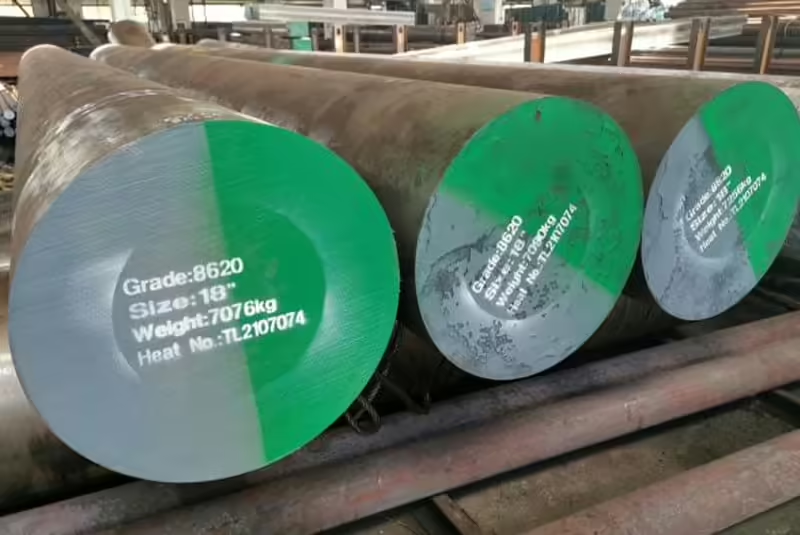
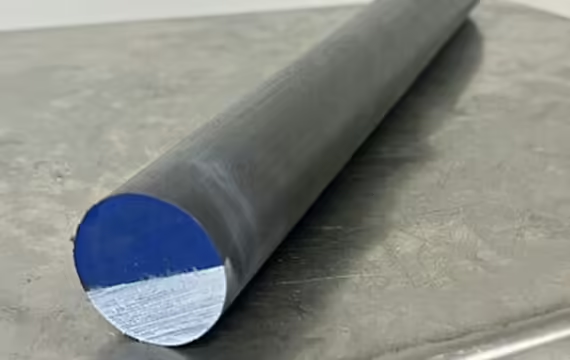
Understanding the chemical makeup of 8620 alloy steel is crucial for predicting its behavior and performance in various applications.
Detailed Chemical Composition of 8620 Alloy Steel
The following table outlines the typical chemical composition of 8620 alloy steel :
| Element | Weight Percentage (%) |
|---|---|
| Carbon (C) | 0.18 – 0.23 |
| Manganese (Mn) | 0.70 – 0.90 |
| Phosphorus (P) | ≤ 0.035 |
| Sulfur (S) | ≤ 0.040 |
| Silicon (Si) | 0.15 – 0.35 |
| Nickel (Ni) | 0.40 – 0.70 |
| Chromium (Cr) | 0.40 – 0.60 |
| Molybdenum (Mo) | 0.15 – 0.25 |
Key Mechanical Properties of 8620 Alloy Steel
The mechanical properties of 8620 alloy steel vary depending on the heat treatment applied. However, some general characteristics include:
- High Surface Hardness: Achieved through case hardening (carburizing).
- Good Core Strength: Provides resistance to shock and fatigue.
- Excellent Toughness: Resists cracking and fracture.
- Good Wear Resistance: Suitable for applications involving friction and abrasion.
Heat Treatment of 8620 Alloy Steel


Heat treatment is essential for optimizing the mechanical properties of 8620 alloy steel. The most common process is carburizing, which increases the carbon content of the surface layer.
Carburizing and Hardening 8620 Alloy Steel
Carburizing is typically performed at temperatures between 1650°F and 1700°F (899°C and 927°C) in a carbon-rich atmosphere. This process diffuses carbon into the surface of the steel, creating a hard outer case. Subsequent quenching and tempering operations further refine the microstructure and achieve the desired hardness and core strength.
Tempering 8620 Alloy Steel for Desired Properties
Tempering is performed after quenching to reduce brittleness and improve toughness. The tempering temperature determines the final hardness and strength of the steel. Lower tempering temperatures result in higher hardness but lower toughness, while higher tempering temperatures provide greater toughness but lower hardness.
Applications of Alloy Steel 8620
Alloy steel 8620 is widely used in various industries due to its versatile properties.
8620 Alloy Steel in the Automotive Industry
In the automotive sector, 8620 alloy steel is commonly used for:
- Gears: Provides high wear resistance and strength for demanding gear applications.
- Shafts: Offers good fatigue resistance and torsional strength for shafts and axles.
- Camshafts: The hard surface resists wear from constant contact with other engine components.
- Connecting Rods: Provides the necessary strength and toughness to withstand high stresses.
8620 Alloy Steel in Aerospace and Other Industries
Beyond automotive, 8620 alloy steel finds applications in:
- Aerospace Components: Used in landing gear components and other critical parts.
- Fasteners: Provides high strength and durability for bolts, screws, and other fasteners.
- Bearings: Offers good wear resistance for bearing races and other bearing components.
- Tooling: Used for certain types of tooling where a combination of hardness and toughness is required.
Advantages and Disadvantages of Alloy Steel 8620
Like any material, alloy steel 8620 has its own set of advantages and disadvantages.
Key Advantages of Alloy Steel 8620
- Excellent Case Hardenability: Achieves a very hard surface after carburizing.
- Good Core Strength and Toughness: Provides resistance to impact and fatigue.
- Versatile Applications: Suitable for a wide range of industries and components.
- Relatively Cost-Effective: Compared to some higher-alloy steels.
Potential Disadvantages of 8620 Alloy Steel
- Lower Corrosion Resistance: Compared to stainless steels, it requires protective coatings in corrosive environments.
- Not Suitable for High-Temperature Applications: Strength decreases at elevated temperatures.
Comparing Alloy Steel 8620 with Other Alloys
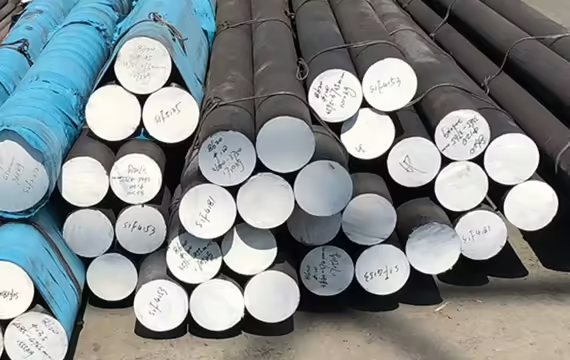
While 8620 alloy steel is a popular choice, it’s essential to consider alternative materials depending on specific application requirements.
8620 Alloy Steel vs. 4140 Steel
Alloy steel 4140 offers higher strength and hardness in its through-hardened condition compared to 8620. However, 8620 excels in case-hardened applications requiring a hard surface and tough core. The choice depends on whether surface hardness or overall strength is the primary concern.
8620 Alloy Steel vs. 9310 Steel
Alloy steel 9310 has a higher nickel content than 8620, resulting in improved toughness and fatigue resistance. However, it is also more expensive. Alloy steel 8620 is often preferred for applications where cost is a significant factor.
Conclusion
Alloy steel 8620 stands out as a versatile and reliable material for a wide range of applications. Its unique combination of alloying elements provides a desirable balance of surface hardness, core strength, and toughness. Through appropriate heat treatment, its properties can be further optimized to meet specific performance requirements. While it may not be suitable for every application, alloy steel 8620 remains a popular choice in industries demanding high performance and durability. This comprehensive guide has explored the key properties, applications, heat treatment processes, advantages, and disadvantages of alloy steel 8620, providing valuable insights for engineers and material selection professionals.
FAQ
What is the primary use of alloy steel 8620?
Alloy steel 8620 is primarily used for case-hardened components requiring a hard wear-resistant surface and a tough core. Common applications include gears, shafts, camshafts, and fasteners.
Is 8620 alloy steel corrosion resistant?
8620 alloy steel has lower corrosion resistance than stainless steels. It typically requires protective coatings or surface treatments for use in corrosive environments.
How is alloy steel 8620 heat treated?
The most common heat treatment for alloy steel 8620 is carburizing, followed by quenching and tempering. Carburizing increases the surface carbon content, while quenching and tempering optimize hardness and toughness.
What is the difference between 8620 alloy steel and 4140?
Alloy steel 4140 is a through-hardening steel with higher overall strength and hardness compared to 8620. 8620 alloy steel is preferred for case-hardened applications where a hard surface and tough core are essential.