Every tool and die shop eventually faces the same operational headache: a critical forming die cracks under a sudden load spike, or an extrusion punch wears down so fast that it ruins part tolerances. When choosing materials for cold-work applications, the decision often narrows down to two classic high-carbon, high-chromium grades. Evaluating D2 vs D3 Tool Steel is not a matter of finding out which metal is universally superior, but rather understanding how small shifts in chemistry completely change how a tool behaves under pressure.
Whether you are designing intricate automotive stamping dies or high-speed slitting knives, picking the wrong alloy guarantees frequent tool room maintenance and unexpected press downtime. This guide breaks down the core structural differences between these two workhorses so you can confidently spec the exact material your production environment demands.
Table of Contents
What is D2 Tool Steel?
D2 is a high-carbon, high-chromium cold-work tool steel widely utilized in industrial tooling and die manufacturing. It delivers an exceptional balance of wear resistance, high hardness, and adequate toughness, enabling it to withstand heavy loads and impact without succumbing to wear or cracking. Its chemical composition includes Carbon (C), Chromium (Cr), Silicon (Si), Manganese (Mn), Vanadium (V), and Molybdenum (Mo). With a carbon content of approximately 1.5% and chromium ranging from 11.5% to 13%, D2 achieves a hardness of around 60 HRC following proper heat treatment.
What is D3 Tool Steel?
D3 is also classified as a high-carbon, high-chromium cold-work die steel, characterized by superior wear resistance, excellent hardenability, good thermal stability, and high compressive strength. This grade is typically specified for tooling applications involving minimal impact loads but demanding extreme wear resistance, such as dies, punches, cold-cutting knives, drill bushings, gauges, and drawing dies.
Chemical composition comparison of D2 vs D3 Tool Steel
| Element | D2 Tool Steel | D3 Tool Steel |
| Carbon (C) | 1.40% – 1.60% | 2.00% – 2.30% |
| Silicon (Si) | ≤0.60% | ≤0.40% |
| Manganese (Mn) | ≤0.60% | ≤0.40% |
| Chromium (Cr) | 11.50% – 13.00% | 11.50% – 13.00% |
| Vanadium (V) | ≤1.00% | — |
| Molybdenum (Mo) | 0.70% – 1.20% | — |
| Phosphorus (P) | ≤0.030% | ≤0.030% |
| Sulfur (S) | ≤0.030% | ≤0.030% |
Key Distinction: D2 contains Vanadium (V) and Molybdenum (Mo), which significantly enhance its strength and toughness. Conversely, D3 features a higher carbon content, resulting in greater hardness and wear resistance, though with slightly reduced toughness compared to D2 at equivalent hardness levels.
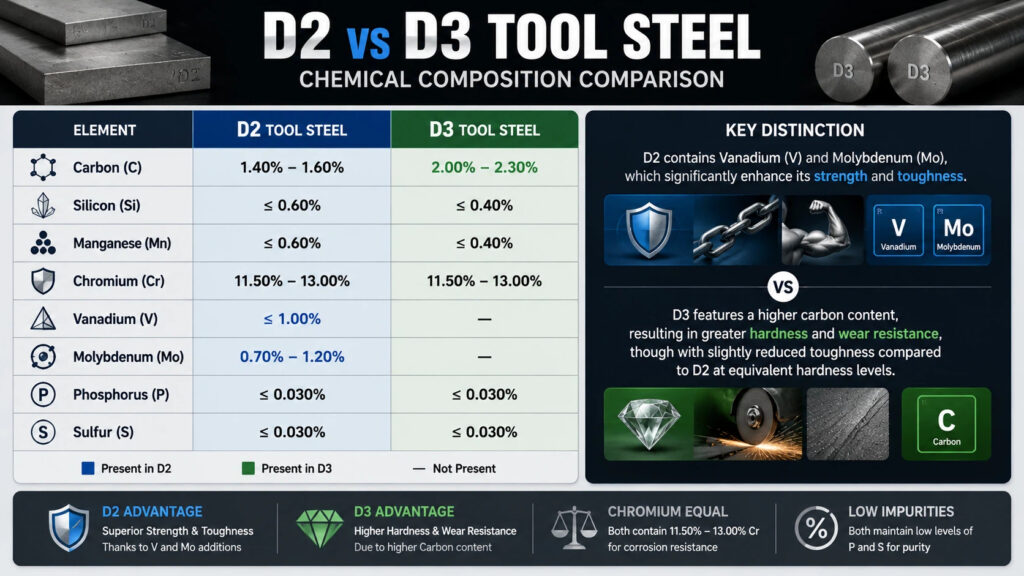
The chemical composition ranges provided above align with industrial benchmarks for cold-work tool steels. For precise elemental tolerances and standardized grade classifications, you can refer to the official ASTM A681 specifications to ensure your procurement meets rigorous industrial quality control requirements.
D2 vs D3 Tool Steel Core Performance Comparison
| Performance Attribute | D2 Tool Steel | D3 Tool Steel |
| Wear Resistance | Excellent (synergistic effect of Cr and V) | Superior (higher carbon content) |
| Toughness / Impact Resistance | Good; withstands moderate impact loads | Moderate; better suited for low-impact applications |
| Hardness | High (~60 HRC) | Very High |
| Hardenability & Dimensional Stability | Good; minimal distortion during heat treatment | Good |
| Machinability | Good in annealed condition; difficulty increases with hardness | Good in annealed condition; difficulty increases with hardness |
| Corrosion Resistance | Moderate (better than D3, but inferior to stainless steel) | Lower; best suited for dry environments |
| Compressive Strength | High (dependent on post-heat-treatment hardness) | High |
| Cost Efficiency | Generally more cost-effective due to broader applicability | May be higher; narrower application scope |
D2 vs D3 Tool Steel Typical Application Scenarios
Common Uses for D2 Tool Steel
- Cutting Tools: Guillotine knives, slitting knives, and cutting blades in paper, textile, and food processing industries
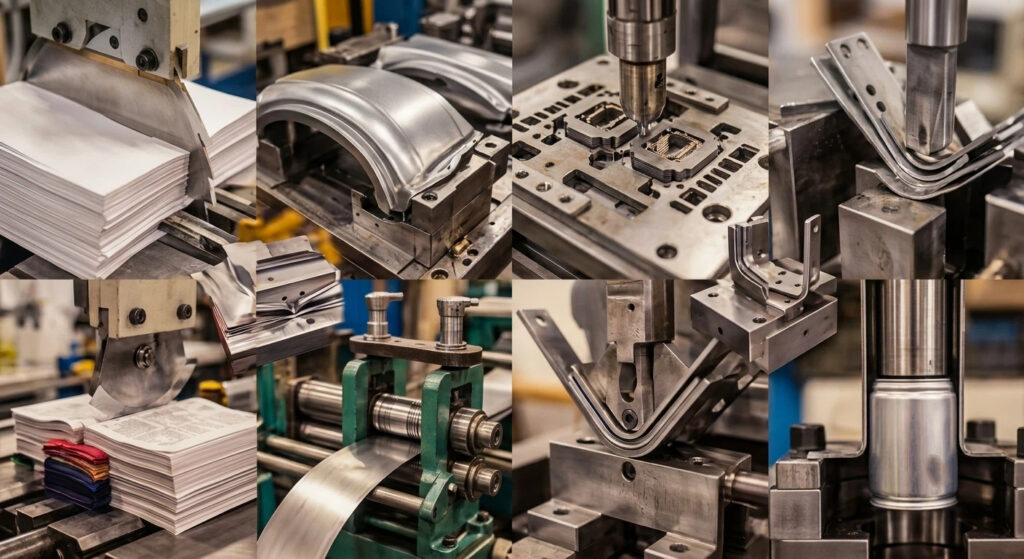
- Cold-Work Dies: Stamping and forming tools, punches, dies, and rotary slitters for automotive, aerospace, and construction sectors
- Metalworking Tools: Rolling mills, thread rolling dies, and forming rolls
Common Uses for D3 Tool Steel
Silicon steel sheet dies
Simple-shaped drawing and blanking dies
Complex bending dies requiring high wear resistance (both punch and die components)
Wear-resistant die inserts in deep drawing applications
Punch components for aluminum cold extrusion dies
Bending dies for carbon steel sheets with carbon content of 0.65%–0.80%
Selection Criteria: D2 or D3?
When deciding between D2 and D3, evaluate the following critical factors:
| Consideration | Recommended Grade | Rationale |
| High impact loads + wear requirements | D2 | Superior toughness reduces risk of cracking |
| Extreme wear resistance + low impact | D3 | Higher hardness delivers maximum wear performance |
| Humid or mildly corrosive environments | D2 | Marginally better corrosion resistance due to alloy balance |
| Dry environments + severe wear | D3 | Optimized for wear resistance in non-corrosive conditions |
| Cost-sensitive projects requiring versatility | D2 | Broader application range typically offers better value |
| Long-run, high-volume production | D3 | Enhanced wear resistance extends die service life |
Heat Treatment and Machining Considerations
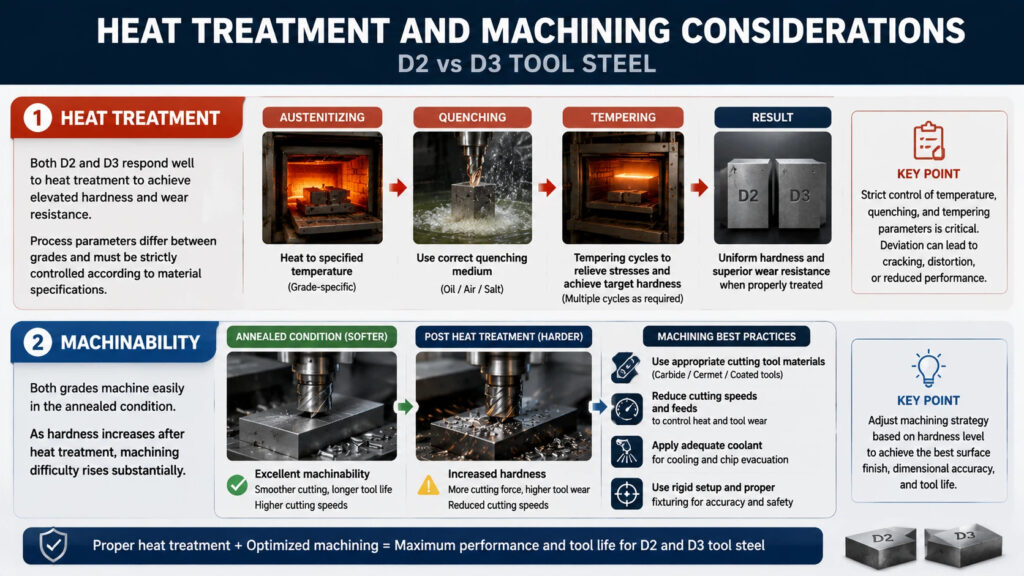
Heat Treatment: Both D2 and D3 respond well to heat treatment to achieve elevated hardness and wear resistance. However, specific process parameters—including austenitizing temperature, quenching medium, and tempering cycles—differ between grades and must be strictly controlled according to material specifications.
Machinability: Both grades exhibit favorable machinability in their annealed condition. As hardness increases post-heat-treatment, machining difficulty rises substantially. Appropriate cutting tool materials, reduced cutting speeds, and adequate coolant application are essential for successful processing of hardened components.
Conclusion
| D2 Tool Steel | D3 Tool Steel | |
| Primary Strength | Balanced wear resistance and toughness | Maximum wear resistance and hardness |
| Optimal For | Cold-work tooling subject to high impact and heavy wear | Precision dies and wear parts in low-impact, high-abrasion environments |
| Selection Guidance | First choice when complex service conditions demand both strength and toughness | Preferred when wear is the dominant failure mode and impact risk is minimal |
Navigating the trade-offs between D2 vs D3 Tool Steel requires a clear look at your machinery’s actual failure modes. If your production lines suffer from premature tool chipping or catastrophic cracking caused by heavy impact shocks, D2 remains the standard industry choice due to its vanadium and molybdenum additions. On the flip side, when your process involves low-impact, highly abrasive materials—such as drawing dies or silicon steel blanking—the massive carbon content of D3 delivers the surface hardness needed to maximize tool life.
Ultimately, treating tool steel selection as an investment in uptime rather than a simple purchasing expense is what keeps a shop profitable. By matching the specific mechanical stresses of your press room to the strengths of either D2 or D3, you protect your tooling from premature wear and ensure consistent, predictable production runs.
FAQ
Which grade offers better wear resistance?
D3 demonstrates marginally superior wear resistance compared to D2, attributable to its elevated carbon content, making it ideal for tooling and dies subjected to extreme abrasive conditions. That said, D2 still delivers excellent wear resistance and hardness, with the added benefit of superior dimensional stability during hardening.
Which is more cost-effective?
D2 is generally the more economical choice. Its wider range of applications and greater market availability typically translate to more competitive pricing.
Which has better corrosion resistance?
While neither D2 nor D3 qualifies as stainless steel, D2 offers better corrosion resistance than D3 due to its optimized chromium content and overall alloy balance. D3 is renowned for its wear resistance and dimensional stability, but if the operating environment involves humidity or mild corrosive exposure, D2 would be the more suitable option.