Table of Contents
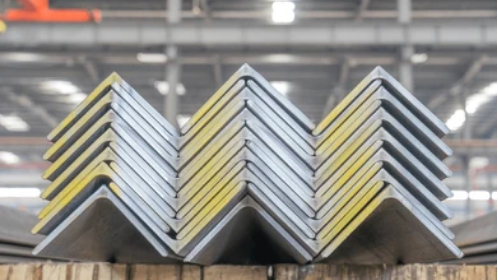
A fundamental structural section used across construction, manufacturing, power transmission and warehousing, angle steel—often called angle iron—features an L-shaped cross‑section with two perpendicular legs. This economical profile, available as equal‑leg and unequal‑leg variants, offers simple connection details and reliable performance for frames, brackets, racks and supporting members. For procurement teams and engineers, understanding its classifications, strengths and limits helps specify the right section for any industrial application.
What is Angle Steel and how is it specified?
Commonly produced by hot-rolling (and sometimes cold forming for precision applications), Angle Steel is defined by its leg dimensions and thickness. Equal-leg sections are noted as leg×leg×thickness (for example, ∠50×50×5), while unequal-leg types use long-leg×short-leg×thickness notation (∠80×50×6). Materials range from carbon structural steels (e.g., Q235) and low-alloy grades (e.g., Q345) to stainless variants for corrosive environments. These choices influence weldability, cost and long-term performance.
Classification and manufacturing routes
Angle sections are grouped by cross-section (equal vs unequal), manufacturing process (hot-rolled for economy; cold-formed for finish and tolerance), and material (carbon, low alloy, stainless). Hot-rolled Angle Steel dominates large projects due to throughput and lower cost; cold-formed angles are often preferred where surface quality and precise dimensions matter for fabricated assemblies.
Key advantages that drive B2B demand
The popularity of Angle Steel in commercial projects stems from several practical benefits:
- Simple geometry for fast assembly. Its right-angle profile allows direct bolting and welding, speeding frame erection and bracket installation.
- Balanced mechanical behavior. The L-section provides useful bending stiffness and torsional resistance for many secondary members at a competitive cost.
- Excellent fabricability. Angle sections are straightforward to cut, drill and weld on the shop floor, allowing flexible customization for machinery bases or racking systems.
- Cost efficiency and supply. Mature hot-rolling processes and wide availability make Angle Steel an economical choice for large infrastructure and factory projects.
These traits make angle sections attractive to construction contractors, machinery manufacturers, power utility fabricators and logistics equipment suppliers.
Practical limitations and selection cautions
While versatile, Angle Steel has limitations you must plan for in design and procurement:
- Shear and torsion sensitivity. The L-shape places the shear center away from the centroid, increasing torsional vulnerability under certain load cases. Avoid using single angles for high-shear members without suitable bracing.
- Local stability issues. Thin legs and sharp corners are prone to local buckling under compressive loads; consider stiffening or using paired angles for column or compressed elements.
- Corrosion vulnerability. Protective coatings such as paint, hot-dip galvanizing or other treatments are required to prevent accelerated corrosion in outdoor or damp environments.
- Lower space efficiency. Compared with I-beams or channels, angles deliver less effective section modulus per unit weight—plan quantities and member spacing accordingly for long-span structures.
Typical industrial applications
Angle Steel is found throughout heavy industry and infrastructure: structural frames and bracing in construction, trusses in bridgeworks, supports for transmission towers, machine bases and conveyor supports in manufacturing, pallet racking and mezzanine structures in warehousing, and brackets for telecom and power line equipment. Its adaptability also makes it a go-to element in temporary works and site gantries.
Specifying Angle Steel in an RFQ: a short checklist
When you request quotes, include these must-have items so suppliers return compliant proposals:
1.Exact section notation (e.g., ∠50×50×5).
2.Material grade and standard (e.g., Q235 / ASTM A36 / stainless 304).
3.Surface finish requirement (painted, hot-dip galvanized, mill finish).
4.Manufacturing process preference (hot-rolled or cold-formed if critical).
5.Tolerance / straightness class and any NDT or test certificates needed.
6.Delivery packaging, lead time, MOQ and warranty terms.
Specifying these points up front streamlines comparison and reduces substitution risk.
Final recommendation
For reliable, cost-effective structural members, Angle Steel remains a top choice. To ensure the right performance in your project, request detailed technical datasheets and surface treatment evidence from suppliers.
Need a tailored specification or volume quote for Angle Steel? Contact our industrial procurement team today for a fast, compliant proposal and on-site support.
Short FAQ
How do you read angle steel sizes?
Sizes are given as leg×leg×thickness for equal angles, or long-leg×short-leg×thickness for unequal angles (all in millimetres).
Where is angle steel most commonly used?
Structural frames, brackets, racking, transmission tower supports and machinery bases are typical uses.
How to protect ordinary angle steel from rust?
Standard options include painting, cold galvanizing, and hot-dip galvanizing—the latter offers the best outdoor corrosion resistance.