In the world of structural design and steel procurement, a subtle geometric difference often determines the profit and loss of an entire project. For site engineers, designers, and steel buyers, the debate of H-beam vs I-beam is more than just a choice of shape—it is a strategic decision regarding torsional strength, construction efficiency, and material costs. While both may look like “I-shaped” metal components to the naked eye, their mechanical DNA is entirely different. If you are in the specification phase and aren’t sure which one to spec for your job, this guide will get you sorted by examining everything from physical attributes to field applications.
Table of Contents
First, what they actually look like
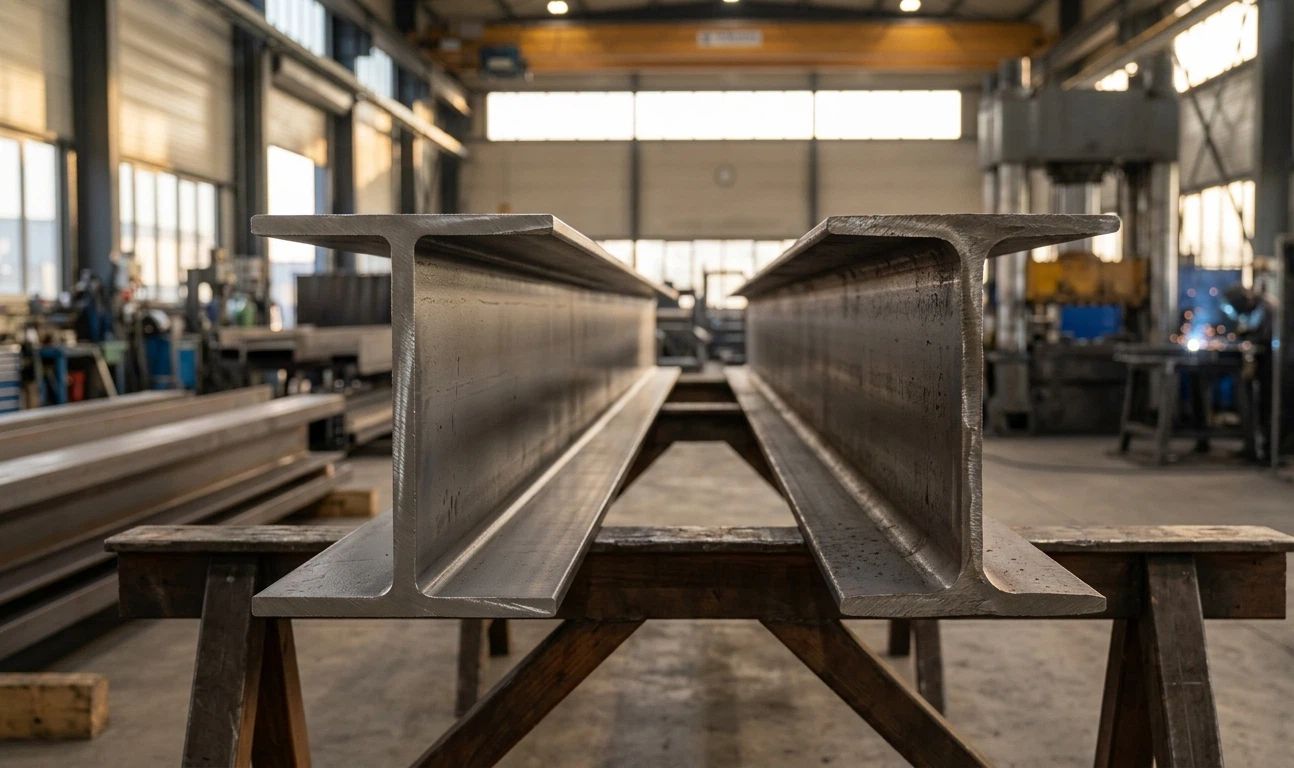
- H-beam is a clean “H.” It features wide flanges where the top and bottom are parallel witha uniform thickness and right-angle corners where the web meets the flange. It comes inthree flavors: HW (wide), HM (medium), and HN (narrow). These are labeled byHeight x Width x Web Thickness X Flange Thickness-for example, H300 x200 x 8 X 12. It is the go-to for modern steel construction because it handles loads bothways.
- I-beam looks like the letter “I.” It has narrower flanges with a slope on the inside—thicker at the web and thinner at the edge, creating a trapezoid shape. It features rounded corners where the web and flange meet. These are named by web height in centimeters (e.g., 16#, 32a#). This is an old-school hot-rolled section: cheap and readily available, but only ideal for one-direction loading.
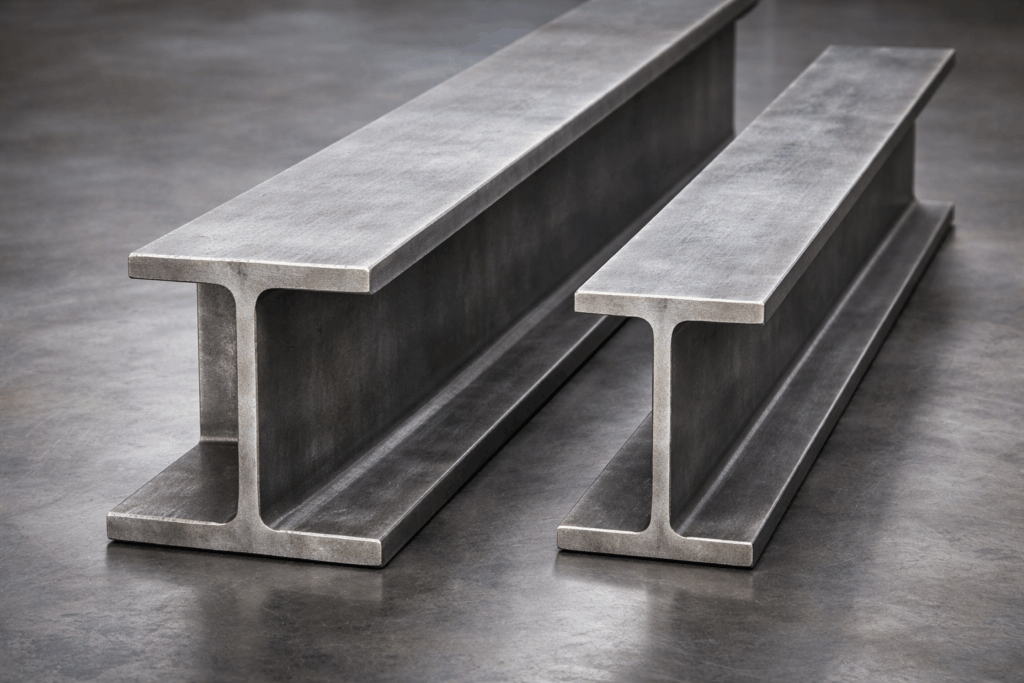
How to distinguish between H-beam and I-beam
- Check the flanges: H-beam has wide, parallel flanges with even thickness and sharp corners. I-beam has narrow flanges that are tapered on the inside with varying thickness and rounded transitions.
- Check the label: H-beam gives you four numbers (height, width, web thick, flange thick). I-beam just gives you a size number like 20# or 30b, offering no detailed dimensions.
- Check the loading: H-beam resists bending and torsion in both directions and remains stable sideways. I-beam only works one way; it is weak in torsion and prone to lateral buckling. In plain English: it tips over easily.
- Check the application: For primary structures and long spans, use H-beam. For secondary beams and temporary bracing, I-beam gets the job done cheaper.
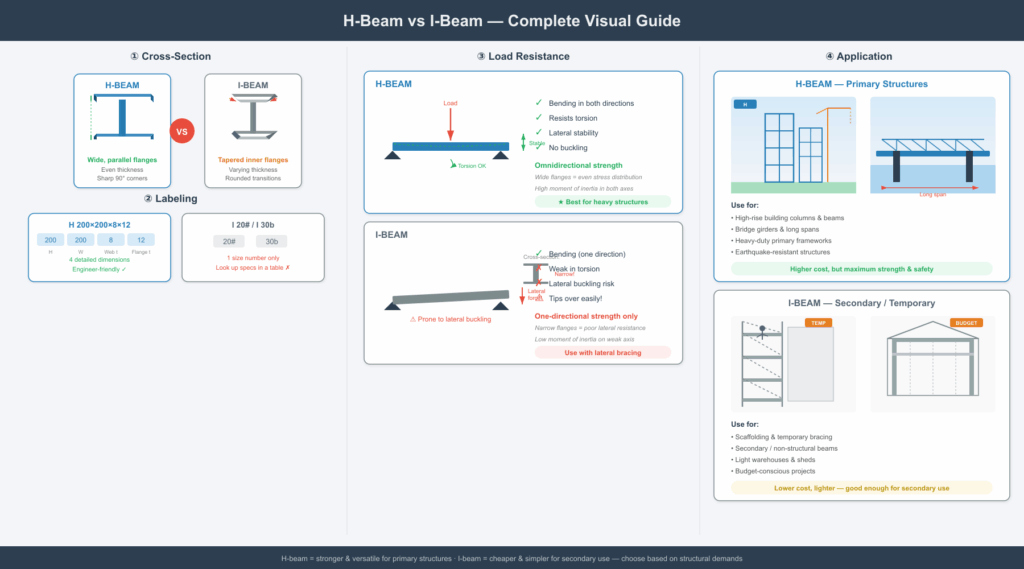
H-beam: costs more, delivers more
H-beams offer balanced strength in both directions, providing excellent bending resistance and torsional stability. Using H-beams can save 15% to 20% on material for the same load capacity. Furthermore, the parallel flanges make welding and bolting straightforward, which speeds up erection. It is the standard choice for long spans, heavy loads, and high-rise frames.
- Downside: Production costs typically run 20% to 30% higher than I-beams, with more complex specs and occasionally longer lead times.
I-beam: cheap, with caveats
I-beams offer a low price point with plenty of stock and a mature manufacturing process. They are adequate for one-way bending and are highly economical for light structures.
- Downside: They are weak in torsion and offer poor lateral stability. The tapered flanges complicate connections, leading to tricky detailing at joints. They are risky to use as columns as they tend to buckle sideways. Don’t ask them to do the heavy lifting.
Actual use cases for H-beams and I-beams
- H-beam carries the big loads: Used for columns and main beams in high-rise and super high-rise buildings, long-span industrial halls, bridges, and heavy equipment supports. It is ideal for any primary member needing two-way stability.
- I-beam handles the lighter stuff: Used for secondary beams, purlins, and wall girts in small-to-medium buildings. Also common in temporary supports, scaffolding, and light trusses where cost is a major factor.


Conclusion
In the final analysis of H-beam vs I-beam, there is no absolute “winner,” only the most appropriate “choice” for your specific engineering needs. H-beams, with their balanced multi-directional load capacity and ease of connection, are the backbone of modern high-rises and long-span structures. Meanwhile, I-beams continue to offer incredible value for secondary members and temporary supports due to their cost-effectiveness in one-way loading scenarios. Understanding these mechanical boundaries is the key to ensuring structural safety while optimizing your project’s ROI. Before placing your next order, evaluate your load model to ensure you are choosing the right “steel skeleton” for your job.
FAQ
Can H-beam fully replace I-beam?
No. For heavy loads and long spans, use H-beam. For light duty and tight budgets, I-beam makes more sense. It’s horses for courses.
Which carries more at the same height?
I-beam has a higher section modulus and moment of inertia. For the same weight, it can outperform H-beam by 10% to 40% in specific one-way load capacities.
Which one for columns?
H-beam first, especially the HW wide-flange series. It is stable both ways and resists buckling. An I-beam used as a column risks lateral failure.
Which erects faster?
H-beam. The parallel flanges allow for simpler connections and less field labor compared to the fiddly welding required for I-beam’s tapered flanges.