When selecting mild steel for international projects, Q235B is often the first choice due to its balance of cost and ductility. However, relying on this grade without a deep understanding of Q235B limitations can lead to structural failures or procurement errors.
As a versatile carbon structural steel under the Chinese GB/T 700 standard, Q235B excels in general construction. But it is not a “one-size-fits-all” solution. In this guide, we break down the technical boundaries you must respect to ensure project safety.
Table of Contents
1.Defining the Core Q235B Limitations
The first step in any engineering evaluation is recognizing where a material reaches its breaking point. Most Q235B limitations stem from its specific chemical composition—primarily its carbon content (0.12% to 0.20%) and its relatively high levels of impurities compared to premium alloys.
While its weldability is excellent, its yield strength of $235\text{ MPa}$ is relatively low. For high-stress applications, designers often find that the material requires excessive thickness to meet safety factors, which inadvertently increases the overall project weight and logistics costs.
2.Temperature Sensitivity and Cold Brittleness
Perhaps the most discussed among Q235B limitations is its performance in cold climates. Q235B is rated for impact testing at $20^{\circ}\text{C}$. Unlike Q235C or Q235D, it does not undergo rigorous charpy V-notch testing at $0^{\circ}\text{C}$ or $-20^{\circ}\text{C}$.
In environments where temperatures drop below freezing, Q235B risks “cold brittleness.” This means the steel can fracture suddenly under load rather than deforming plastically. If your project is in a high-latitude region, ignoring these Q235B limitations could be a critical oversight.
3.Comparison with International Equivalents
Global buyers often ask: “Is Q235B the same as ASTM A36 or S235JR?” While they are functionally similar, subtle differences reveal further Q235B limitations. For instance, ASTM A36 often has a slightly higher manganese content, which improves grain structure.
The following table highlights the technical gaps between these common grades:
| Propiedad | Q235B (GB) | ASTM A36 | S235JR (EN) S235JR |
| Límite elástico | 235 MPa | 250 MPa | 235 MPa |
| Resistencia a la tracción | 370 – 500 MPa | 400 – 550 MPa | 360 – 510 MPa |
| Prueba de impacto | 20C | Not Always Required | 20 C |
| Carbon Content | 0.20% | 0.26% | 0.17% |
Even when substituting, Q235B limitations persist in the form of varying phosphorus and sulfur limits, which affect the long-term fatigue life of the steel.
4.Thickness vs. Strength Decay
A common trap for junior engineers is assuming the yield strength remains constant. One of the physical Q235B limitations is the strength reduction as plate thickness increases.
When the steel thickness exceeds $16\text{mm}$, the yield strength drops from $235\text{ MPa}$ to approximately $225\text{ MPa}$. For plates over $40\text{mm}$, it drops further. This decay must be accounted for in structural calculations to avoid under-designing critical supports.
5.Fabrication Risks: Welding and Q235B Limitations
While Q235B is generally “easy” to weld, its limitation becomes apparent when joining it to dissimilar metals. For example, if you are welding Q235B to a High carbon steel billet or high-strength alloy, the risk of heat-affected zone (HAZ) cracking increases.
The carbon equivalent value (CEV) of Q235B is usually low, but impurities like sulfur ($S \le 0.045\%$) can cause hot shortness during high-speed automated welding. Pre-heating or specialized filler metals are often required to mitigate these specific Q235B limitations.
6.Corrosion Resistance in Harsh Environments
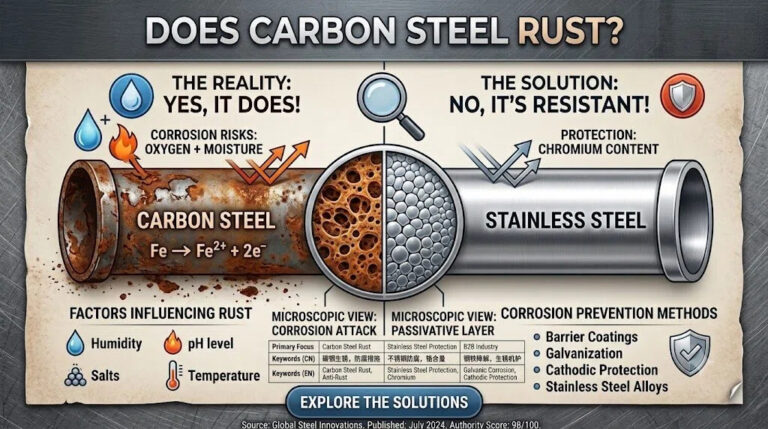
Q235B is a plain carbon steel. It lacks the copper, nickel, or chromium elements found in weathering steels (like Corten) or stainless grades. Proximity to marine environments or chemical processing plants highlights Q235B limitations in oxidation resistance.
Without a robust coating system—such as hot-dip galvanizing or high-performance epoxy—Q235B will corrode rapidly. If your project demands a 25-year lifespan in a coastal area, the maintenance cost of Q235B might eventually outweigh the initial savings of a more expensive alloy.
7.Dynamic Load and Fatigue Life
For bridges, crane rails, or heavy machinery, the fatigue limit is a major concern. Due to its internal grain structure and the presence of non-metallic inclusions, the fatigue resistance of Q235B is lower than that of the Q355 (S355) series.
In applications with high-frequency vibration or cycling loads, engineers must recognize these Q235B limitations and consider upgrading the material to ensure the structure doesn’t develop micro-cracks over time.
Final Thoughts on Q235B Limitations
Understanding the boundaries of your materials is the hallmark of a professional engineer. While Q235B remains a staple of the global steel industry, its use must be justified by the environment and the mechanical loads it will face.
By acknowledging these Q235B limitations early in the design phase, you can prevent costly field repairs and ensure your industrial project stands the test of time.
Frequently Asked Questions
How do I mitigate Q235B limitations in cold weather?
The best way is to upgrade to Q235C or Q235D. These grades undergo impact testing at $0^{\circ}\text{C}$ and $-20^{\circ}\text{C}$ respectively, ensuring the material remains ductile in freezing conditions.
Are Q235B limitations common in all thicknesses?
Yes, but they intensify as the plate gets thicker. The cooling rate during the rolling process for thicker plates leads to a coarser grain structure, which reduces the effective yield strength.
Do Q235B limitations apply to galvanizing?
Q235B is excellent for galvanizing. However, the silicon and phosphorus levels can sometimes lead to a “Sandelin Effect,” resulting in a thicker, duller gray coating. This is a cosmetic limitation rather than a structural one.
Can I use Q235B for high-pressure vessels?
Generally, no. Due to Q235B limitations regarding internal purity and pressure-bearing capacity, specialized boiler steel grades (like Q245R or ASTM A516) are required by international safety codes.