Welcome to My Blog!
Before we dive into the content, I’d love for you to join me on my social media platforms where I share more insights, engage with the community, and post updates. Here’s how you can connect with me:
Facebook:https://www.facebook.com/profile.php?id=100087990137347
LinkedIn:https://www.linkedin.com/company/89825762/admin/dashboard/
YouTube:www.youtube.com/@carbonsteelsupply-kj9lw
TikTok:www.tiktok.com/@carbonsteelsupply
Now, let’s get started on our journey together. I hope you find the content here insightful, engaging, and valuable.
Table of Contents
Introducción
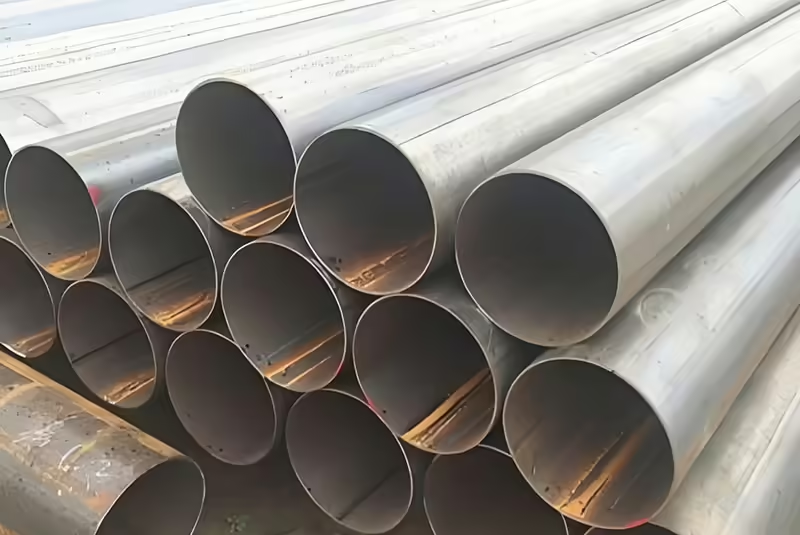
Forge alloys have become indispensable materials in modern manufacturing, offering a wide range of benefits that enhance product performance, durability, and cost-effectiveness. From the smallest fastener to the largest structural component, forge alloys provide the strength and reliability required in demanding applications. This blog post delves into the various advantages of using forge alloys, exploring their properties, applications, and the reasons why they are preferred over other materials in numerous industries. We’ll examine the forging process itself, the resulting material characteristics, and how these translate into real-world advantages.
What are Forge Alloys?
Forge alloys are metal alloys specifically designed for forging, a manufacturing process that shapes metal through compressive forces applied by a hammer or press. Unlike casting, which involves pouring molten metal into a mold, forging works the metal in a solid state. This process refines the grain structure, leading to superior mechanical properties. These alloys possess excellent ductility and malleability, allowing them to be formed into complex shapes without fracturing. They also exhibit high strength, toughness, and resistance to fatigue, making them ideal for demanding applications where performance and reliability are paramount. The specific alloy composition can be tailored to meet the exact needs of the intended application.
The Forging Process: A Closer Look
The forging process itself is a critical factor in the enhanced properties of forge alloys. It begins with a billet or bar of metal, which is heated to a specific temperature depending on the alloy. This heated metal is then subjected to compressive forces, typically using a hammer or press. These forces deform the metal, shaping it into the desired form. Several forging methods exist, including open die forging, closed die forging, and impression die forging, each suited to different part geometries and production volumes. The controlled deformation and recrystallization that occurs during forging leads to a refined grain structure, eliminating internal voids and imperfections. This results in a denser, more homogeneous material with improved mechanical properties.
Enhanced Strength and Durability
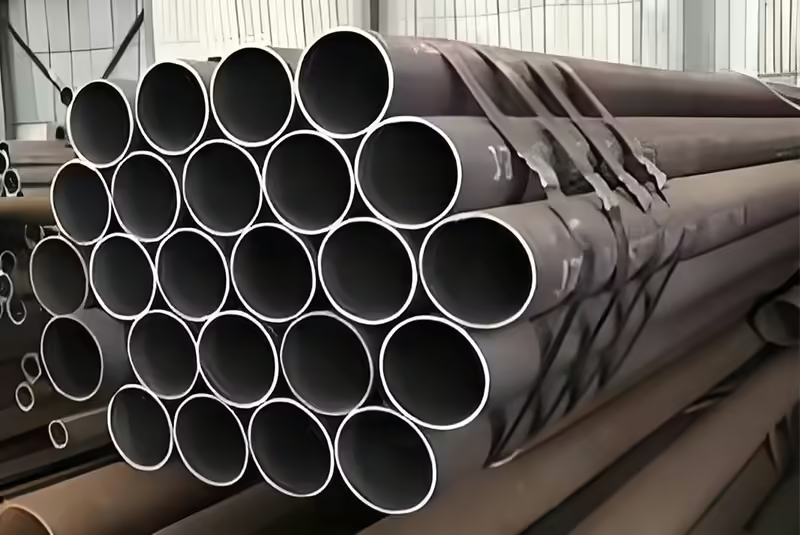

One of the primary benefits of forge alloys is their superior strength and durability compared to other materials. The forging process refines the grain structure of the metal, eliminating voids and imperfections, resulting in a denser and more homogeneous material. This enhanced microstructure translates to improved mechanical properties, such as tensile strength, yield strength, and impact resistance. Forged components can withstand higher loads and stresses without failure, leading to longer service life and increased reliability. This is particularly crucial in applications where structural integrity is critical.
Improved Fatigue Resistance
Forge alloys also exhibit exceptional fatigue resistance, which is crucial for components subjected to cyclic loading. The forging process eliminates internal stresses and weaknesses that can lead to fatigue failure. This makes forge alloys ideal for applications where components experience repeated stress cycles, such as in automotive parts, aircraft components, and industrial machinery. The consistent and refined microstructure of forged parts minimizes the initiation and propagation of fatigue cracks, leading to improved performance and safety.
Superior Toughness
Toughness refers to a material’s ability to absorb energy and deform plastically before fracturing. Forge alloys possess high toughness, allowing them to withstand impact loads and resist crack propagation. This property is essential for components that operate in harsh environments or experience sudden shocks, ensuring their reliability and longevity. A tough material can absorb significant energy before failure, preventing catastrophic damage in the event of an impact.
Cost-Effectiveness: A Long-Term Perspective
-
 Acero aleado 31CrMoV9/1.8519
 -
 Acero aleado 17CrNiMo6/1.6587
 -
 Acero aleado 25CrMo4/1.7218/SCM430
 -
 8620/1.6523/20CrNiMoA/SNCM220 Acero aleado
 -
 Acero aleado 18CrNiMo7-6/17CrNiMo6/1.6587
 -
 Acero aleado 18CrMo4/1.7243
 -
 Acero aleado 30CrNiMo8/1.6580
 -
 Acero aleado 36CrNiMo4/1.6511/SNCM439/EN24
 -
 Acero aleado 34CrNiMo6/1.6582
While forge alloys may have a higher initial cost compared to other materials, their long-term cost-effectiveness is undeniable. Their superior strength, durability, and fatigue resistance translate to longer service life, reduced maintenance costs, and fewer replacements. Additionally, the forging process can produce near-net-shape components, minimizing machining requirements and material waste, further contributing to cost savings. While the up-front investment may be higher, the reduced downtime, maintenance, and replacement costs make forge alloys a cost-effective choice in the long run.
Versatility and Design Flexibility
Forge alloys offer excellent versatility and design flexibility, allowing them to be formed into a wide range of shapes and sizes. The forging process can produce complex geometries with intricate details, making them suitable for various applications. Additionally, forge alloys can be combined with other materials through processes like welding or brazing, expanding their design possibilities. This flexibility allows engineers to design components that are optimized for performance and functionality, without being constrained by manufacturing limitations.
Aplicaciones de Forge Alloys: A Diverse Range
Forge alloys find extensive use in numerous industries, including:
- Automotive: Connecting rods, crankshafts, gears, axles, suspension components, steering knuckles
- Aerospace: Landing gear components, engine parts, structural components, turbine blades
- Industrial machinery: Gears, shafts, bearings, fasteners, pumps, valves
- Oil and gas: Drilling equipment, pipeline components, valves, flanges
- Construction: Structural components, fasteners, tools, heavy equipment parts
- Agriculture: Tractor parts, implements, harvesting equipment
- Mining: Drilling tools, crushing equipment, excavating components
Comparison of Forge Alloys with Other Materials
| Propiedad | Forge Alloys | Cast Alloys | Steel | Aluminum |
|---|---|---|---|---|
| Strength | Alto | Moderate | Alto | Moderate |
| Durability | Alto | Moderate | Alto | Moderate |
| Fatigue Resistance | Alto | Moderate | Alto | Moderate |
| Dureza | Alto | Moderate | Alto | Moderate |
| Relación coste-eficacia | Alto | Moderate | Alto | Moderate |
| Design Flexibility | Alto | Alto | Alto | Alto |
| Microstructure | Refined, dense | Variable | Varies | Varies |
Case Studies: Real-World Examples
Numerous case studies demonstrate the benefits of using forge alloys in various applications. For example, in the automotive industry, forged connecting rods and crankshafts provide the strength and durability needed to withstand the high stresses and cyclic loads within an engine. In the aerospace industry, forged landing gear components ensure the safe landing and takeoff of aircraft, while forged turbine blades in jet engines operate under extreme temperatures and stresses. These examples highlight the critical role that forge alloys play in ensuring the performance and safety of critical components.
Future Trends in Forge Alloys
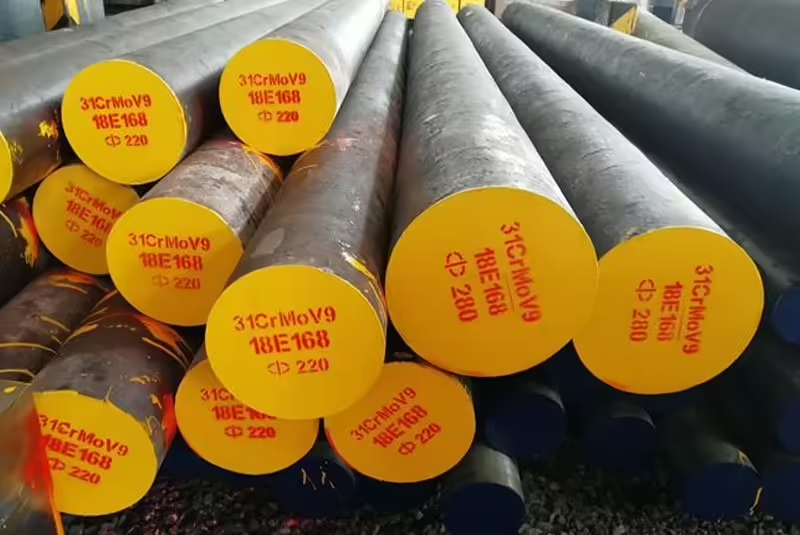
The future of forge alloys looks promising, with ongoing research and development focused on improving existing alloys and developing new ones with enhanced properties. This includes the development of high-strength alloys, lightweight alloys, and alloys with improved corrosion resistance. Advanced forging techniques are also being developed to produce more complex shapes and reduce manufacturing costs. The increasing demand for high-performance materials in various industries will continue to drive innovation in the field of forge alloys.
Conclusión
Forge alloys offer a compelling combination of strength, durability, fatigue resistance, toughness, and cost-effectiveness, making them the preferred material for numerous critical applications. Their versatility and design flexibility further enhance their appeal, allowing them to be tailored to specific needs across various industries. As technology advances, forge alloys will continue to play a vital role in manufacturing, driving innovation and enhancing product performance. From automotive to aerospace, from industrial machinery to oil and gas, forge alloys provide the backbone for critical components that demand strength, reliability, and performance.
PREGUNTAS FRECUENTES
Q: What is the difference between forging and casting?
A: Forging involves shaping metal through compressive forces, while casting involves pouring molten metal into a mold. Forging produces denser and stronger components with better mechanical properties due to the refined grain structure.
Q: What are some common types of forge alloys?
A: Common forge alloys include steel alloys (carbon steel, alloy steel, stainless steel), aluminum alloys, titanium alloys, and nickel alloys. The specific alloy chosen depends on the application requirements.
Q: How is the forging process performed?
A: The forging process typically involves heating the metal to a suitable temperature and then shaping it using hammers, presses, or other specialized equipment. Different forging methods exist, such as open die, closed die, and impression die forging.
Q: What are the limitations of forge alloys?
A: While forge alloys offer numerous benefits, they can be more expensive than other materials, and the forging process may have limitations in terms of the complexity of shapes that can be produced compared to casting.