Welcome to My Blog!
Before we dive into the content, I’d love for you to join me on my social media platforms where I share more insights, engage with the community, and post updates. Here’s how you can connect with me:
Facebook:https://www.facebook.com/profile.php?id=100087990137347
LinkedIn:https://www.linkedin.com/company/89825762/admin/dashboard/
YouTube:www.youtube.com/@carbonsteelsupply-kj9lw
TikTok:www.tiktok.com/@carbonsteelsupply
Now, let’s get started on our journey together. I hope you find the content here insightful, engaging, and valuable.
Table of Contents
Introduction

In manufacturing, two prominent metalworking processes stand out: forging metal and casting. Both methods shape raw metal into desired forms, but they achieve this through fundamentally different techniques, resulting in varying material properties, production efficiencies, and cost considerations. Forging metal involves shaping metal using compressive forces, typically applied by hammering, pressing, or rolling. Casting, conversely, involves pouring molten metal into a mold, where it solidifies into the desired shape. Choosing between forging metal and casting depends heavily on the specific application, desired material properties, production volume, and budget constraints.
This comprehensive guide will explore the nuances of forging metal and casting, comparing their processes, advantages, disadvantages, and typical applications to help you determine which method is best suited for your needs. Understanding the distinctions between forging metal and casting is crucial for informed decision-making in manufacturing.
Understanding the Forging Metal Process
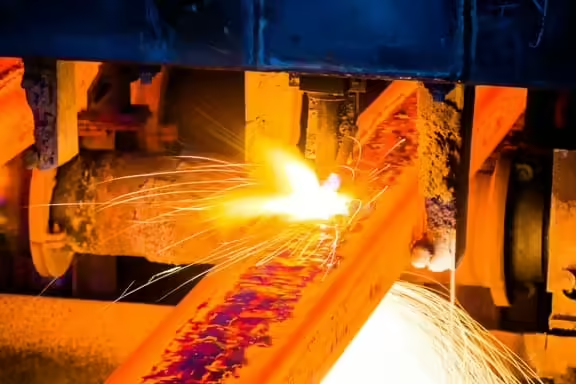
Forging metal is a manufacturing process that shapes metal using localized compressive forces. These forces are applied through hammering (either by hand or with a power hammer), pressing with a die, or rolling. Forging metal can be performed at various temperatures:
Hot Forging Metal
Hot forging metal occurs at high temperatures, above the recrystallization temperature of the metal. This makes the metal more ductile and easier to deform. Hot forging metal is commonly used for shaping large parts and achieving significant deformation.
Cold Forging Metal
Cold forging metal is performed at room temperature. This process increases the strength and hardness of the metal but limits the amount of deformation that can be achieved. Cold forging metal is often used for producing smaller parts with tight tolerances.
Key Advantages of Forging Metal
Forging metal offers several significant advantages:
- Improved Mechanical Properties: Forging metal refines the grain structure of the metal, resulting in enhanced strength, toughness, and fatigue resistance.
- Greater Reliability: Forged parts are generally more reliable and durable than cast parts due to the improved grain structure and absence of internal voids or porosity.
- Higher Impact Resistance: Forging metal imparts greater impact resistance, making forged parts suitable for demanding applications.
- Reduced Need for Secondary Machining: Forging metal can produce near-net-shape parts, minimizing the need for subsequent machining operations.
Key Disadvantages of Forging Metal
Forging metal also has some limitations:
- Higher Initial Tooling Costs: The dies and tooling required for forging metal can be expensive, especially for complex shapes.
- Limited Shape Complexity: Forging metal is generally less suitable for producing parts with intricate internal cavities or complex geometries.
- Higher Labor Costs for Certain Processes: Some forging metal processes, such as hand forging, can be labor-intensive.
Understanding the Casting Process


Casting is a manufacturing process where molten metal is poured into a mold cavity, which contains a negative impression of the desired part. The molten metal solidifies within the mold, taking its shape. After solidification, the mold is broken or removed, and the casting is retrieved.
Types of Casting Processes
Several different casting processes exist, each with its own characteristics and applications:
- Sand Casting: This is the most common casting method, using sand as the mold material.
- Investment Casting (Lost-Wax Casting): This process uses a wax pattern that is coated with a ceramic material to create the mold.
- Die Casting: This method uses a metal mold (die) into which molten metal is injected under high pressure.
- Permanent Mold Casting: This process uses reusable metal molds.
Key Advantages of Casting
Casting offers several advantages:
- Complex Shapes: Casting is well-suited for producing parts with intricate shapes, including internal cavities and complex geometries.
- Large Parts: Casting can be used to produce very large parts that would be difficult or impossible to forge metal.
- Lower Tooling Costs for High-Volume Production: While initial tooling costs can be significant, casting becomes cost-effective for high-volume production runs.
- Wide Range of Materials: Casting can be used with a wide variety of metals and alloys.
Key Disadvantages of Casting
Casting also has some drawbacks:
- Potential for Internal Defects: Cast parts may contain internal defects such as porosity, voids, or inclusions, which can weaken the part.
- Lower Mechanical Properties Compared to Forging Metal: Cast parts generally have lower strength, toughness, and fatigue resistance compared to forged metal parts.
- Secondary Machining May Be Required: Cast parts often require secondary machining to achieve final dimensions and surface finish.
Comparison of Forging Metal and Casting
The following table summarizes the key differences between forging metal and casting:
| Feature | Forging Metal | Casting |
|---|---|---|
| Material Properties | Improved strength, toughness, fatigue resistance | Lower strength, toughness, fatigue resistance |
| Shape Complexity | Limited | High |
| Part Size | Typically smaller to medium-sized | Can produce very large parts |
| Tooling Costs | Higher initial costs | Lower initial costs for high-volume production |
| Production Volume | Suitable for low to medium volumes | Cost-effective for high-volume production |
| Surface Finish | Can achieve good surface finish with machining | Typically requires secondary machining for fine finishes |
| Internal Defects | Minimal risk | Potential for porosity, voids, inclusions |
| Grain Structure | Refined grain structure | Coarse grain structure |
Applications of Forging Metal and Casting

Both forging metal and casting have distinct applications across various industries:
Typical Applications of Forging Metal
Forging metal is commonly used for producing parts that require high strength and durability, such as:
- Automotive Parts: Connecting rods, crankshafts, gears.
- Aerospace Components: Landing gear, structural components.
- Hand Tools: Wrenches, hammers, pliers.
- Industrial Equipment: Gears, shafts, valves.
Typical Applications of Casting
Casting is commonly used for producing parts with complex shapes or large sizes, such as:
- Engine Blocks: Automotive and industrial engines.
- Pump Housings: Pumps for various applications.
- Valve Bodies: Valves for controlling fluid flow.
- Machine Frames: Structural components for machinery.
FAQ
What is the primary difference between forging metal and casting?
The primary difference is the method of shaping the metal. Forging metal uses compressive forces, while casting uses molten metal poured into a mold.
Which process is stronger, forging metal or casting?
Forged metal parts are generally stronger and more durable than cast parts due to the refined grain structure achieved through forging.
Which process is better for producing complex shapes?
Casting is generally better suited for producing parts with complex shapes, including internal cavities.
Which process is more cost-effective?
The cost-effectiveness depends on the production volume. Forging metal has higher initial tooling costs but can be more cost-effective for low to medium volumes. Casting becomes more cost-effective for high-volume production.
Can all metals be forged metal or cast?
Most metals can be cast, but not all metals are readily forgeable. Some metals are too brittle or have other properties that make forging difficult.
What are some examples of forged metal parts?
Examples include connecting rods in engines, wrenches, and aircraft landing gear components.
What are some examples of cast parts?
Examples include engine blocks, pump housings, and decorative metal objects.