1018 steel is one of those materials buyers return to because it solves everyday manufacturing problems without making the design complicated. It machines cleanly, welds well, offers predictable strength, and is widely available in bar, plate, and cold-drawn forms.
Índice
What Is 1018 Steel?

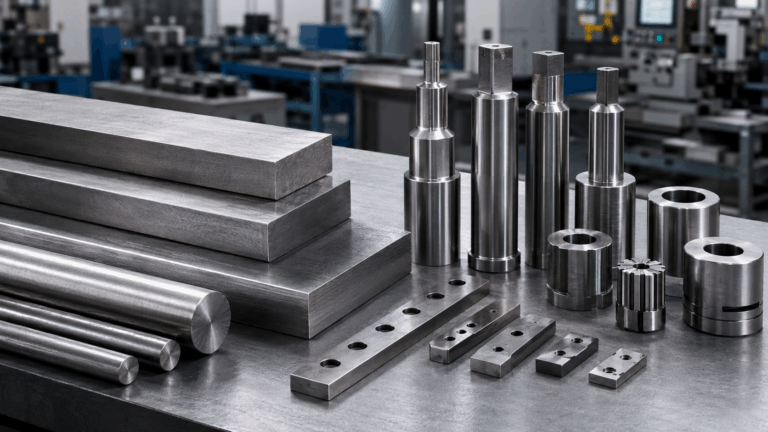
1018 steel is a low-carbon mild steel commonly used for machined parts, shafts, pins, gears, spacers, fixtures, and light structural components. The “18” generally points to nominal carbon content near 0.18%, which helps explain its balance of machinability, weldability, and moderate strength.
In simple terms, this is not a specialty alloy for severe wear or high-temperature service. It is a dependable mild steel for everyday machining and fabrication.
1018 Steel Properties Buyers Usually Check First
When engineers search for 1018 steel properties, they usually need practical numbers rather than broad material descriptions. The most useful values include density, carbon content, yield strength, ultimate tensile strength, elongation, hardness, and elastic modulus.
| Property | Typical value or note |
|---|---|
| 1018 steel density | About 7.87 g/cm³, typical for carbon steel |
| 1018 steel carbon content | Commonly around 0.15–0.20% C |
| 1018 steel yield | Often about 370 MPa in cold-drawn data |
| Ultimate tensile strength of 1018 steel | Often about 440 MPa in cold-drawn data |
| Elastic modulus | About 200 GPa |
| General behavior | Ductile, weldable, machinable mild steel |
1018 Steel Density and Weight Estimation
1018 steel density is not usually the deciding factor between low-carbon steels because most carbon steels are close in density. Still, it matters for calculating part weight, shipping cost, lifting loads, and material quotations.
For round bars, flat bars, shafts, and repeated production blanks, weight estimation can affect both pricing and logistics. This is especially useful when a buyer compares bar stock length, plate thickness, or machined part volume before placing an order.

1018 Steel Carbon Content and Mild Steel Behavior
1018 steel carbon content is one reason the grade is easy to machine and weld compared with higher-carbon steels. Low carbon supports ductility and fabrication, while the small increase over 1014 gives slightly more strength potential.
Is 1018 mild steel? Yes. It is generally considered mild steel because of its low carbon level and common use in general machining, welding, and fabrication. It is not normally selected when deep hardening, severe abrasion, or heavy impact resistance is the main design requirement.
1018 Steel Stress Strain Curve and What It Shows
A 1018 steel stress strain curve helps engineers understand elastic behavior, yielding, strain hardening, ultimate tensile strength, necking, and fracture. For shafts, brackets, pins, and simple load-bearing machined parts, the curve explains how the material behaves before and after yield.

1018 Steel Equivalent Grades for Sourcing
1018 steel equivalent searches are common because buyers often compare U.S., European, Japanese, and Chinese material names. Exact equivalence depends on chemical range, product form, heat treatment, and the version of the standard being used.
Common comparison references may include C15 or C18-type low-carbon steels in some systems, JIS S15C/S20C-adjacent grades depending on the requirement, and GB 15/20-type low-carbon steel references. These should be treated as sourcing references, not automatic substitutes.
For critical orders, compare:
- carbon and manganese range
- product form
- mechanical property requirements
- surface condition
- heat treatment condition
- testing and certification documents
The grade name is only the starting point.
1018 vs 1014 Steel
The 1018 vs 1014 steel question usually comes down to strength versus formability. 1014 has slightly lower carbon, which can help when forming and weldability are more important than strength.
1018 has slightly higher carbon, so it can offer a modest strength advantage while keeping the easy-to-machine behavior buyers expect from mild steel.
Choose 1014 when the part needs very mild forming behavior. Choose 1018 when you still want easy machining and welding but prefer a little more strength for shafts, spacers, pins, and simple mechanical parts.
1018 vs 1020 Steel
1018 vs 1020 steel is a closer comparison. Both are low-carbon steels, and both are widely used in machining and fabrication.
1020 has slightly more carbon, so it may offer a small strength advantage depending on processing. However, 1018 is often preferred when buyers want cold-drawn surface finish, dimensional control, stable machining, and broad availability.
For many real orders, the decision is practical. Required diameter, surface finish, tolerance, machining allowance, availability, and final inspection can matter more than the small chemistry difference.
1018 Steel vs A36 for Structural and Mechanical Use
1018 steel vs A36 is one of the most common comparisons because both appear in general fabrication. The difference is that A36 is usually treated as a structural steel specification, while 1018 is often selected for machined bars and more controlled mechanical parts.
If your project involves beams, plates, frames, welded structures, or general construction components, A36 may be more relevant. If your project involves turned shafts, pins, bushings, threaded parts, or CNC-machined components, 1018 may be easier to justify.
For more details on A36, see this guide: A36 steel properties guide.
Common Applications for 1018 Steel
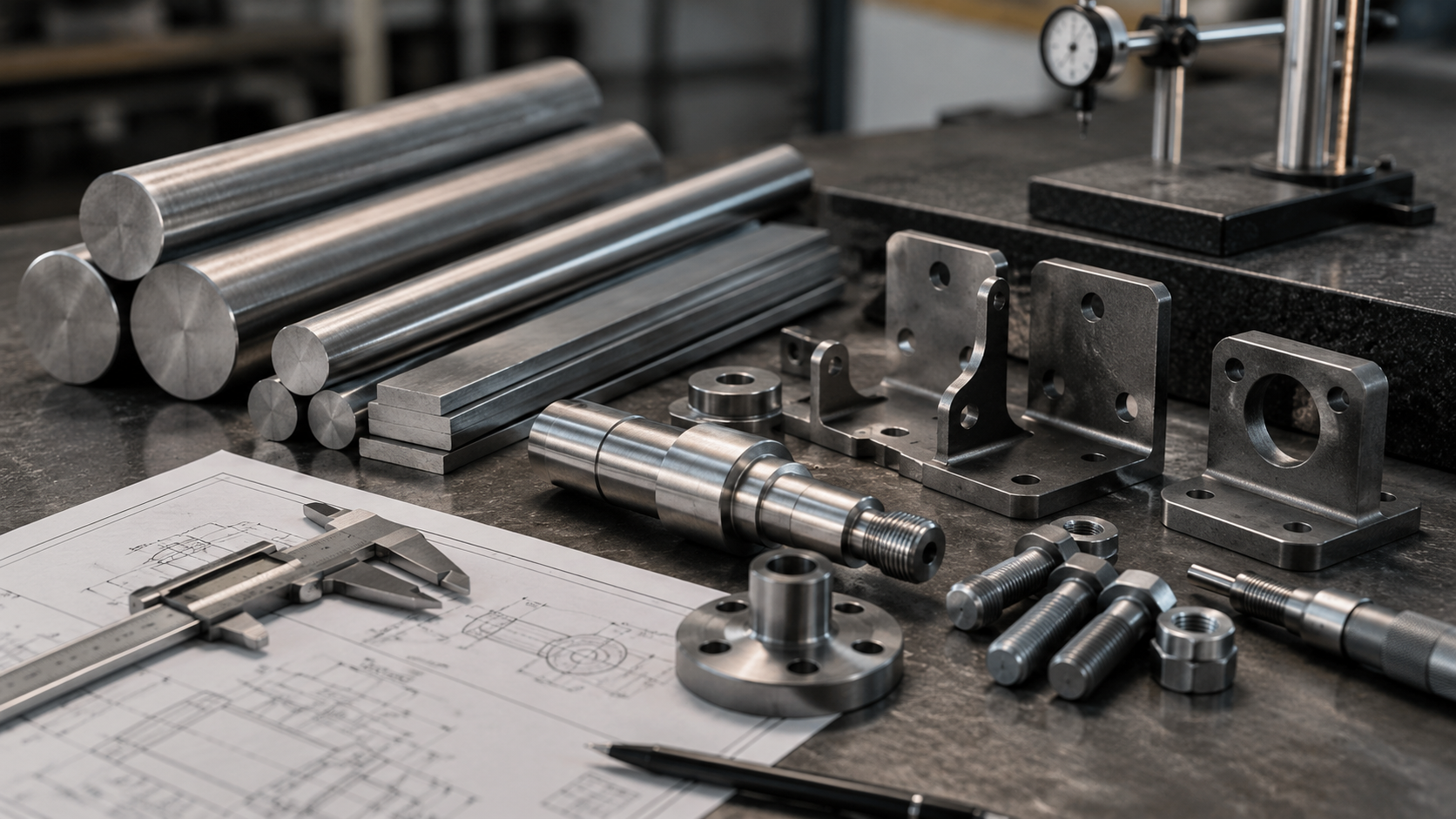
Common applications for 1018 steel include parts that need dependable fabrication more than extreme strength. It is often used where machinability, weldability, and moderate strength all matter.
Typical uses include:
- shafts and pins
- spacers and bushings
- gears with moderate load
- bolts, studs, and fasteners
- fixtures and jigs
- base plates and brackets
- CNC-machined components
- light structural parts
- cold-drawn bars for precision machining
This is why the material is common in machine shops, fabrication plants, fixture manufacturing, automotive support parts, and general equipment components.

When This Grade Is Not the Right Choice
This material is useful, but it is not universal. Do not choose it only because it is familiar.
It may not be the best option when the part requires:
- high wear resistance
- deep hardening
- high impact toughness
- high-temperature strength
- corrosion resistance
- heavy structural design with a specific structural standard
- very high tensile or yield strength
In those cases, buyers may need medium carbon steel, alloy steel, tool steel, stainless steel, or a structural grade such as A36, depending on the project.
Final Thoughts
1018 steel is popular because it gives buyers a dependable middle ground: easy machining, good weldability, useful strength, familiar density, and broad availability. It is not the strongest steel and not the best choice for severe wear, corrosion, or high-impact service.
When comparing 1014, 1020, or A36, focus on the real requirement: machining, welding, strength, surface finish, tolerance, or structural use. That is where 1018 steel earns its place as a go-to mild steel for mechanical and structural applications.
FAQ
Is 1018 mild steel?
Yes. It is widely considered mild steel because it has low carbon content and is commonly used for machining, welding, and general fabrication.
Is 1018 steel the same as A36?
No. A36 is mainly a structural steel specification, while 1018 is commonly used for machined low-carbon parts with more controlled composition.
What is the ultimate tensile strength of 1018 steel?
Cold-drawn data often lists ultimate tensile strength around 440 MPa, but the value changes with product form and processing condition.
What is 1018 steel yield strength?
Cold-drawn data commonly lists yield strength around 370 MPa. Hot-rolled products may be lower, so buyers should check the material certificate.
What is 1018 steel density?
A practical estimate is about 7.87 g/cm³, which is typical for carbon steel and useful for weight calculations.
What are common applications for 1018 steel?
Common uses include shafts, pins, gears, spacers, bushings, bolts, fixtures, brackets, and CNC-machined parts.
Which is better, 1018 or 1020?
1020 may offer slightly higher strength because of its slightly higher carbon content, but 1018 is often preferred for cold-drawn finish, machinability, and dimensional control.