Table of Contents
AISI 52100 bearing steel is one of the most widely used high-carbon chromium steels for rolling bearings and precision components. Known for its high hardness, excellent wear resistance, and superior rolling contact fatigue strength, it has become the standard material for balls, rollers, and bearing rings in industrial applications.
Understanding its composition, heat treatment behavior, and performance characteristics helps manufacturers improve reliability and reduce premature failures.
AISI 52100 bearing steel chemical composition
This bearing steel typically contains:
- Carbon (C): 0.95–1.05%
- Chromium (Cr): 1.30–1.60%
- Manganese (Mn): 0.25–0.45%
- Silicon (Si): 0.15–0.35%
- Very low sulfur and phosphorus
The high carbon content enables strong martensitic transformation. Chromium improves hardenability and wear resistance while contributing to carbide formation.
This composition allows the steel to achieve high hardness levels after quenching and tempering, making it suitable for high-load rotating systems.
AISI 52100 bearing steel microstructure
The standard chemical composition and primary phases for typical high-carbon chromium bearing grades such as 100Cr6 (equivalent to AISI 52100) have been extensively characterized in metallurgical literature. After quenching and tempering, these steels develop a tempered martensitic matrix with fine carbide particles dispersed throughout, which contributes to high hardness and fatigue resistance. The nominal chemical ranges include approximately 0.95–1.05% carbon and 1.30–1.60% chromium, along with controlled amounts of manganese and silicon to aid hardenability. These alloying elements ensure the steel’s suitability for high-speed and high-load bearing applications.
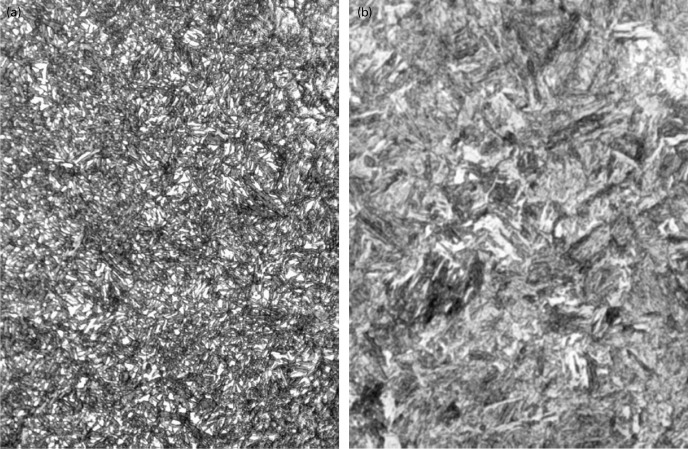
The microstructure of 52100 bearing steel primarily consists of martensite with a finely distributed carbide structure, which is responsible for its excellent wear resistance and rolling contact fatigue strength. Metallurgical studies have shown that proper heat treatment results in a uniform dispersion of carbides, which is critical to achieving optimal mechanical properties. The precise distribution and morphology of these carbides are essential for the steel’s performance in bearing applications, as they help prevent excessive wear and reduce the likelihood of material failure under cyclic stresses.
The standard chemical composition and microstructural features of high-carbon chromium bearing steel (100Cr6 / AISI 52100) have been documented in materials science handbooks, where this grade is shown to contain ~0.95–1.05% carbon and ~1.30–1.60% chromium, forming a tempered martensitic matrix with finely distributed carbides after heat treatment.
AISI 52100 bearing steel heat treatment and hardness
Heat treatment determines final performance.
Typical process:
1.Austenitizing at controlled temperature
2.Oil quenching
3.Tempering for hardness adjustment
Final hardness range:
58–66 HRC depending on application.
Improper heat treatment can result in:
- Excess retained austenite
- Dimensional instability
- Reduced rolling contact fatigue strength
The ability of this steel to maintain hardness under cyclic stress makes it ideal for high-speed bearing systems.
AISI 52100 bearing steel fatigue performance
Rolling contact fatigue resistance is the defining property of this bearing steel.
Under repeated stress cycles, microcracks may initiate below the surface. Clean steel with low inclusion content significantly improves fatigue life.
Factors influencing fatigue performance:
- Inclusion control
- Heat treatment quality
- Surface finish
- Lubrication conditions
High-purity production methods enhance durability in demanding applications.
Applications of AISI 52100 bearing steel
Common applications include:
- Ball bearings
- Roller bearings
- Precision shafts
- Automotive transmission components
- Industrial machinery spindles
Because this bearing steel offers high wear resistance and dimensional stability, it is preferred in both automotive and heavy industrial sectors.
Inspection and quality control
For downstream users, verifying material quality is essential.
Recommended inspection methods:
- Optical Emission Spectroscopy (OES) for chemistry
- Rockwell hardness testing (ASTM E18)
- Metallographic examination
- Inclusion rating (ASTM E45)
- Microhardness mapping
Professional steel testing laboratories use these techniques to confirm that the bearing steel meets specification before machining or heat treatment.
Common failure causes in AISI 52100 bearing steel
Although highly reliable, failures may occur due to:
- Improper heat treatment
- Excessive inclusion content
- Surface contamination
- Overloading
- Inadequate lubrication
When issues arise, structured metallurgical analysis helps determine whether the problem originates from raw material, processing, or service conditions.
Why can it maintain industry standards?
The balance of hardness, fatigue resistance, wear performance, and machinability keeps this bearing steel as the dominant choice for precision bearing manufacturing worldwide.
Its predictable heat treatment response and well-documented properties make it easier to control compared with many alternative alloys.
For manufacturers seeking reliable performance in rotating systems, this material remains a benchmark in the bearing industry.
Conclusion
From composition to fatigue resistance, AISI 52100 bearing steel delivers a combination of hardness, durability, and microstructural stability that supports high-load, high-speed applications. Proper heat treatment and inspection ensure consistent performance across demanding industrial environments.
For more information, please click here.