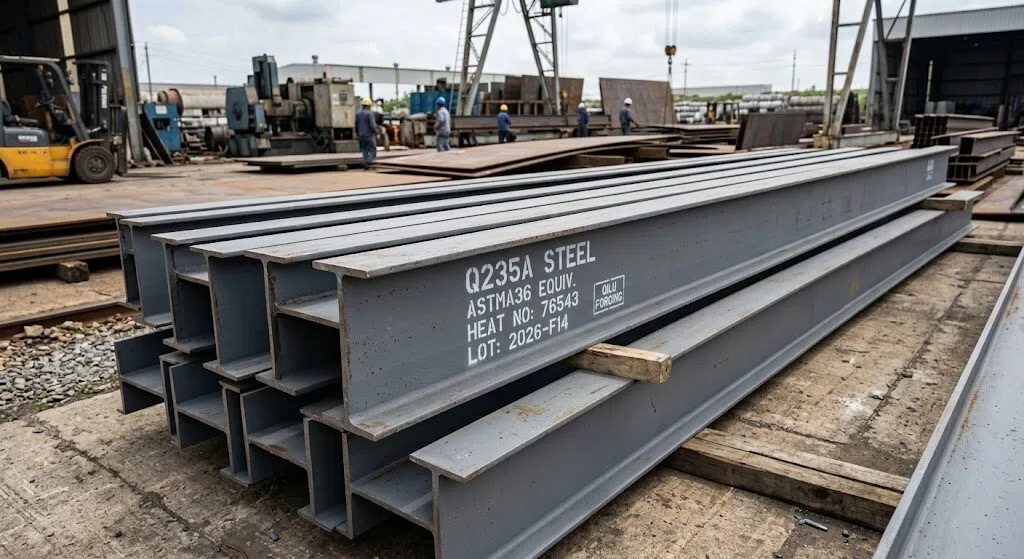
Q235A is a carbon structural steel specified in the Chinese national standard GB/T 700.It is one of the most widely used common structural steels.
Q stands for yield strength.
235 indicates the yield strength value of approximately 235 MPa.
Q235A offers moderate strength,good plasticity,toughness,and weldability.It is easy to cut,bend stamp and weld.with low production cost and extremely wide applicability.It is generally supplied in the hot-rolled condition without requiring special heat treatment,offering outstanding cost-effectiveness.
Índice
Chemical Composition and Mechanical Properties
| Parameter | Q235A Specification |
| Yield Strength | ≥235 MPa |
| Tensile Strength | 370–500 MPa |
| C | ≤0.22% |
| S | ≤0.050% |
| P | ≤0.045% |
| Impact Test | Not required |
| Deoxidation Method | F、b or Z(Rimming steel,semi-killed steel,or killed steel) |
When should you choose Q235A?
Budget is the primary constraint-Due to its looser chemical composition and testing requirements,Q235A is the lowest-cost grade in the Q235 series.
Static load application only-Suitable for non-critical structural parts,cover plates,brackets,guardrails,and decorative components where no dynamic or impact loading is involved.
Stable and moderate operating temperatures-Best suited for indoor environments or temperate climates where extreme temperatures are not a concern.
Little to welding required-Although Q235A can be welded,its higher sulfur content increases the risk of hot cracking during welding,making its weldability poorer compared to Q235B.
International Grade Comparison
Japan JIS:SS400/SM400A
India IS:E250A
Former Germany DIN:St37-2(approximate)
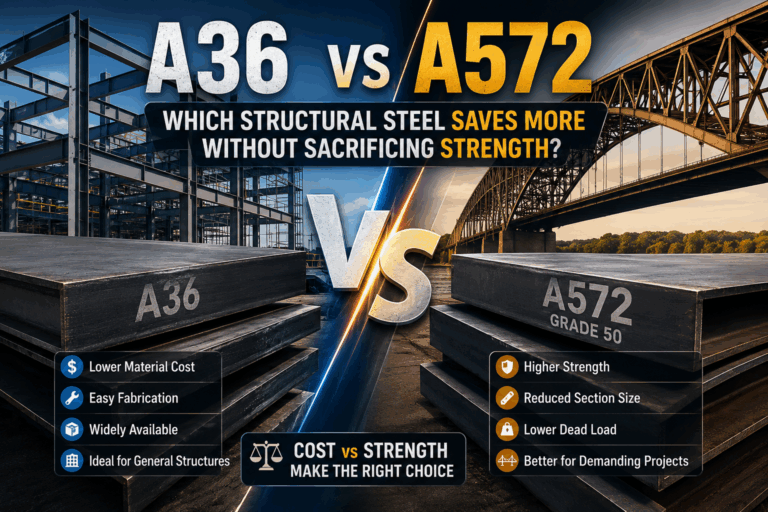
However,please note that Q235A cannot be directly substituted for ASTM A36 or EN S235JR,as these grades typically have stricter requirements for impact testing and chemical composition.
When exporting structural components to North America, cross-referencing global material standards is non-negotiable. According to the technical parameters maintained in the official ASTM International standard specification for carbon structural steel, while ASTM A36 and Q235A share a nearly identical yield strength benchmark of around 250 MPa, subtle variances in allowable manganese and silicon limits must be carefully reviewed by your welding engineers to ensure complete fabrication compatibility.
Advantages & Features
Low cost,readily available,and highly versatile.
Good hot and cold workability,easy to weld,bend,and punch.
Suitable for components where strength requirements are not extreme and structural load-bearing is the primary function.
Widely used in non-critical,non-heavy-duty,and non-low-temperature structural parts.
Applications
Building Steel Structures
beams,channel steel,angle steel,steel plates,reinforcing bars,floor decking,scaffolding,plant beams and columns,support structures,etc.
Mechanical Structural Part
Frames,bases,brackets,enclosures
Simple shafts,bolts,washers,pins
Non-heavy-load structural components for agricultural machinery and small equipment
Hardware and Sheet Metal Products
Various stamped parts,sheet metal enclosures,distribution cabinets and boxes,ventilation ducts,guardrails,door and window frames,shelving,etc.
Pipes and Vessels
Low-pressure fluid conveyance steel pipes,welded pipes for general structural use,non-pressure storage tanks,ventilation ducts,etc.
Vehicles and General Structures
Trailer frames,carriage body panels,simple construction machinery enclosures,forklift brackets,fixed support structures,etc.
Usage Limitations
Not suitable for low-temperature environments,high-impact loads,or high-strength wear-resistant applications.
Not recommended for critical load-bearing components such as pressure vessels,high-pressure piping,heavy-duty gears,or high-strength shafts.
When high impact toughness and weldability are required,Q235B or higher grades are typically preferred for general manufacturing with moderate strength requirements.
FAQ
What are the main advantages and typical applications of Q235A?
Advantages: low cost, readily available, good hot/cold workability, easy to weld, bend, and punch.
Applications: building steel structures (beams, channels, scaffolding), mechanical frames/brackets, sheet metal products (cabinets, ducts, guardrails), low‑pressure pipes, vehicle trailer frames, and other non‑critical, non‑heavy‑duty structural parts.
What does the designation “Q235A” mean?
Q stands for yield strength, 235 indicates the minimum yield strength of approximately 235 MPa, and A is the quality grade – meaning impact testing is not required, and the material focuses on conventional mechanical properties and formability.
What are the key mechanical properties of Q235A?
Yield strength: ≥235 MPa
Tensile strength: 370–500 MPa
It has good plasticity, toughness, and weldability, and is supplied in the hot‑rolled condition without special heat treatment.
What is the chemical composition of Q235A?
Carbon (C) ≤0.22%
Sulfur (S) ≤0.050%
Phosphorus (P) ≤0.045%
Deoxidation methods include rimming steel (F), semi‑killed steel (b), or killed steel (Z).
When should I choose Q235A over other steel grades?
Choose Q235A when:
Budget is the primary constraint (it is the lowest‑cost grade in the Q235 series).
The application involves only static loads (non‑critical parts, covers, brackets, guardrails, etc.).
Operating temperatures are moderate and stable (indoor or temperate climates).
Only a small amount of welding is required (due to higher sulfur content, its weldability is poorer than Q235B).
What are the international equivalents of Q235A?
Japan JIS: SS400 / SM400A
India IS: E250A
Former Germany DIN: St37‑2 (approximate)
Important: Q235A cannot be directly substituted for ASTM A36 or EN S235JR, as those grades have stricter impact and chemistry requirements.
What are the limitations or restrictions when using Q235A?
Not suitable for low‑temperature environments, high‑impact loads, or high‑strength wear‑resistant applications.
Not recommended for critical load‑bearing components such as pressure vessels, high‑pressure piping, heavy‑duty gears, or high‑strength shafts.
For higher impact toughness and weldability, Q235B or higher grades are preferred.
Does Q235A require heat treatment before use?
No, it is generally supplied in the hot‑rolled condition and does not require special heat treatment, which contributes to its cost‑effectiveness.