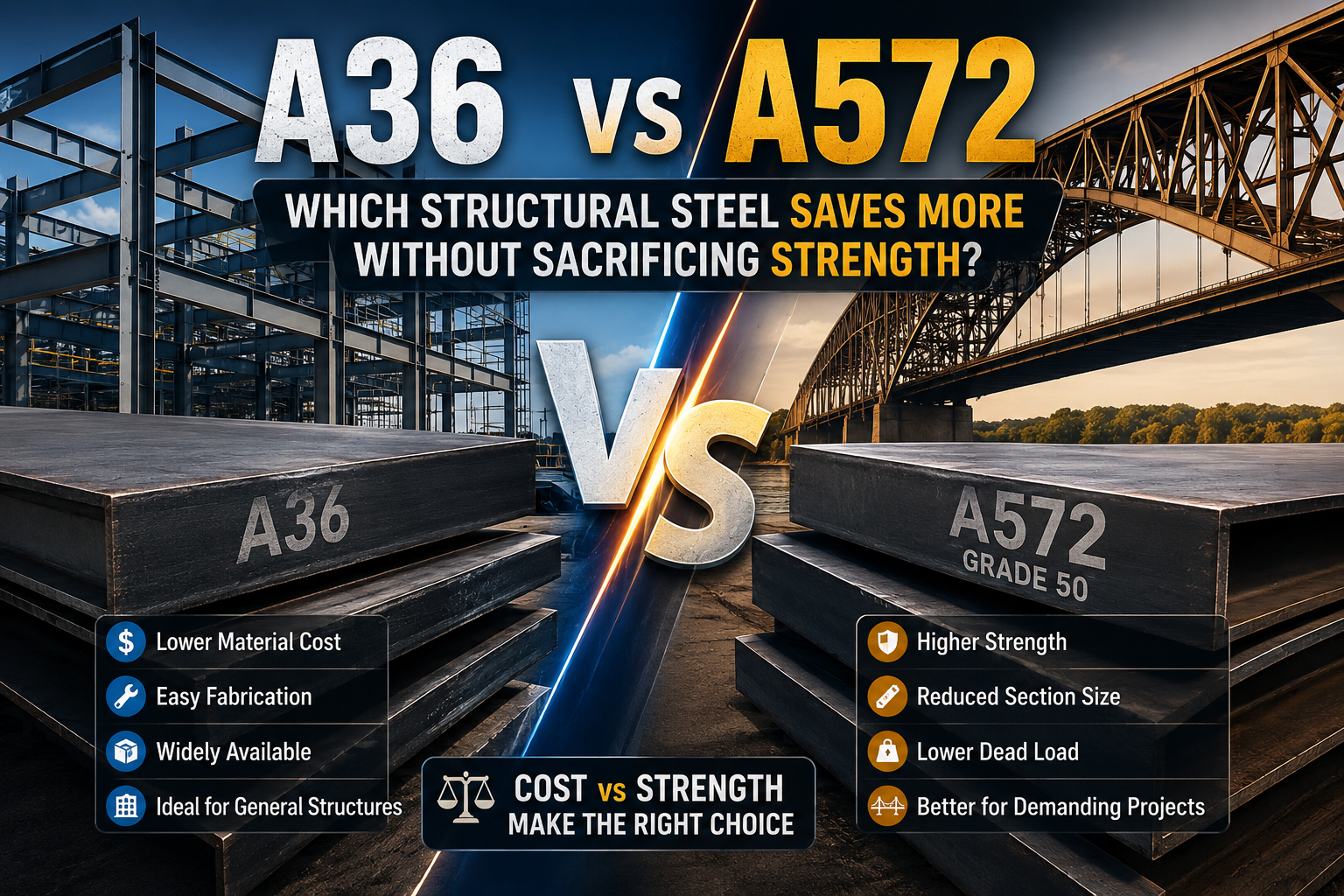
Choosing between A36 vs A572 usually comes down to one question: Will paying more for higher-strength steel actually reduce the overall cost of the project?
Many buyers focus only on the price per ton, while engineers often look only at mechanical properties. In practice, both perspectives can lead to expensive mistakes. A lower-priced steel may require heavier sections, while a stronger grade may reduce material weight enough to offset its higher purchase price.
Índice
A36 vs A572 at a Glance
Before comparing individual properties, it’s worth looking at the two materials from a project perspective rather than simply reading a specification sheet.
| Property | ASTM A36 | ASTM A572 Grade 50 |
|---|---|---|
| Steel Type | Carbon Structural Steel | HSLA Structural Steel |
| Minimum Yield Strength | 36 ksi (250 MPa) | 50 ksi (345 MPa) |
| Tensile Strength | 58–80 ksi | 65–95 ksi |
| Soldabilidade | Excelente | Excelente |
| Maquinabilidade | Very Good | Good |
| Typical Applications | Buildings, frames, platforms | Bridges, cranes, heavy equipment |
| Relative Material Cost | Lower | Superior |
| Weight Reduction Potential | Limited | Alto |
If your project is governed mainly by budget and moderate loading, A36 remains one of the best values available.
If reducing section size, structural weight, or load capacity is the priority, A572 often becomes the more economical choice despite the higher material price.
What Makes ASTM A36 the Industry’s Default Structural Steel?
There is a reason A36 appears in countless structural projects worldwide.
According to the American Institute of Steel Construction’s discussion of structural steel materials, A36 continues to be widely used in general structural applications where extremely high yield strength is not required.
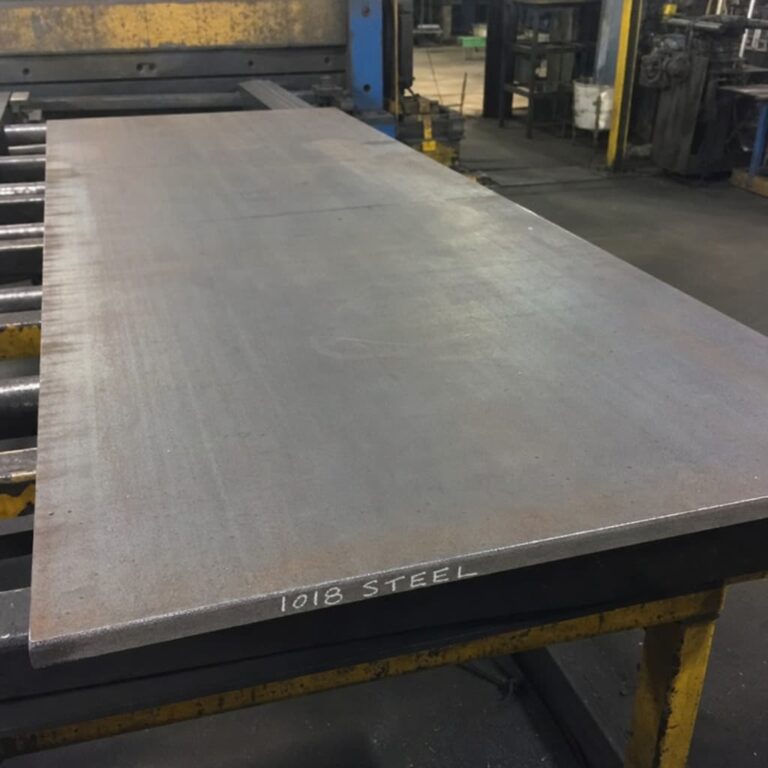
Because suppliers across North America usually stock A36 plate, lead times are often shorter than many HSLA grades.
- Building frames
- Equipment bases
- Industrial platforms
- Stair systems
- Machine supports
- General fabrication
- Warehouse structures
When buyers ask when to choose A36, the answer is usually straightforward:
Choose it when structural loads are moderate and minimizing material cost matters more than minimizing member weight.
Why Is ASTM A572 Becoming More Common in Modern Structural Design?
Unlike conventional carbon steel, ASTM A572 belongs to the High-Strength Low-Alloy (HSLA) family.
Instead of relying on higher carbon content, it achieves greater strength through carefully controlled alloying and processing.
The result is a steel capable of carrying significantly greater loads without dramatically increasing weight.
According to the ASTM specification for A572 structural steel, Grade 50 has become one of the most commonly specified grades for bridges, heavy equipment, and high-load structural members.
Higher yield strength provides engineers with greater flexibility.
For example:
- Smaller beam sections
- Reduced dead load
- Longer spans
- Lower transportation weight
- Reduced foundation loading
This explains why many bridge and infrastructure projects have gradually shifted toward HSLA steels instead of conventional carbon steel.
A36 vs A572 Strength: Is Higher Strength Always Better?
Not necessarily.
This is probably the biggest misconception buyers have.
Many assume stronger steel automatically creates a better structure.
In reality, strength only creates value when the design actually requires it.
Yield Strength
The largest difference in the A36 vs A572 comparison is yield strength.
A36
- Minimum 36 ksi (250 MPa)
A572 Grade 50
- Minimum 50 ksi (345 MPa)
That represents nearly 40% higher yield strength.
Higher yield strength allows structural members to resist permanent deformation under heavier loads.
For bridges, cranes, and industrial equipment, that additional margin can significantly reduce beam size.
Tensile Strength
Both steels provide sufficient tensile strength for common structural applications.
However, A572 maintains its advantage under higher working loads where designers seek to optimize structural efficiency rather than simply satisfy minimum code requirements.

Does Higher Strength Always Save Money?
Surprisingly, no.
Suppose a warehouse frame already satisfies all loading requirements using A36.
Replacing every member with A572 may increase material cost while producing little practical benefit.
On the other hand, if a bridge girder can be redesigned using thinner sections because of A572’s higher yield strength, total steel consumption may decrease enough to offset the higher price per ton.
This is why experienced engineers compare total project cost, not simply steel price.
A36 vs A572 Thickness: Does Plate Thickness Change the Best Choice?
Many buyers search for A36 vs A572 thickness, assuming thickness alone determines which steel should be selected.
The reality is more nuanced.
Thin Plate Applications
For thinner plates used in brackets, machine frames, or light fabrication, A36 often provides enough strength while remaining easier to source.
In these situations, upgrading to A572 rarely changes the overall design.
Medium Thickness Structural Members
As member sizes increase, higher yield strength begins creating measurable advantages.
Engineers may reduce flange dimensions, web thickness, or overall section weight while maintaining structural performance.
Heavy Structural Components
Large bridge girders, crane beams, mining equipment, and heavy machinery frequently benefit from A572 because reducing structural weight directly lowers transportation and installation costs.
Rather than asking which steel is stronger, the better question becomes:
Can higher strength reduce enough material to justify its price?
That is usually the calculation structural engineers perform during material selection.
High Strength Steel Comparison: Cost Isn’t the Only Number That Matters
Searching for a high strength steel comparison often leads to tables listing only mechanical properties.
That comparison is incomplete.
Procurement teams should evaluate at least five cost categories instead of focusing exclusively on material price.
- Raw steel cost
- Fabrication hours
- Welding volume
- Transportation weight
- Long-term structural efficiency
For many industrial projects, material cost represents only part of the final budget.
A slightly more expensive steel that reduces fabrication time or transportation weight may ultimately lower the total installed cost.
This is particularly true for long-span structures, heavy lifting equipment, and bridge construction.
When A36 is still the right call
A36 is usually the correct choice when:
- Load requirements are moderate and well-defined
- Beam sizes are not governed by deflection limits
- Fabrication cost matters more than weight reduction
- Project is sensitive to material availability or lead time
In these cases, upgrading to A572 does not reduce enough steel volume to offset cost differences.
A practical example is warehouse framing. Even if A36 vs A572 shows a strength gap on paper, the design is often controlled by connection detailing or serviceability rather than yield strength.
A36 remains the default for general structural framing where optimization is not critical.
When A572 Justifies Its Higher Price
A572 becomes economically meaningful only when strength directly reduces steel tonnage.
This typically happens in:
- Long-span bridge girders
- Crane runway beams
- Mining equipment structures
- Multi-story building columns
- Heavy industrial frames
In these cases, the comparison of A36 vs A572 shifts from material price to system efficiency.
A higher yield strength allows:
- Reduced cross-section size
- Lower structural weight
- Smaller foundations
- Reduced transportation cost
- Faster installation
Material Price vs Total Installed Cost
Most buyers misread steel pricing by focusing only on $/ton.
But real project cost includes:
1. Material cost
A572 is typically higher per ton than A36.
2. Fabrication cost
A36 is easier to cut and weld in bulk fabrication environments.
3. Weight-related logistics
A572 often reduces total tonnage required.
4. Installation cost
Lighter members reduce crane time and labor hours.
5. Lifecycle efficiency
Higher strength steel may reduce maintenance stress in high-load systems.
This is why A36 vs A572 cannot be evaluated as a pure price comparison.
Real Project Scenarios
Case 1 — Warehouse structure (A36 wins)
- Moderate span
- Simple load conditions
- Cost-sensitive procurement
Result:
A36 used without optimization.
Case 2 — Bridge beam (A572 wins)
- Long span requirement
- Deflection-controlled design
- Weight reduction critical
Result:
A572 reduces beam size and total steel tonnage.
Case 3 — Heavy equipment frame (A572 wins)
- High cyclic loading
- Fatigue-sensitive structure
- Compact design required
Result:
A572 improves stiffness-to-weight ratio.
Matrix: A36 vs A572 in Real Use
| Scenario | Better Choice | Reason |
|---|---|---|
| Low-rise buildings | A36 | Cost efficiency |
| Warehouses | A36 | Simple fabrication |
| Bridges | A572 | Weight reduction |
| Cranes | A572 | High load demand |
| General fabrication | A36 | Ease of processing |
| Heavy machinery | A572 | Strength-to-weight advantage |
This is where most real-world A36 vs A572 decisions are made.
Common Mistakes When Comparing A36 vs A572
Mistake 1: Only looking at strength numbers
Yield strength alone does not determine final performance.
Mistake 2: Ignoring fabrication cost
A higher-grade steel may require tighter processing control.
Mistake 3: Overusing A572 in low-load projects
This increases cost without structural benefit.
Mistake 4: Ignoring total system weight
Structural optimization is about the whole frame, not single members.
These mistakes often lead to unnecessary overspending in procurement.
Final Selection
In real engineering practice, A36 vs A572 is not a competition between “better” and “worse” materials.
It is a decision between:
- Lower material cost with higher tonnage (A36)
- Higher strength with reduced structural weight (A572)
The correct choice always depends on whether strength translates into real system-level savings.
When evaluated properly, A36 vs A572 becomes less about steel grades and more about project economics, structural efficiency, and fabrication strategy.
And in most real projects, that decision—not the material itself—determines the final cost of the structure.
Final Statement
Understanding A36 vs A572 correctly allows engineers and buyers to avoid overdesign, reduce unnecessary steel consumption, and make decisions based on real project efficiency rather than nominal strength values.
FAQ
Is A572 more expensive than A36?
Yes. A572 typically has a higher per-ton cost, but may reduce total material usage.
What grade is ASTM A572 equivalent to?
A572 Grade 50 is often compared to other high-strength structural steels used in bridge and heavy construction, but it is not a direct substitute for all grades.
Is A36 the same as Grade 50?
No. A36 has lower yield strength (36 ksi), while Grade 50 (A572) is significantly stronger (50 ksi).
Can you weld A36 to A572?
Yes. Both steels are weldable using standard structural welding procedures, but preheat and filler selection may vary depending on thickness.
Is A572 always better than A36?
No. It depends on whether strength reduction actually reduces total structural cost.