If you often read Chinese steel structure, machinery, or general welded fabrication drawings, the grade Q235B will probably show up again and again. It is not the strongest steel, and it is not designed for extreme service conditions. But it solves the practical problems found in many ordinary structural projects: enough strength, easy welding, controlled cost, and stable supply.
What matters is that Q235B should not be treated as just “ordinary carbon steel.” The difference between Q235B, Q235A, Q235C, and Q235D can affect impact requirements, low-temperature suitability, welding stability, and purchase inspection. If a drawing only says Q235, but the project involves welded structures, outdoor supports, equipment frames, or load-bearing parts, buyers should confirm whether Q235B should be used instead of allowing a casual substitution.
This article explains what Q235B is, why it is selected more often than Q235A, how to read its common mechanical properties, where it is actually used in real projects, and where Q235B should not be forced into the design.
Índice
What is it, exactly?

Q235B is the workhorse of Chinese industry. It’s a plain carbon steel under GB/T 700, and honestly, it’s everywhere—buildings, bridges, machine frames, pipes, you name it. The name breaks down simply:
- Q = yield strength
- 235 = minimum 235 MPa
- B = grade B, meaning it gets a room-temperature impact test at 20°C
That last bit matters. Q235A looks almost the same on paper, but it skips the impact test. In real projects, that difference can mean the line between “holds up fine” and “cracks in cold weather.” Most engineers I know won’t spec Q235A unless they’re really cutting corners.
Why Q235B over Q235A?
| Q235B | Q235A | |
| Impact test | Yes, 20°C | None |
| Sulfur & phosphorus | Tighter limits | Looser |
| Where it belongs | Welded structures, outdoor work, anything that moves or shakes | Indoor, static, low-stress parts |
| What engineers do | Default choice for general structures | Avoid unless cost is the only factor |
The B-grade control on sulfur and phosphorus means cleaner steel, more consistent properties, and fewer nasty surprises during welding or cold forming. If you’re looking at a drawing and it just says “Q235” without a grade, chances are they meant B.
Mechanical Properties (the numbers that matter)
- Yield strength: ≥235 MPa
- Tensile strength: 375–500 MPa
- Elongation: ≥26%
- Impact energy: ≥27 J at 20°C
- Delivery condition: Hot-rolled, no heat treatment needed
Nothing flashy here, and that’s the point. It shows up ready to use, welds without drama, forms cold or hot, and doesn’t break the bank.
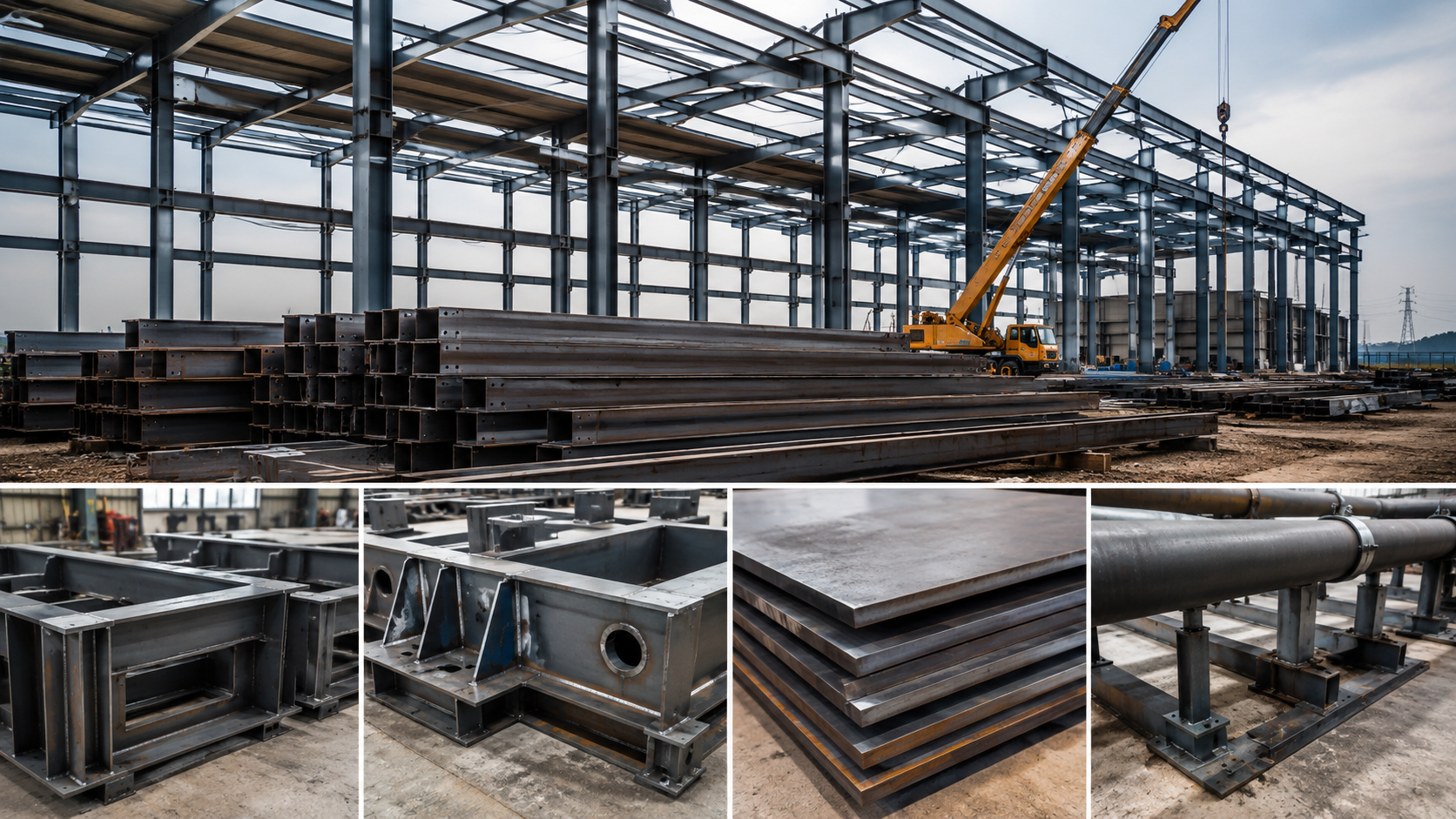
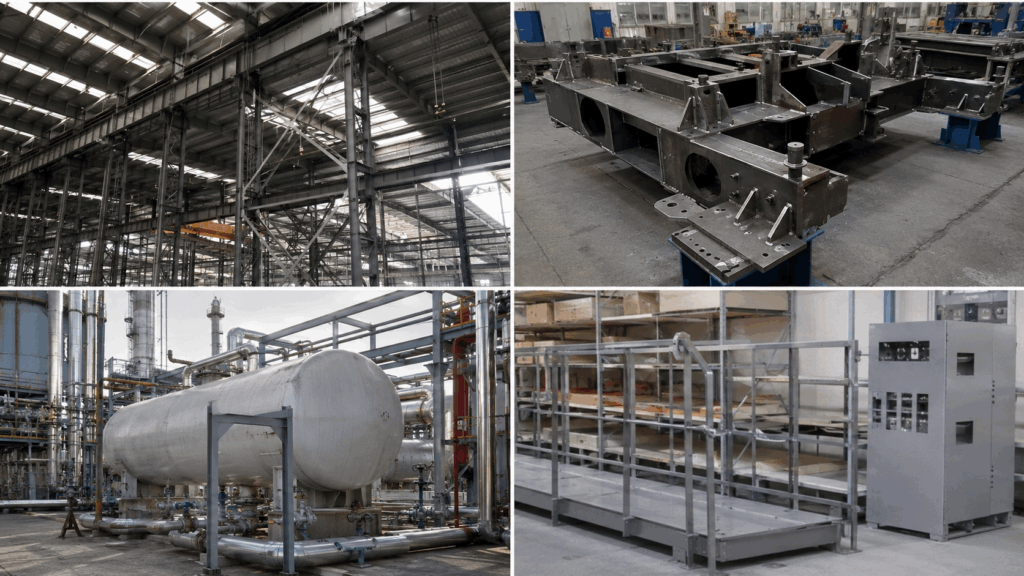
Where You’ll Actually Find It
Building and construction (the big one)
Factory beams, columns, trusses, floor bracing, embed plates, support brackets, roof purlins, bridge substructures. If it’s a steel building in China, Q235B is probably holding it up.
Machinery and equipment
Machine bases, frames, guards, cover plates, welded fabrications, general machined parts. The stuff that needs to be stiff and straight but isn’t taking a beating.
Piping and tanks
Low-pressure welded pipe, structural piping, ordinary tanks, ductwork, pipe supports. Not for high pressure, but fine for water, air, and non-critical fluids.
General metalwork
Railing, shelving, steel frameworks, sheet metal parts, electrical enclosures, workbenches, conveyor supports.
Vehicles and off-road equipment
Non-critical structural parts on construction machinery, trailer components, farm equipment. The parts that carry load but aren’t the main stress members.
What about Q235C and Q235D?
They exist, and they handle lower temperatures better. If you’re building something for a freezer plant in Harbin or a pipeline in Siberia, yeah, look at those. For normal construction and machinery at normal temperatures? Q235B gets you 95% of the performance at a much friendlier price. That’s why it’s the default.
The honest limitations
Let’s be real—this is still just a plain low-carbon steel. It’s not hard, not particularly wear-resistant, and not meant for heavy impact or high pressure. Don’t use it for:
- Heavy-duty shafts or gears (look at 45# steel or 42CrMo)
- High-pressure vessels
- Precision wear parts
- Sub-zero environments without proper design margins
For those, you need higher grades or alloy steels. Q235B knows what it is: the reliable, cheap, easy-to-work foundation material that handles 80% of structural jobs without complaint.
Bottom line
Q235B is the default for a reason. Good weldability, decent toughness, forms and machines easily, and costs less than just about anything else that’ll do the job. Unless you have a specific reason to upgrade — high wear, heavy impact, extreme cold, or serious pressure — this is where you start.
FAQ
What is Q235B material?
Q235B is a Chinese carbon structural steel under the GB/T 700 standard. It is widely used in welded structures, building frames, machinery bases, steel plates, pipe supports, platforms, and ordinary fabricated components. In the grade name, “Q” refers to yield strength, “235” means a minimum yield strength of 235 MPa, and “B” means the steel requires a room-temperature impact test.
What is Q235B material equivalent to ASTM?
Q235B is often compared with ASTM A36 because both are mild carbon structural steels used in general construction and fabrication. However, they are not exactly the same. ASTM A36 normally has a higher minimum yield strength requirement, so buyers should not replace A36 with Q235B unless the project specification, drawing, or engineering team allows it.
What is Q235 steel equivalent to?
Q235 steel is commonly compared with ASTM A36, EN S235JR, JIS SS400, and DIN St37-2. These grades are similar in general structural use, but they are not always direct replacements. Before substitution, buyers should check the required standard, yield strength, tensile strength, chemical composition, impact test, and material certificate.
Is Q235B equivalent to A36?
Q235B and ASTM A36 are similar, but not identical. Q235B has a minimum yield strength of 235 MPa, while ASTM A36 is commonly specified with a minimum yield strength of 250 MPa. For low-risk fabrication, they may be compared. For load-bearing structures, export projects, or ASTM-specified jobs, use the grade required by the drawing or contract.
What is the difference between Q235B and Q235A?
The main difference is impact testing and quality control. Q235B requires a 20°C impact test, while Q235A does not. Q235B also usually has tighter control on sulfur and phosphorus. That is why Q235B is preferred for welded structures, outdoor steelwork, machinery frames, and parts exposed to vibration or changing loads.
What is the difference between Q235B and Q235C?
Q235B is tested for impact performance at 20°C, while Q235C has stricter toughness requirements for lower-temperature service. Q235B is commonly used for normal-temperature construction and machinery work. Q235C is a better choice when the structure may face colder environments or stricter impact toughness requirements.
What are the mechanical properties of Q235B?
Common Q235B mechanical properties include a minimum yield strength of 235 MPa, tensile strength of about 375–500 MPa, elongation of about 26% or higher, and impact energy of 27 J at 20°C. Actual values may vary depending on thickness, product form, and mill certificate, so buyers should always check the MTC before approval.
What is the chemical composition of Q235B?
Q235B is a low-carbon structural steel. Its chemical composition usually includes carbon, manganese, silicon, phosphorus, and sulfur. The relatively low carbon content helps with welding and forming. Phosphorus and sulfur need to be controlled because excessive levels can affect toughness, weldability, and cold forming performance.
What is the density of Q235B steel?
The density of Q235B steel is usually taken as about 7.85 g/cm³, or 7850 kg/m³. This value is commonly used when calculating the weight of steel plates, beams, pipes, frames, tanks, and fabricated steel components.
What is Q235B steel used for?
Q235B steel is used for building frames, beams, columns, brackets, machinery bases, welded structures, steel plates, pipe supports, platforms, railings, low-pressure tanks, electrical enclosures, and general metal fabrication. It is selected when moderate strength, easy welding, easy forming, and cost control are more important than wear resistance, high impact performance, or extreme low-temperature toughness.