Bem-vindo ao Meu Blog!
Antes de mergulharmos no conteúdo, EU adoraria que você se juntasse a mim em minhas plataformas de mídia social, onde compartilho mais insights, me envolva com a comunidade e publique atualizações. Veja como você pode se conectar comigo:
Facebook:https://www.facebook.com/profile.php?id=100087990137347
LinkedIn:https://www.linkedin.com/company/89825762/admin/dashboard/
YouTube:www.youtube.com/@carbonsteelsupply-kj9lw
TikTok:www.tiktok.com/@carbonsteelsupply
Agora, vamos começar nossa jornada juntos Espero que você ache o conteúdo aqui perspicaz, envolvente e valioso.
Índice
Introdução
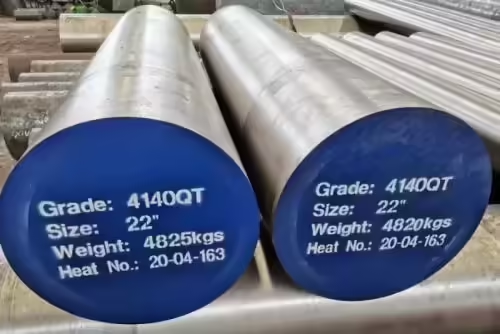
When comparing 4120 Steel vs. 4142 Steel, it’s important to understand their differences in composition, strength, and suitability for various industrial applications.
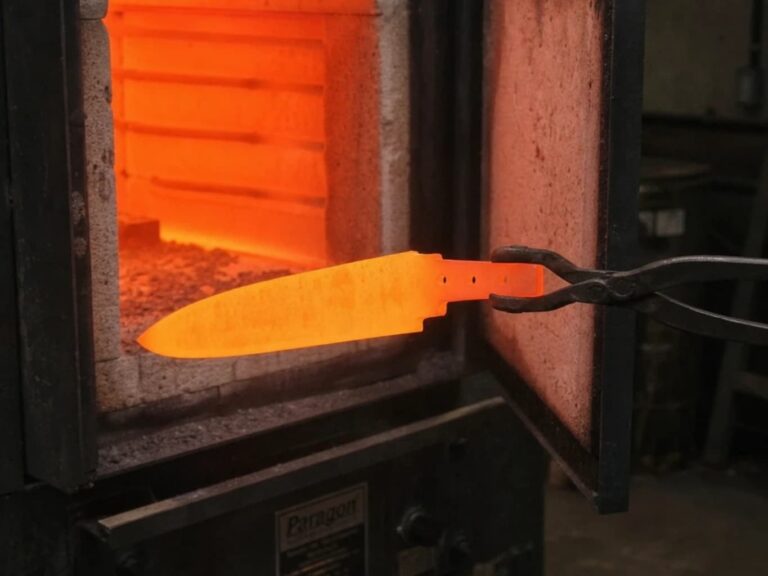
4120 is an alloy steel with high hardenability, no temper brittleness, and good weldability. It has a low tendency to form cold cracks, good machinability and cold strain plasticity. This steel is usually used in the quenched and tempered or carburized quenched state, and is suitable for the manufacture of high-pressure pipes and various fasteners, higher-level carburized parts such as gears, shafts, etc. that work in non-corrosive media and media with working temperatures below 250°C and containing nitrogen-hydrogen mixtures.
4142 steel is an ultra-high strength steel with excellent strength and toughness, as well as good hardenability. It has no obvious temper brittleness. After quenching and tempering, it has a high fatigue limit and resistance to multiple impacts, and also has good low-temperature impact toughness. This steel is suitable for manufacturing large and medium-sized plastic molds that require certain strength and toughness. Usually, surface quenching after quenching and tempering is used as the heat treatment solution.
Steel Composition: 4120 Steel vs. 4142 Steel
4120 Steel
| C | Si | Mn | S | P | Cr | Mo |
| 0.18~0.23% | 0.15~0.35% | 0.90~1.20% | ≤0.04% | ≤0.035% | 0.40~0.60% | 0.13~0.20% |
4142 Steel
| C | Si | Mn | S | P | Cr | Mo |
| 0.40~0.45% | 0.15~0.35% | 0.75~1.00% | ≤0.040% | ≤0.035% | 0.80~1.10% | 0.15~0.25% |
Comparison: 4120 Steel vs. 4142 Steel
-
 31CrMoV9/1.8519 Alloy Steel
 -
 Aço de liga 17CrNiMo6/1.6587
 -
 25CrMo4/1.7218/SCM430 Alloy Steel
 -
 8620/1.6523/20CrNiMoA/SNCM220 Alloy Steel
 -
 Aço de liga 18CrNiMo7-6/17CrNiMo6/1.6587
 -
 18CrMo4/1.7243 Alloy Steel
 -
 30CrNiMo8/1.6580 Alloy Steel
 -
 36CrNiMo4/1.6511/SNCM439/EN24 Liga de Aço
 -
 Aço de liga 34CrNiMo6/1.6582
4120 steel has good hardenability, no temper brittleness, good weldability, and is usually used in the quenched and tempered or carburized quenched state. Its tensile strength is ≥885 MPa, and its yield strength is ≥685 MPa. 4142 steel has high strength, high toughness, good wear resistance and corrosion resistance. Its tensile strength can reach more than 1700 MPa, its yield strength can reach more than 650 MPa, and its elongation is greater than 35%. 4120 steel is suitable for manufacturing high-pressure pipes and various fasteners, higher-level carburized parts such as gears and shafts in non-corrosive media and working temperatures below 250℃. 4142 steel is widely used in petrochemical, shipbuilding, food processing, medical equipment and other fields, such as manufacturing reactors, pipelines, valves and other equipment. In general, 4142 steel has higher strength and hardness than 4120 steel, but may be slightly inferior in welding performance. Both have a wide range of applications, but 4142 steel is more common in applications that require higher corrosion resistance and mechanical properties.
Application Scenarios of 4120 Steel and 4142 Steel
4120 steel has high hardenability, no temper brittleness, and good weldability and machinability. It is usually used in the quenched and tempered or carburized quenched state. It is suitable for manufacturing high-pressure pipes and various fasteners that work in non-corrosive media and media containing nitrogen-hydrogen mixtures with working temperatures below 250°C. Widely used in boiler and steam turbine manufacturing industries as partitions, blades, forgings, and profiles. In the machinery manufacturing industry, higher-level carburized parts such as gears and shafts are made.
4142 steel is an ultra-high strength steel with high strength and toughness, good hardenability, and no obvious temper brittleness. It is suitable for manufacturing large and medium-sized plastic molds that require certain strength and toughness, and surface quenching after quenching and tempering is usually used as a heat treatment solution. Used to manufacture forgings that require higher strength and larger tempered sections than 4135 steel, such as large gears for locomotive traction, supercharger transmission gears, pressure vessel gears, rear axles, connecting rods and spring clips that are subject to heavy loads. It can also be used for oil deep well drill pipe joints and salvage tools below 2000m, and can be used for bending machine molds, etc.
4120 steel vs. 4142 steel: Which should I use?
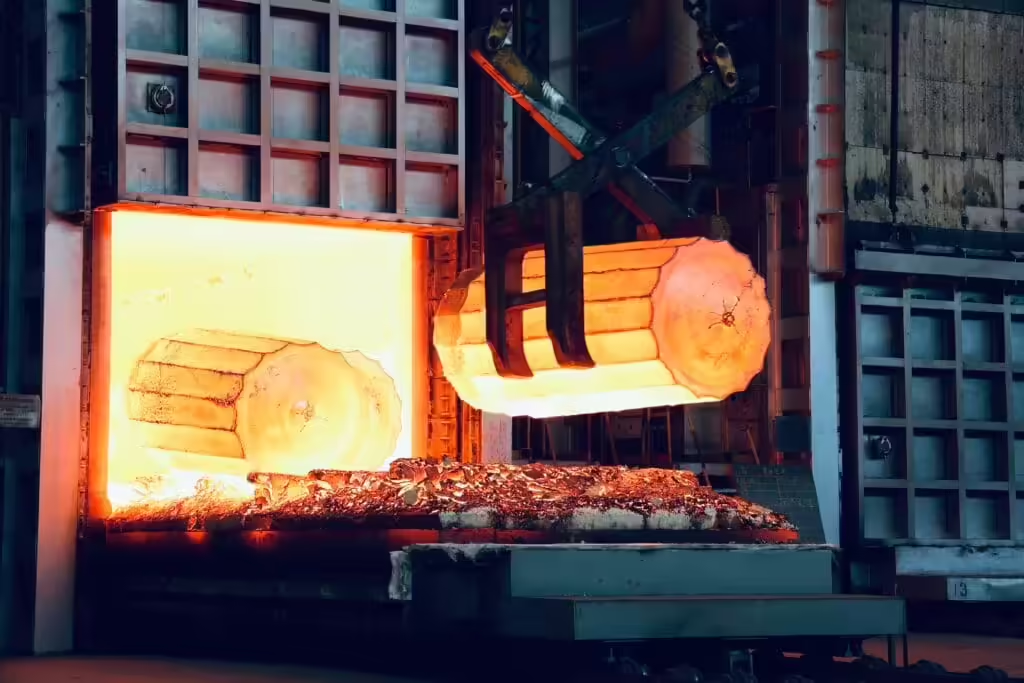
Here are some key factors to compare when choosing 4120 and 4142 tool steels:
Composição química:
– 4120 steel contains carbon (C: 0.18-0.23%), silicon (Si: 0.15-0.35%), manganese (Mn: 0.90-1.20%), chromium (Cr: 0.40-0.60%) and molybdenum (Mo: 0.13-0.20%).
– 4142 steel contains carbon (C: 0.40-0.45%), silicon (Si: 0.15-0.35%), manganese (Mn: 0.75-1.10%), chromium (Cr: 0.8-1.1%) and molybdenum (Mo: 0.15-0.25%).
Mechanical properties:
– 4120 steel has a tensile strength of ≥885 MPa, a yield strength of ≥685 MPa, and an elongation of ≥12%.
– 4142 steel has a tensile strength of more than 1700 MPa, a yield strength of more than 650 MPa, and an elongation of more than 35%.
Heat treatment:
– 4120 steel is usually used in the quenched and tempered or carburized quenched state.
– 4142 steel can be heat treated to achieve a good strength level while maintaining reasonable toughness.
Application areas:
– 4120 steel is suitable for manufacturing high-pressure pipes and various fasteners, higher-grade carburized parts such as gears, shafts, etc. in non-corrosive media and working temperatures below 250°C.
– 4142 steel is suitable for brake molds, bending molds, support tools, mold bases, gears, flanges, chucks, mandrels, spindles, axles, clutch parts, forming rollers, wrenches and other hand tools due to its high strength, high toughness and good wear resistance.
5 Corrosion resistance:
– 4120 steel has good weldability and machinability, but its corrosion resistance is not as good as 4142 steel.
– 4142 steel has better corrosion resistance due to its higher content of chromium.
Price:
– Depending on market conditions, the prices of 4120 and 4142 steel may vary. Generally, 4142 steel may be slightly more expensive due to its higher strength and corrosion resistance.
Conclusão
Taking the above factors into consideration, 4142 steel may be a better choice if high strength and corrosion resistance are required. If the budget is limited and weldability and machinability are high requirements, 4120 steel may be more suitable.
FAQ
Which is more wear-resistant: 4120 steel and 4142 steel?
4120 steel has good weldability and machinability, but its corrosion resistance is not as good as 4142 steel. 4142 steel has better corrosion resistance due to its higher content of chromium.
Which is more cost-effective: 4120 steel and 4142 steel?
The prices of 4120 and 4142 steel may vary. Generally, 4142 steel may be slightly more expensive due to its higher strength and corrosion resistance.
Which is more corrosion-resistant: 4120 steel and 4142 steel?
4120 steel has good weldability and machinability, but its corrosion resistance is not as good as 4142 steel. 4142 steel has better corrosion resistance due to its higher content of chromium.